What Is Arch Support? 12 Surprising Facts Most People Don’t Know
Most of us never learn how our arches work until they start to hurt. Here is the plain-English version: how the arch works, what inserts can and cannot do, and the facts that surprise people most.
What is arch support? The short answer
- Arch support is any insole, insert or shoe feature that gives the arch of your foot extra support and helps spread pressure across the sole.
- It does not reshape your foot. It changes how load is shared while you wear it.
- Many people with flat or high arches never need it. It is meant for symptoms such as heel pain, arch ache or tired feet.
- Shoes, stretching and foot strength matter just as much as the insert.
Your arch in 60 seconds
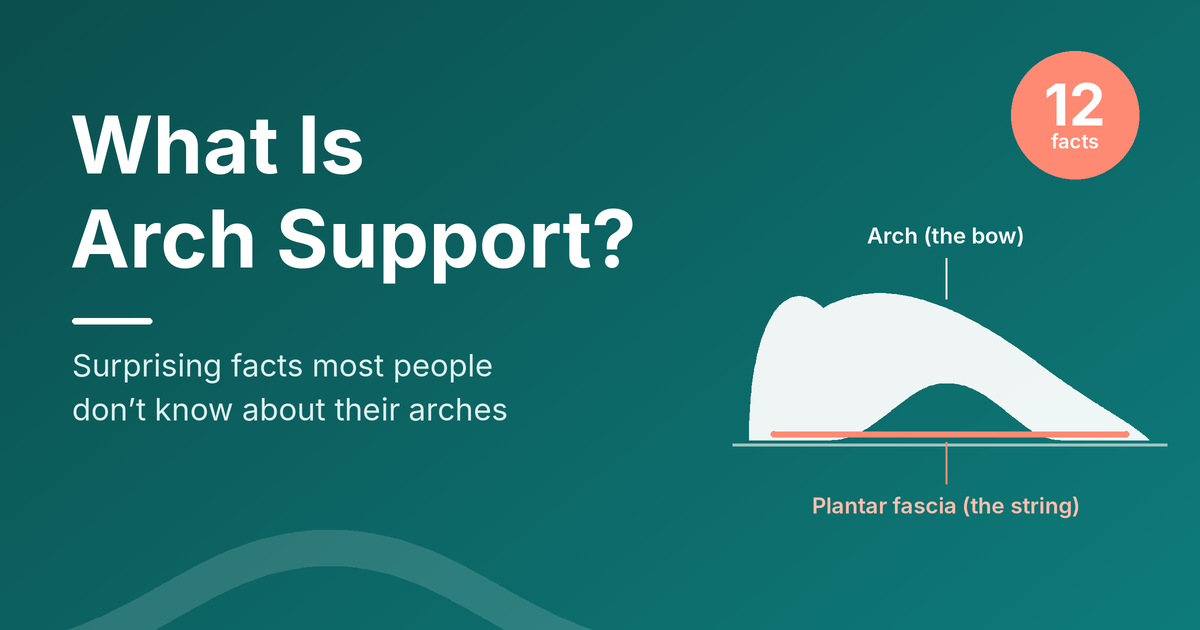
Your foot is not a flat slab. It is built like a flexible bridge, with bones forming a curve and strong tissues holding that curve in place. Picture a bow and string: the bones are the bow, and a thick band under the foot called the plantar fascia is the string, running from your heel to your toes.
When you push off and your toes bend upward, the band tightens and the arch stiffens, turning your foot into a firm lever. When your foot lands, the arch flexes slightly and absorbs the shock. That spring-and-lever job is what arch support tries to assist.
You have three arches, not one
| Arch | Where it is | What it does |
|---|---|---|
| Inner (medial) arch | Inside edge, heel to big toe | The one people usually mean. Absorbs shock and acts as a spring. |
| Outer (lateral) arch | Outside edge, heel to little toe | Lower and flatter. Adds stability when you stand and walk. |
| Cross (transverse) arch | Across the middle of the foot | Helps the foot adapt to uneven ground and spreads load across the ball of the foot. |
So, what is arch support, really?
Arch support is a general name for anything that props up or contours the underside of your foot: an insole, an orthotic, a heel-and-arch insert, or a shoe with a built-in contoured footbed. A good one does three jobs.
What is arch support made of?
Most inserts combine layers: a firm shell or core (often dense foam or hard plastic) that holds the arch, a softer foam, gel or cork layer for comfort, and a fabric top that manages moisture. A stiffer core means more structure. A softer one means more cushion.
What arch support cannot do
It does not change the shape of your foot, it is not a cure, and it does not replace stretching, strengthening or proper shoes. UK public health services state that insoles and similar treatments will not change the shape of the feet, though they can relieve some problems linked to flat feet.
12 surprising facts about arch support
These are the facts that change how most people answer the question “what is arch support?” Tap a fact to open it.
You have three arches, not one
The arch most people mean runs along the inner edge of the foot, but there is also an outer arch and one across the middle. Together they make the foot a flexible, springy structure instead of a flat block.
Flat feet are common and often cause no trouble
The NHS describes flat feet as common and usually nothing to worry about, and says you do not need to do anything if they cause no problems. Pain, stiffness or tiredness is what makes support worth considering, not the footprint alone.
Arch support does not change your foot shape
Think of it as a tool for comfort and load sharing, not a permanent correction. The foot goes back to its own shape when the insert comes out.
Children’s arches develop over time
Most young children have flat-looking feet. According to the NHS, arches usually develop between about 3 and 10 years of age. A pain-free child with flexible flat feet usually needs nothing, but ask a pediatrician or podiatrist if you are concerned.
Your arch can change as an adult
Injury, weight changes, pregnancy, some medical conditions and ageing can all change how the arch behaves. The NHS advises seeing a GP if you did not have flat feet before, or if only one foot is affected. Get a sudden change checked rather than just buying an insert.
High arches are not “stronger” arches
A very high arch tends to be stiff and may absorb shock less well, so people with high arches often feel pressure on the heel and the ball of the foot. They usually do best with cushioning plus moderate support, not a very hard, tall insert.
Softer does not mean more supportive
A thick foam insole feels plush but can compress under your body weight. Support comes from a firm core under the arch, and comfort comes from the top layer. The best inserts combine both.
Foot problems can show up higher up the body
Mayo Clinic notes that changing the way you walk to avoid heel pain may lead to foot, knee, hip or back problems. Aching knees or a tired lower back can sometimes trace back to how the feet are working.
Heel pain is common, and support is only one tool
Plantar fasciitis is one of the most common causes of heel pain, often with stabbing pain on the first steps in the morning. Care usually combines stretching, strengthening and supportive footwear or inserts, not insoles alone.
Custom orthotics are not always better
For many common problems, studies comparing custom and over-the-counter inserts have found similar short-term results, which is why many clinicians suggest trying a well-fitted store-bought insert first. Custom devices still make sense for complex problems, long-lasting pain or when a clinician prescribes them.
Your shoes matter as much as your inserts
Mayo Clinic lists shoes with inadequate support among the factors linked to plantar fasciitis. An insert inside a flimsy or worn-out shoe cannot do much. Look for a firm heel, a stable midsole and enough room for the insert.
Inserts wear out sooner than you think
Foam compresses and covers crack. Typical over-the-counter inserts last about 6 to 12 months, and less with heavy daily use. If yours looks flat or creased, or no longer feels the way it did, replace it.
Have flat feet?
If your wet footprint is mostly filled in and you get aching or tired arches, firmer insoles built for flat feet are a sensible place to start.
How your arch changes over time
Your arch is not fixed for life. It develops in childhood, settles in adulthood, and may change again with age, injury or weight changes.
Myths vs reality
| Common belief | What is closer to the truth |
|---|---|
| “Flat feet always need correcting.” | Many people have flat feet with no pain. Support is for symptoms, not for foot shape alone. |
| “Arch support will fix my foot shape.” | It can relieve symptoms while you wear it, but it does not reshape the foot. |
| “The higher it pushes up, the better.” | Fit matters more than height. A tall arch that does not match your foot can cause new discomfort. |
| “Only older people need arch support.” | Foot pain can happen at any age. Plantar fasciitis is most common between 40 and 60, but runners and people on their feet all day are affected too. |
| “A more expensive insert is always better.” | Matching the insert to your arch, shoes and activity beats a bigger price tag. |
| “Wear it all day from day one.” | Build up gradually over about two weeks so your feet can adapt. |
| “Inserts last forever.” | Most last 6 to 12 months. Replace them when they flatten, crack or lose their feel. |
Who arch support can help, and who may not need it
- Heel pain on the first steps of the day
- Aching arches after standing or walking
- Long shifts on hard floors
- Shoes that wear down unevenly
- Feet that tire quickly
- Comfortable, pain-free feet
- Flat or high arches with no symptoms
- Children with flexible flat feet and no pain
- Anyone whose pain started suddenly after an injury (get it checked first)
Getting started: a simple 4-step plan
- Notice your painWhere does it hurt, and when? Heel, arch, ball of foot, or only at the end of the day?
- Check your shoesA firm heel, stable midsole and a removable insole make any insert work better.
- Try a well-fitted insertMatch firmness to your arch: firmer for flat feet, more cushion for high arches.
- Break in and reviewBuild up wear time over about two weeks, then judge after a few weeks of regular use.
When to get your feet checked
See a doctor or podiatrist if:
- Your feet are painful, stiff, weak or numb
- Only one foot has changed, or your arch dropped when it was not flat before
- You often get foot or ankle injuries, or have trouble with balance
- Pain lasts more than 2 weeks despite supportive shoes
- You have diabetes or reduced feeling in your feet
Frequently asked questions
What is arch support used for?
It is used to ease foot, heel and arch discomfort, improve comfort during long hours on your feet, and help the foot share load more evenly. It is a comfort and support tool, not a treatment for the foot’s shape.
Is arch support the same as an orthotic?
Not exactly. “Orthotic” is the broader term for a device that supports or aligns the foot. Arch supports are one kind, from store-bought insoles to custom-molded devices made by a clinician.
Can I wear arch support every day?
Yes, once your feet have adapted. Start with short wear times and build up over about two weeks. Replace the insert when it wears out.
Do I need to see a doctor before buying insoles?
Not for ordinary tired feet or mild aches. See a professional first if you have diabetes, numbness, swelling, pain in only one foot, or pain that does not improve.
Can arch support cause pain?
It can if the height or firmness does not suit your foot, or if you wear it for too long too soon. Reduce wear time or try a different level of support. Stop if you get sharp pain.
How is arch support different from a cushioned insole?
A cushioned insole mainly softens impact. Arch support adds a contoured, firmer structure under the arch. Many good insoles combine a supportive core with a cushioned top layer.
Final thoughts
Arch support is simple once you know the basics: it helps share load, it does not reshape your foot, and it works best alongside good shoes, gentle stretching and a gradual break-in. Start with comfort, not foot shape, as your guide.
Trusted resources
- NHS overview of flat feet: what flat feet are and when to see a doctor
- Mayo Clinic on plantar fasciitis: a common cause of heel pain
- AAOS OrthoInfo on plantar fasciitis and bone spurs: causes and treatment options
Ready to find insoles for flat feet?
Compare firm, supportive options chosen for flat arches.
Disclaimer: This article answers “what is arch support?” for general education and is not medical advice. It does not diagnose or treat any condition. If you have pain, a medical condition or any doubt, speak with a doctor or podiatrist before using inserts or starting exercises.