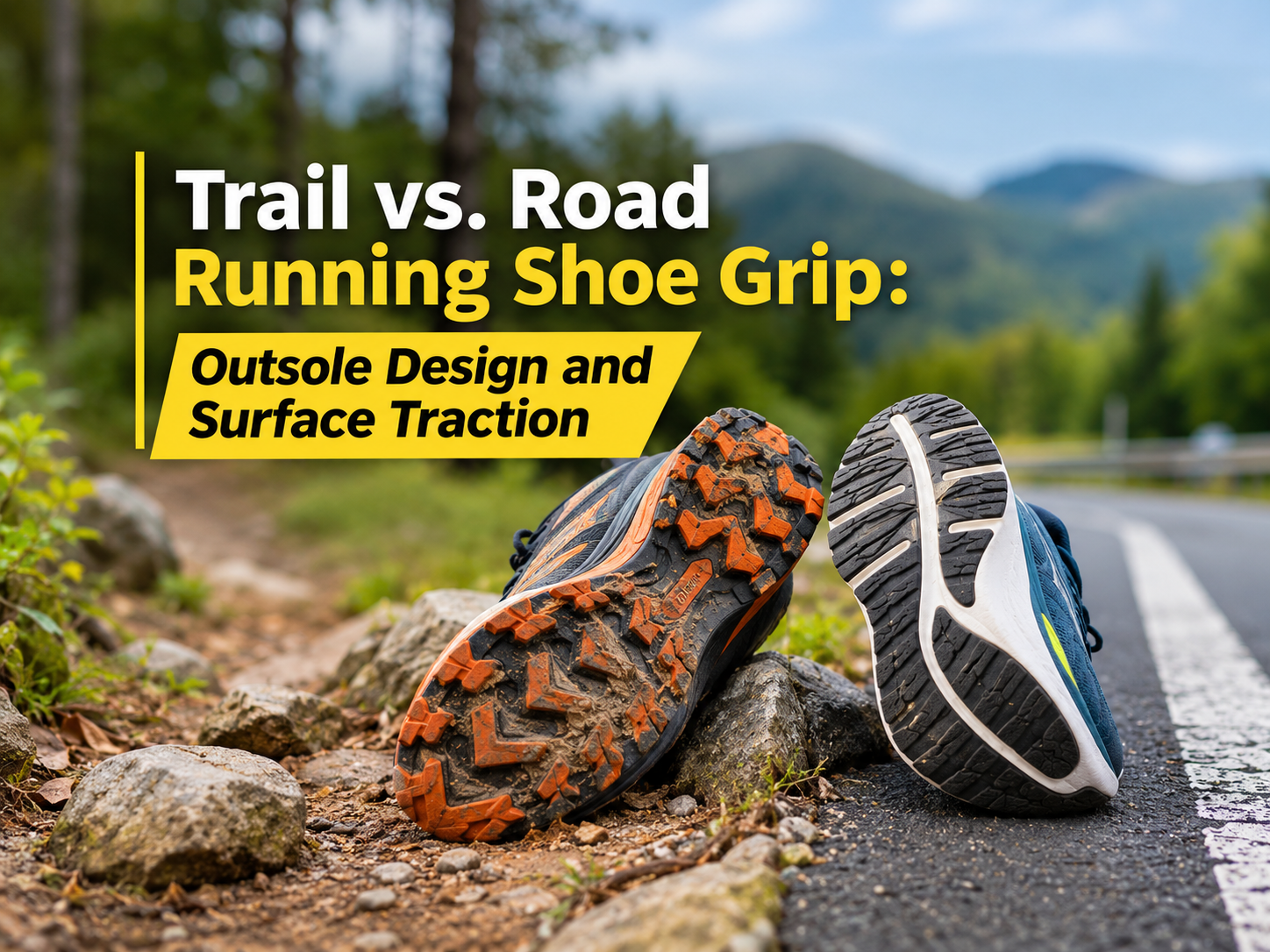
Step off the pavement in a pair of road shoes on a damp forest path and you will feel it within seconds. Your foot slides a little on every downhill, mud packs into the grooves, and each wet root becomes a small gamble. Wear trail shoes on a long city run instead and you may notice the opposite problem: the lugs feel squirmy, the ride feels harsh and the outsole seems to vanish faster than it should.
Grip is the single biggest difference between trail running shoes and road running shoes, and it is also the most misunderstood. This guide breaks down exactly how the two types of outsole work, how they behave on different surfaces, and how to choose the right pair for the kind of running you actually do.
What “Grip” Actually Means in a Running Shoe
Grip comes from two separate mechanisms, and shoe designers balance them very differently depending on where the shoe is meant to be used.
- Mechanical grip. Physical edges, called lugs, dig into or hook onto soft ground such as dirt, mud, grass, gravel and snow. The deeper and more widely spaced the lugs, the more they can penetrate and the better they shed debris.
- Frictional (adhesive) grip. On hard surfaces like asphalt, concrete and rock, nothing can dig in. Grip depends on how much rubber touches the surface and how well that rubber conforms to it. Softer, stickier compounds and larger contact areas usually mean more friction.
Road shoes are built around frictional grip. Trail shoes lean on mechanical grip, then add rubber technology to improve friction on rock and wet ground. Understanding that split explains almost everything else in this article.
How Road Running Shoe Outsoles Are Designed
Road running surfaces are flat, firm and consistent. Because of that, road shoe outsoles can be thin, light and fairly simple.
- Shallow tread. Grooves are usually only about 0 to 2 mm deep. Their main job is to flex with the foot and let a little water escape rather than to dig into anything.
- Large contact area. More flat rubber touching the ground means steadier friction on pavement.
- Durable rubber. Many road shoes use harder carbon-style rubber in high-wear zones such as the heel and forefoot, which helps them last for hundreds of miles.
- Weight and flexibility. With no deep lugs to carry, the shoe stays lighter and the forefoot flexes smoothly, which supports a natural toe-off on hard ground.
This design is excellent for sidewalks, roads, tracks and treadmill sessions. It is not designed for soft ground, because there is simply nothing on the outsole to bite into mud or loose soil.
How Trail Running Shoe Outsoles Are Designed
Trail surfaces change from one step to the next. Dry dust, wet clay, loose stones, roots and slick rock can all appear in a single mile. Trail outsoles are engineered to handle that unpredictability.
- Deeper lugs. Most trail shoes use roughly 3 to 5 mm lugs, while shoes for deep mud can go to 6 mm or more.
- Lug shape and direction. Forward-facing lugs under the forefoot help with climbing and push-off. Rearward-facing or angled lugs under the heel help with braking on descents.
- Spacing. Wider gaps between lugs let mud and wet soil fall out instead of packing in and turning the outsole into a smooth slick.
- Stickier rubber options. Many trail shoes use softer, high-friction compounds designed to cling to wet rock and roots.
- Protection. Some models add a rock plate and a reinforced toe cap, which makes the whole shoe stiffer and more protective than a road shoe.
Trail vs Road Running Shoe Grip: Side-by-Side Comparison
| Feature | Road Running Shoe | Trail Running Shoe |
|---|---|---|
| Typical lug depth | About 0–2 mm | About 3–8 mm depending on terrain |
| Main grip type | Friction from large flat contact | Mechanical bite plus sticky rubber |
| Best surfaces | Asphalt, concrete, track, treadmill | Dirt, gravel, mud, roots, rock, snow |
| Mud shedding | Poor | Good to excellent |
| Wear on hard roads | Slow | Fast, lugs wear down quickly |
| Ride on pavement | Smooth and consistent | Can feel firm, unstable or noisy |
| Weight | Usually lighter | Usually a bit heavier |
| Underfoot protection | Basic | Often adds rock plate and toe guard |
Lug Depth: How Deep Is Deep Enough?
Lug depth is the easiest outsole number to compare, but more is not always better. Deeper lugs bite harder into soft ground, but they also flex more under load, wear faster on hard surfaces and can feel unstable on firm, dry trails.
- Under 2 mm: Road use only.
- 2 to 3.5 mm: Road-to-trail hybrids, ideal for paved paths, rail trails and smooth park routes.
- 3.5 to 5 mm: The sweet spot for most general trail running, from packed dirt to rocky singletrack.
- 5 mm and above: Muddy, soft or loose terrain such as winter trails, fell running and off-trail routes.
Rubber Compounds: The Hidden Half of Grip
Two shoes with identical lugs can grip very differently if their rubber is different. Softer rubber deforms around tiny surface imperfections and grips better on wet rock, but it wears faster. Harder rubber lasts longer but can feel slippery on smooth, wet surfaces.
- Road shoes tend to prioritise durability, because pavement is abrasive and miles add up quickly.
- Trail shoes often prioritise stickiness, especially in shoes aimed at wet climates or rocky terrain. The trade-off is faster wear if you run on pavement to reach the trailhead.
- Hybrid shoes usually use a middle-of-the-road compound intended to handle pavement and light trail without wearing out too quickly.
When comparing shoes, look for descriptions such as “all-terrain rubber”, “sticky rubber for wet rock” or “durable road rubber”. These descriptions often tell you more than the tread picture alone.
Grip on Different Surfaces
Dry Pavement and Concrete
Road shoes are ideal here. The flat outsole puts the most rubber on the ground, so grip is steady and predictable. Trail shoes still work, but the lugs can squirm slightly at speed, and the contact area is smaller.
Wet Pavement and Painted Lines
Wet roads, manhole covers and road paint are slippery for almost every shoe. Road shoes with a softer outsole and a bit of groove pattern tend to handle them well. Trail shoes with very hard lugs or small contact areas can feel nervous here.
Packed Dirt and Gravel Paths
This is where hybrids shine. Moderate lugs add confidence in corners and on small loose patches without feeling awkward on harder stretches. Road shoes are usually fine on very firm dirt but feel less secure on loose gravel.
Mud and Soft Ground
Mud is the toughest test for any outsole. Road shoes clog and become slick almost immediately. Trail shoes with deep, widely spaced lugs bite into the surface and release debris with each step, which keeps traction consistent.
Wet Rock, Roots and Technical Terrain
Here, rubber compound matters as much as lug depth. Shoes with sticky rubber and multi-directional lugs give the best control. Road shoes are risky here because smooth rubber has almost nothing to hold on to when wet.
Snow and Slush
Deeper lugs help with packed snow and slush. Icy surfaces are a different problem entirely, and neither road nor standard trail shoes grip well on pure ice. Runners in icy conditions often use dedicated traction devices or studded winter shoes.
Can You Run on Trails in Road Shoes?
Yes, on easy terrain. Smooth, dry, well-packed paths such as gravel greenways, crushed-stone rail trails and flat park tracks are usually fine for road shoes. The problem starts when conditions change.
Road shoes also tend to have softer, thinner uppers and less underfoot protection, so sharp rocks and roots can feel much more noticeable through the sole.
Can You Run on Roads in Trail Shoes?
You can, and many runners do, especially when roads connect trail sections. For short road stretches this is perfectly fine. For regular road mileage, expect a few trade-offs:
- Faster wear. Soft rubber and tall lugs wear down quickly on asphalt.
- Less stable feel. Lugs can flex slightly, which feels less precise at faster paces.
- Firmer, noisier ride. Many trail shoes are built stiffer for protection, which can feel harsh over long road runs.
Road-to-Trail Hybrid Shoes: The Middle Option
If your runs mix pavement and dirt, a hybrid shoe can be the most practical choice. These shoes usually combine a more road-like ride with a moderate lug pattern and a durable all-purpose rubber. They are well suited to runners who start from home, cross a few streets and then enter a park or trail network.
A hybrid will not match a dedicated trail shoe in deep mud or a dedicated road shoe in pure road speed, but for mixed routes it often delivers the best balance.
How to Choose the Right Grip for Your Running
- Look at your terrain honestly. If more than about 80 percent of your running is on pavement, a road shoe is usually the right primary pair.
- Check your climate. Wet, muddy regions benefit from deeper lugs and sticky rubber. Dry, dusty trails often work better with moderate lugs and a more durable compound.
- Consider your pace and distance. Faster runners often prefer lower, more stable lugs. Long-distance trail runners may want extra protection and cushioning.
- Test the lug pattern. Look for multi-directional lugs for control on both climbs and descents, and wide spacing if you run in mud.
- Try them on a surface similar to your route. If possible, walk on a hard floor and on varied ground to feel the stability.
- Match your shoe to the worst conditions you regularly face. A shoe that is safe on your muddiest route is usually fine on easier days.
Common Grip Mistakes Runners Make
- Choosing the most aggressive lugs for every run. Very deep lugs are overkill on firm trails and wear out quickly on pavement.
- Ignoring the rubber compound. Lug depth alone does not tell you how a shoe will behave on wet rock.
- Using worn-out shoes. Once lugs are visibly rounded or shallow, mechanical grip drops sharply. Replace shoes before the tread is gone.
- Not cleaning mud from the outsole. Packed-in dirt reduces traction on the next run and can speed up wear.
- Buying a size that lets the foot slide. Even a great outsole cannot compensate for a foot that moves inside the shoe. Fit and lockdown are part of overall grip and control.
How to Look After Your Outsole
- Rinse off mud and grit after wet runs, and let shoes dry naturally away from direct heat.
- Inspect the lugs every few weeks for rounded edges, uneven wear and torn rubber.
- Rotate between two pairs when possible. This gives each pair time to recover and helps match the shoe to the terrain.
- Avoid using your best trail shoes for long road commutes to the trailhead.
Frequently Asked Questions
Is trail running shoe grip better than road shoe grip?
Not universally. Trail shoes grip better on soft, loose and uneven ground. Road shoes grip better on hard, flat surfaces because they offer more contact area. “Better” depends entirely on the surface.
How deep should lugs be for general trail running?
Roughly 3.5 to 5 mm works well for most trails, covering packed dirt, gravel and moderately rocky paths. Muddier terrain may call for 5 mm or more.
Are trail shoes slippery on wet pavement?
They can be, especially models with hard rubber and small contact areas. Many modern trail shoes with softer compounds handle wet pavement acceptably, but a smooth road shoe usually offers more reliable wet-road grip.
Do trail shoes wear out faster on roads?
Yes. Asphalt is abrasive, and the softer rubber and taller lugs found on many trail shoes wear down faster than a durable road outsole would.
Can one shoe do everything?
A road-to-trail hybrid comes closest, but it is always a compromise. If you run both extremes regularly, owning one road shoe and one trail shoe is the more comfortable and safer approach.
When should I replace my running shoes because of grip loss?
Replace them when the tread looks smooth or heavily rounded, when you notice slipping that was not there before, or when the rubber begins to peel or crack. Many runners replace road shoes at around 300 to 500 miles, while trail shoes can wear out sooner on abrasive terrain.
Final Thoughts
The difference between trail and road running shoe grip comes down to surface and purpose. Road outsoles use shallow tread and broad contact to deliver smooth, durable friction on hard ground. Trail outsoles use deeper lugs and often stickier rubber to bite into soft, slippery and uneven terrain.
Choose the outsole that matches the surfaces you run on most, and match it to the worst conditions you regularly face. The right grip protects your joints, builds confidence on descents and helps your shoes last longer. If your running mixes both worlds, a hybrid or a two-shoe rotation will serve you better than forcing a single shoe to do everything.