
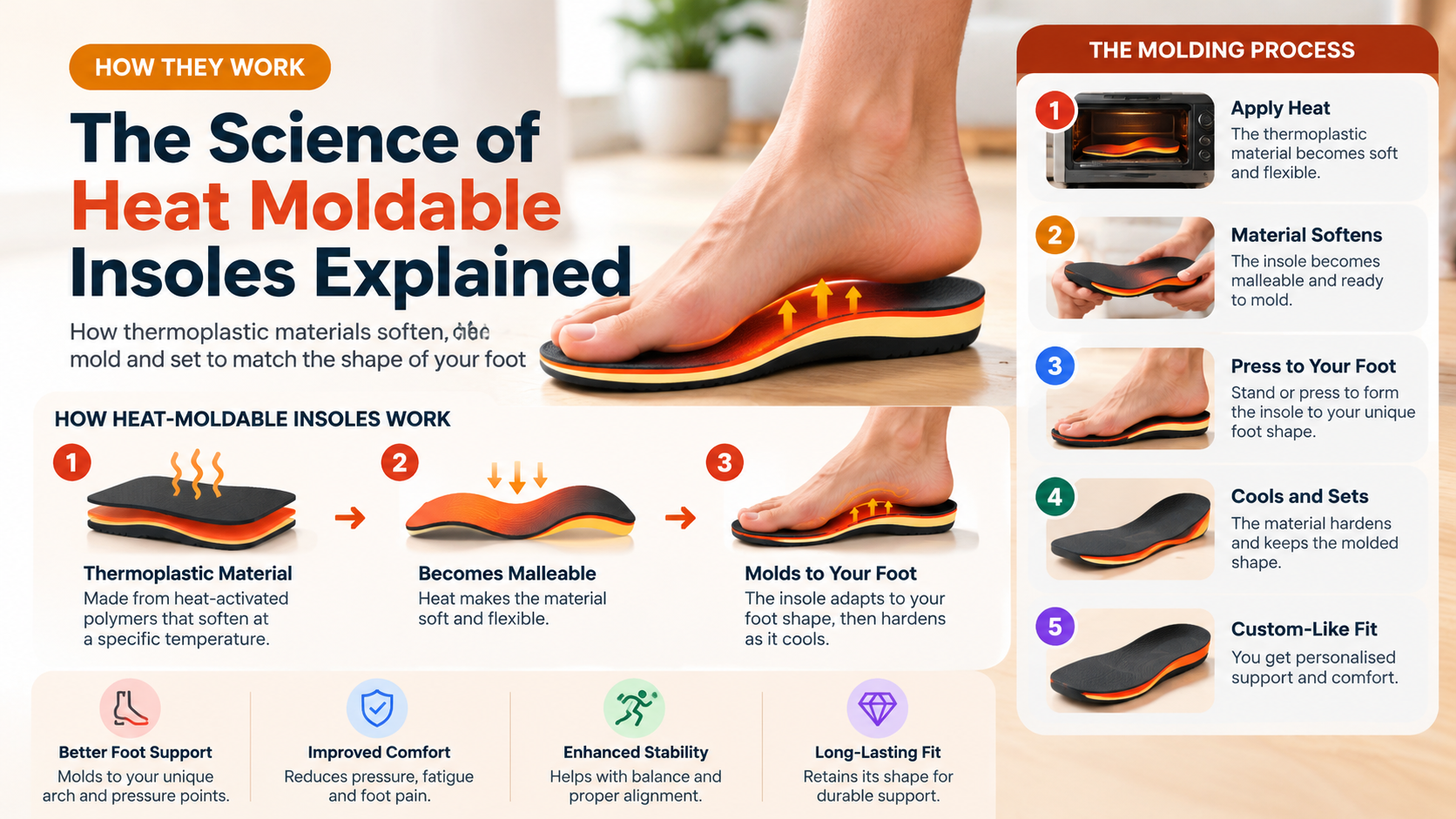
The Science of Heat Moldable Insoles Explained
Heat moldable insoles promise something that sounds almost too good to be true: warm them up, step in, and they reshape themselves to match your foot. There is no mystery behind it. The effect comes from well-understood polymer science, and once you understand it, you can mold your insoles more accurately, avoid common mistakes and judge whether they are the right solution for your feet.
In this guide to the science of heat moldable insoles, you will learn what these insoles are made from, why heat makes them soft, why they harden again in the shape of your foot, how to mold them safely, who benefits most, and how long you can expect them to last.
Quick answer
Heat moldable insoles contain thermoplastic or foam layers. Heating them gives the material’s molecules enough energy to move, so the insole becomes soft. Pressing it against your foot gives it a contoured shape, and as it cools the molecules lock into place and the new shape stays.
What Are Heat Moldable Insoles?
Heat moldable (or heat-formable) insoles are shoe inserts that can be softened with heat and then shaped to the underside of your foot. They sit between ready-made flat insoles and fully custom orthotics made from a mold or scan by a professional. Because the shaping happens at home or in a store, they offer a more personal fit at a much lower cost.
Most designs share a similar construction: a comfortable top cover, a cushioning layer, a moldable core that responds to heat, and a firmer base or heel cup that provides stability.
The Science Behind the Mold: Thermoplastics Explained
What Is a Thermoplastic?
A thermoplastic is a plastic that becomes soft and pliable when heated and hardens again when cooled, and this change can be repeated. Plastics are made of very long chain-like molecules called polymers. How those chains are arranged, and how freely they can move, decides whether the material feels hard, bendy or soft.
Why Heat Makes the Material Soft
At room temperature the polymer chains are tangled together and, in some regions, packed into neat ordered crystalline zones. These zones act like tiny anchor points that hold the material in a fixed shape, which is why a cool insole feels firm.
When you heat the material, the molecules gain energy and start to vibrate and slide. Once the temperature passes a critical point, usually called the glass transition or softening range, the chains can move past each other and the insole becomes rubbery and easy to bend. This is the window in which it can be reshaped.
Why It Keeps Its Shape When It Cools
While the softened insole is pressed against your foot, its chains settle into the new contour. As it cools, the molecules lose energy, movement slows, and the ordered zones re-form around the new shape. The structure becomes rigid again, so the insole keeps the shape of your arch and heel.
Viscoelasticity: Why Timing Matters
Plastics and foams are viscoelastic, meaning they behave partly like a thick liquid and partly like a spring. While warm, the viscous part lets the material flow into your foot’s shape, but the elastic part wants to spring back toward its original form. That is why instructions tell you to stand still and wait for the whole cooling period. If you move too soon, the material is still soft, and the shape can be distorted.
Thermal Insulation and Safety
Foams trap air, which makes them poor heat conductors. The surface can feel manageable while the inside is still hot, and it also means insoles cool gradually. Always test the temperature before placing a heated insole inside a shoe, and never skip the cooling step.
What Are Heat Moldable Insoles Made Of?
| Material | What it does | Key traits |
|---|---|---|
| EVA (ethylene-vinyl acetate) foam | Cushioning and moldable layer | Light, flexible, widely used, softens at moderate temperatures |
| TPU (thermoplastic polyurethane) | Support shells and arch elements | Durable and resilient, good rebound |
| Polyethylene foam | Contouring layers | Closed-cell structure that holds its shape after cooling |
| Polypropylene | Rigid support shells | Strong and stiff, usually needs more heat to shape |
| Cork composites | Contouring and firm cushioning | Natural feel, molds gradually with warmth and pressure |
| Viscoelastic memory foam | Pressure-relieving top layers | Softens slowly with body heat and recovers slowly |
Clinical-grade foams and shells used by specialists often need hotter temperatures and special ovens. Consumer insoles are designed for safer, lower temperatures that suit a home oven, hair dryer or in-store heater.
Body-Heat Molding vs Oven or Heat Gun Molding
Not all moldable insoles use the same method:
- Oven or heat-gun molding: the insole is preheated, typically for a minute or two, then pressed into the shoe. The change is fast and noticeable.
- Warm-up in the shoe: some products soften with warmth from walking or a hair dryer aimed into the shoe.
- Body-heat molding: viscoelastic foams respond gradually to the heat of your foot, so the contour develops over days of wear rather than minutes.
Manufacturers publish the temperature and time that suit their materials, usually somewhere between roughly 70 and 120 degrees Celsius (160 to 250 degrees Fahrenheit) for oven-style products. Always follow the instructions that come with your pair, since overheating can warp or damage the layers.
Why a Molded Insole Can Help Your Feet
A flat insole only meets your foot at the heel and the ball. A contoured insole fills the gap under your arch, which has several benefits:
- Greater contact area: spreading pressure over more of the sole instead of a few small areas.
- Lower peak pressure: reducing the load under the heel and ball of the foot.
- Better alignment support: helping the foot stay more stable during walking.
- Improved shock absorption: cushioning each step.
- Personal fit: matching your arch height and foot width instead of a one-size shape.
These effects can ease discomfort from everyday overuse. They do not replace medical treatment for a diagnosed condition.
Who Might Benefit From Heat Moldable Insoles?
- People with mild to moderate arch or heel fatigue after long periods of standing or walking.
- Those with flexible flat feet who want more arch support.
- Runners and active people who want a personalised fit without custom orthotics.
- People who find standard insoles feel uncomfortable or not quite right.
- Anyone looking for an affordable stepping stone before deciding on custom orthotics.
Who Should Be Careful or Seek Advice First?
- People with diabetes, reduced feeling in the feet or poor circulation, because they may not notice heat damage, pressure points or skin problems.
- Anyone with severe deformities, an active foot ulcer or recent foot surgery.
- People with persistent or unexplained foot, knee or back pain, who should get a proper assessment first.
- Children, whose feet are still developing, who should see a professional before using insoles.
How to Mold Heat Moldable Insoles Properly
Always read and follow your product’s own instructions. The general process looks like this:
- Prepare the shoes. Choose the pair you will wear most with the insoles, remove the original insole and put on the socks you normally wear.
- Heat the insoles. Use the method and time recommended by the manufacturer. Do not guess or heat for longer.
- Test the temperature. Make sure the surface is comfortable to touch before it goes anywhere near your foot.
- Insert and put on the shoes. Slide the insoles in carefully and lace the shoes snugly but not tightly.
- Stand still with weight evenly balanced. Keep your arches relaxed and natural, without rolling inward or outward, and stay still for the full recommended cooling time.
- Let them set. Do not walk until the time is up, then check that the contour feels supportive but comfortable.
Some products can be re-heated and re-molded if the first attempt does not feel right. Check the packaging to see how many times that is advised.
Safety reminder
Never use an insole that feels too hot, never leave a heating insole unattended, and stop immediately if the material smells strongly, smokes or looks distorted. Skin burns are the most common avoidable problem with heat molding.
Common Molding Mistakes
- Overheating: can warp, shrink or separate the layers.
- Underheating: the material never softens enough to take your foot’s shape.
- Moving too soon: the shape is distorted before it sets.
- Standing with collapsed arches: molds a flattened contour, which defeats the purpose.
- Molding in the wrong shoe: insoles may not fit properly in a different shoe afterward.
- Ignoring the break-in period: wearing new insoles all day from the start can cause aching.
Breaking In Your Insoles
Even a well-molded insole changes how your feet are loaded, so muscles and tissues need time to adapt. Build up gradually and listen to your body.
Mild awareness of the new support is normal. Sharp pain, numbness, blisters or pain that worsens over time are not, and you should stop and get advice.
Heat Moldable vs Custom Orthotics vs Standard Insoles
| Feature | Standard insoles | Heat moldable insoles | Custom orthotics |
|---|---|---|---|
| Fit | Generic shape | Shaped to your foot at home or in store | Made from a professional cast or scan |
| Cost | Lowest | Moderate | Highest |
| Best for | Basic cushioning | Mild to moderate needs and personalised comfort | Complex or medical conditions |
| Adjustability | None | Often re-moldable a limited number of times | Adjusted by a clinician |
| Professional input | Not required | Usually not required | Prescribed and assessed |
How Long Do Heat Moldable Insoles Last?
Lifespan depends on how often you wear them, your body weight, the activities you do and the materials used. As a rough guide, many people replace them after 6 to 12 months of regular use. Foams gradually compress, the top cover wears, and the supportive contour flattens. Signs it is time for a new pair include visible cracks, flattened arches, persistent odor, worn-through areas or the return of the old foot discomfort.
Caring for Your Insoles
- Remove them from shoes after wear to let them dry in open air.
- Clean the cover gently with a damp cloth and mild soap, then air dry fully.
- Keep them away from radiators, car dashboards and direct sun, because heat can reshape them.
- Do not machine wash or tumble dry.
- Rotate shoes so insoles have time to dry.
Buying Guide: What to Look For
- Clear heating instructions that suit the equipment you have.
- Arch height and support level that fit your foot type and shoe depth.
- A breathable, moisture-wicking top layer.
- A supportive heel cup to stabilise the rear of the foot.
- The right size and trim-to-fit guides for your shoes.
- Appropriate use, such as everyday, work boots, running or dress shoes.
Frequently Asked Questions
Are heat moldable insoles the same as custom orthotics?
No. They are shaped to your foot, but they are not prescribed or made from a professional assessment. They suit many everyday needs, while complex conditions usually need custom orthotics.
Can I mold them more than once?
Often yes, because thermoplastics can be reheated, but the number of times depends on the product. Repeated heating can eventually weaken the materials, so check the instructions.
Why did my insoles not mold properly?
The usual causes are too little heat, too short a heating time, moving before they cooled or standing with your arches collapsed. A second attempt, following the instructions carefully, often helps.
Do they work in any shoe?
They work best in shoes with a removable insole and enough depth for the extra volume. Tight shoes can squeeze the foot and cause pressure.
Can I use a hair dryer instead of an oven?
Only if the manufacturer says so. Methods are designed around each material, and uneven or excessive heat can damage it.
How do I know they are working?
You should notice more comfortable support under the arch and heel, and less tiredness after long periods on your feet. If discomfort continues for a few weeks, consider seeing a podiatrist.
Final Thoughts
Heat moldable insoles work because of simple, reliable physics: heat frees the molecules in a thermoplastic to move, pressure gives the material your foot’s shape, and cooling locks that shape in place. When you follow the heating instructions, mold in a neutral standing position and break the insoles in gradually, they can offer a comfortable, affordable and personalised step up from a standard insole.
They are not a cure for every foot problem, so if you have ongoing pain, diabetes, circulation or sensation problems, speak to a podiatrist or doctor. For everyday comfort and mild support, understanding the science will help you get far better results from your insoles.
Medical disclaimer
This article provides general information only and is not medical advice. It does not replace an assessment by a qualified healthcare professional. Always follow the manufacturer’s instructions for heating and use, and seek professional advice about persistent foot problems.