
Foot Strengthening Exercises With a Towel: A Complete Step-by-Step Guide

Your feet contain 26 bones, 33 joints and more than 100 muscles, tendons and ligaments. They absorb shock, balance your body and push you forward with every step. Even so, most people train their legs, core and arms while ignoring the small muscles that hold the arch up and keep the toes working properly. Over time, weak foot muscles can contribute to tired arches, heel pain, toe cramping and poor balance.
The good news is that you do not need a gym, special machine or expensive equipment to change this. A simple hand towel is enough. Towel-based foot exercises are gentle, low-impact and easy to do at home, at your desk or while watching TV. This guide explains why they work, how to perform each exercise correctly, how to progress safely over four weeks and which mistakes to avoid.
Table of Contents
- Why strengthen your feet?
- What you need before you start
- Exercise 1: Towel scrunch (toe curl)
- Exercise 2: Seated towel stretch
- Exercise 3: Towel slide
- Exercise 4: Short-foot lift on a towel
- Exercise 5: Folded-towel balance
- A 4-week progression plan
- Common mistakes
- Who should be careful
- Frequently asked questions
- Final thoughts
Why Strengthen Your Feet?
The foot works as a spring-like structure. The bones form arches, the plantar fascia (a thick band along the sole) acts like a bowstring, and the intrinsic foot muscles (small muscles that start and end inside the foot) help control how much the arch flattens with each step. When these muscles are weak, other tissues such as the plantar fascia, the Achilles tendon and the calf muscles must work harder to compensate.
Regular foot strengthening may help you:
- Support the arch and improve how the foot absorbs shock.
- Improve balance and stability, which matters for everyday walking, sports and healthy ageing.
- Reduce overload on the heel, ball of the foot and calf during long days on your feet.
- Improve toe control, which helps push-off when walking and running.
- Build body awareness so you notice how you stand and move.
Research on foot-core training shows that targeted exercises can improve intrinsic muscle strength and balance in many people, although results vary and improvements take weeks of consistent practice.
Why Use a Towel?
A towel is an ideal training tool for several reasons. It is soft, so it is comfortable on bare feet. It creates just enough friction and resistance for the toes to grip. It can be folded, rolled or looped to change the difficulty. And you almost certainly own one already. A smooth floor such as tile or hardwood works best for the scrunch and slide exercises, because carpet adds too much friction.
What You Need Before You Start
- One medium hand towel (about 40 × 70 cm or 16 × 28 inches) and, for stretches, a longer bath towel or exercise strap-length towel.
- A sturdy chair with your knees at about 90 degrees.
- A smooth, non-carpeted floor surface.
- Bare feet, so the small muscles can move freely.
- A wall or countertop nearby for the balance exercise.
- Comfortable, loose clothing and about 10 to 15 minutes.
Before you begin, rotate each ankle in slow circles 10 times in each direction and wiggle your toes for 30 seconds. This increases blood flow and prepares the joints for movement.
Exercise 1: Towel Scrunch (Toe Curl)
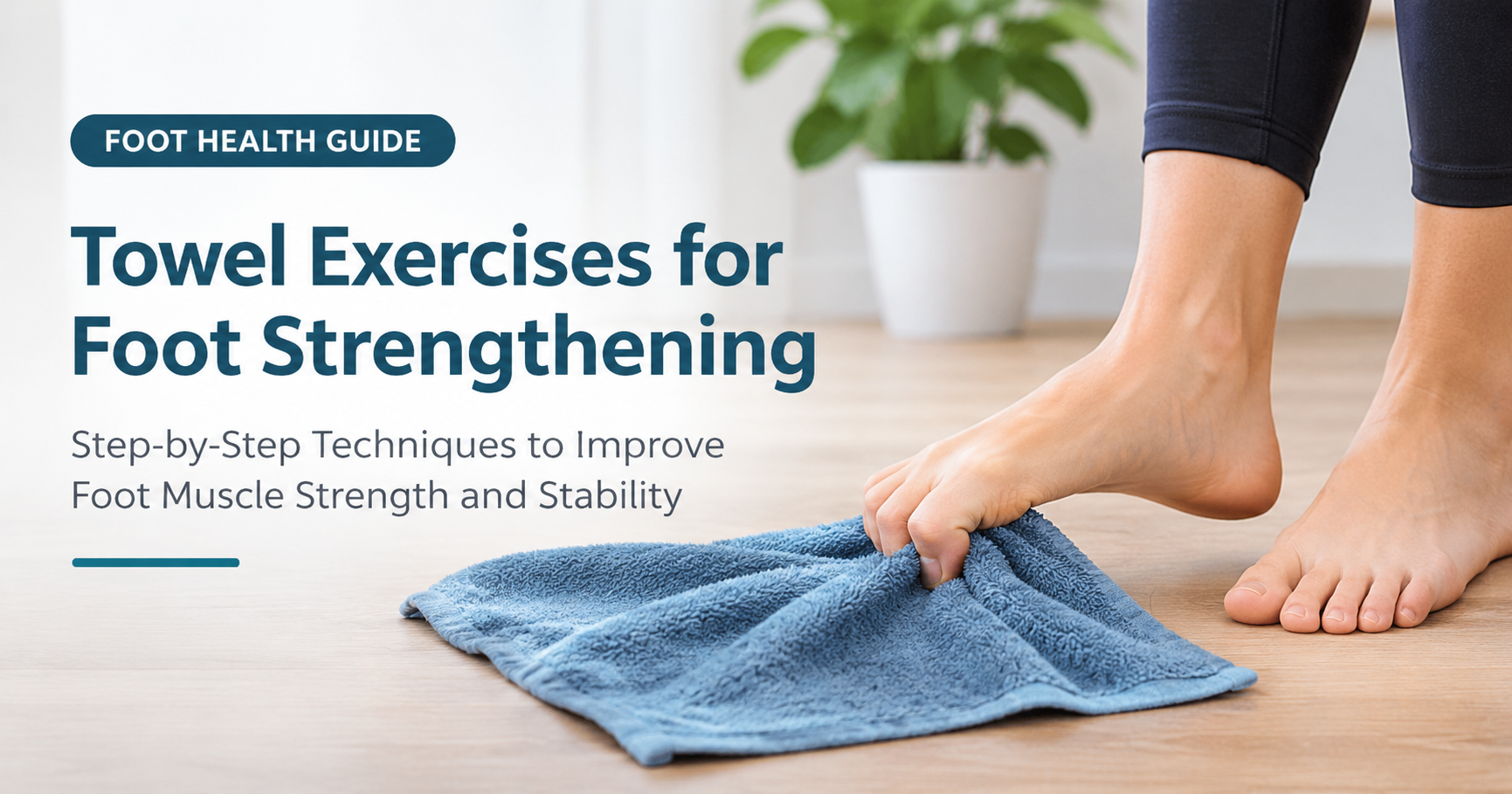
The towel scrunch is the best-known towel exercise. It trains the muscles that flex the toes and the small muscles under the arch.

How to do it
- Sit on a chair with your feet flat on the floor and a hand towel spread flat in front of you.
- Place one foot at the near edge of the towel with your heel on the floor.
- Spread your toes wide, then curl them downward to grip the towel.
- Pull the towel toward your heel, scrunching it under your foot as you go.
- Release, reset your toes and repeat until the whole towel has been gathered.
- Smooth the towel out again and switch feet.
Sets and reps: 2 sets of 10 scrunches per foot to start.
What you should feel: work under the arch and in the toes. You should not feel sharp pain or cramping that does not ease when you pause.
Make it harder
- Place a light object such as a book or a small water bottle on the far end of the towel so you must pull it along.
- Use a slightly damp towel for more friction.
- Perform the exercise barefoot while standing, holding a chair for support, once you are comfortable seated.
Exercise 2: Seated Towel Stretch
Strength and flexibility work together. This stretch lengthens the plantar fascia, the Achilles tendon and the calf muscles, which often feel tight when the foot is overworked.

How to do it
- Sit on the floor or the edge of a bed with one leg straight in front of you.
- Loop a long towel around the ball of that foot, just below the toes.
- Hold an end of the towel in each hand with your back tall.
- Gently pull the towel toward you so the toes and ankle move toward your shin.
- Stop when you feel a comfortable stretch through the arch and the back of the calf.
- Hold for 30 seconds, then relax. Repeat 2 to 3 times per foot.
Safety note: keep your knee straight but not locked, and never bounce. A stretch should feel like firm tension, not pain.
Exercise 3: Towel Slide
The towel slide strengthens the muscles that control side-to-side motion of the foot and ankle. These muscles help you stay steady on uneven ground.

How to do it
- Sit with your feet flat and place one foot on a hand towel on a smooth floor.
- Keep your heel anchored and slowly slide the front of the foot to the right, then to the left.
- Move only from the foot and ankle, not from the knee or hip.
- Keep the movement slow and controlled. Count about two seconds each way.
Sets and reps: 2 sets of 8 slides in each direction per foot.
Exercise 4: Short-Foot Lift on a Towel
The short-foot exercise is widely used by physical therapists to activate the intrinsic muscles that raise the arch. Practising it on a towel gives gentle feedback because you can feel the towel shift under your foot.
How to do it
- Sit tall with your foot flat on a folded towel. Keep your toes relaxed and long.
- Without curling your toes, try to draw the ball of your foot toward your heel. Imagine making the foot shorter.
- You should see the arch rise slightly. The toes and heel stay in contact with the towel.
- Hold for 5 seconds, then release slowly.
Sets and reps: 2 sets of 5 holds per foot.
Many people curl their toes the first time. If that happens, rest your fingers on top of your toes to remind them to stay relaxed, and make the movement smaller.
Exercise 5: Folded-Towel Balance
Once the earlier exercises feel easy, this move adds balance training, which challenges the foot and ankle muscles to work together.
How to do it
- Fold a towel into a thick pad and place it on a non-slip floor next to a wall or counter.
- Stand on the towel on one foot, with your other foot lifted slightly. Lightly touch the wall for safety if needed.
- Keep your knee soft, your hips level and your standing foot spread with the big toe, little toe and heel pressing evenly down.
- Hold for 15 seconds, then switch feet.
Sets and reps: 2 sets of 15 seconds per foot. Progress to 30 seconds, then try closing your eyes only when you are close to a support.
A 4-Week Progression Plan
Consistency matters more than intensity. Aim for three to four sessions per week, leaving at least one rest day between sessions. Increase the load slowly, because the small muscles of the foot adapt more slowly than larger muscles.

If any exercise causes pain that lasts more than a few hours, stay at the previous week’s level for another week before moving up.
Common Mistakes to Avoid
- Rushing the reps. Slow, controlled movements recruit more muscle than fast, sloppy ones.
- Clawing the toes during the short-foot lift. This uses the wrong muscles.
- Using a towel that bunches or slips on carpet. Choose a smooth floor surface.
- Pulling the stretch too hard. Overstretching can irritate the plantar fascia.
- Doing too much too soon. Foot muscles fatigue quickly. Start small.
- Ignoring pain. Mild muscle fatigue is normal, but sharp or persistent pain is a signal to stop.
- Training only one foot. Do both sides, even if one feels stronger.
Who Should Be Careful?
Towel exercises are generally gentle, but check with a doctor, podiatrist or physical therapist before starting if you:
- Have diabetes, neuropathy or reduced feeling in your feet.
- Have a recent foot or ankle injury, fracture or surgery.
- Have severe or worsening heel pain, swelling, redness or warmth.
- Experience numbness, tingling or unexplained foot cramping.
- Are pregnant and have swelling or balance concerns.
This article is for general education and is not medical advice. If you have ongoing foot pain or a medical condition, consult a qualified healthcare professional for personal guidance.
Helping Your Feet Between Workouts
Exercises work best when supported by good daily habits. Choose footwear with enough toe room and appropriate cushioning for your activity, and replace worn-out shoes. Spend some time barefoot at home on safe surfaces so the feet can move naturally. Roll the sole of each foot over a small ball for a minute at the end of the day if it feels good. Vary your standing and walking surfaces, and take breaks if your job keeps you on hard floors for hours. Staying hydrated and keeping a healthy weight also reduce the load carried by your feet.
Frequently Asked Questions
How often should I do towel foot exercises?
Three to four times per week is a good target for most healthy adults. You can do short sessions of 10 to 15 minutes, and rest at least one day between sessions at the start.
How long until I notice results?
Many people feel better control and less foot fatigue within three to four weeks. Visible and measurable strength gains usually need six to eight weeks or more of regular practice.
Can towel exercises fix flat feet?
They can help strengthen the muscles that support the arch and improve function, but they do not change the bone structure. For painful or rigid flat feet, a podiatrist can recommend the best approach.
Are towel scrunches good for plantar fasciitis?
Gentle toe and arch strengthening along with calf and plantar fascia stretching are commonly included in rehabilitation programs. If you have heel pain, begin gently and consult a professional for a plan that suits you.
Should I do the exercises barefoot?
Yes. Barefoot practice lets the toes spread and grip properly, and it lets you feel the muscles working.
Is it normal for my foot to cramp?
Mild cramping is common when the small muscles are new to the work. Stop, stretch the toes gently and rest. Reduce the number of repetitions next time. If cramps are frequent or severe, speak to a healthcare provider.
Can older adults do these exercises?
Yes. Seated versions are particularly suitable, and the balance exercise can be done with a firm support. Foot strength and balance are important for staying active and steady as we age.
Do I need any special equipment?
No. A regular towel and a chair are enough. Some people later add resistance bands or textured mats, but they are optional.
Final Thoughts
Strong, flexible feet are the foundation of every step you take. With a simple towel and about 15 minutes, a few times a week, you can train the small muscles that support your arches, improve balance and help your feet handle the demands of daily life. Start with the towel scrunch and stretch, add the slide and short-foot lift as you improve, and finish with the folded-towel balance when you feel confident. Be patient, keep your movements slow and controlled, and listen to your body. Small, regular effort leads to lasting results.