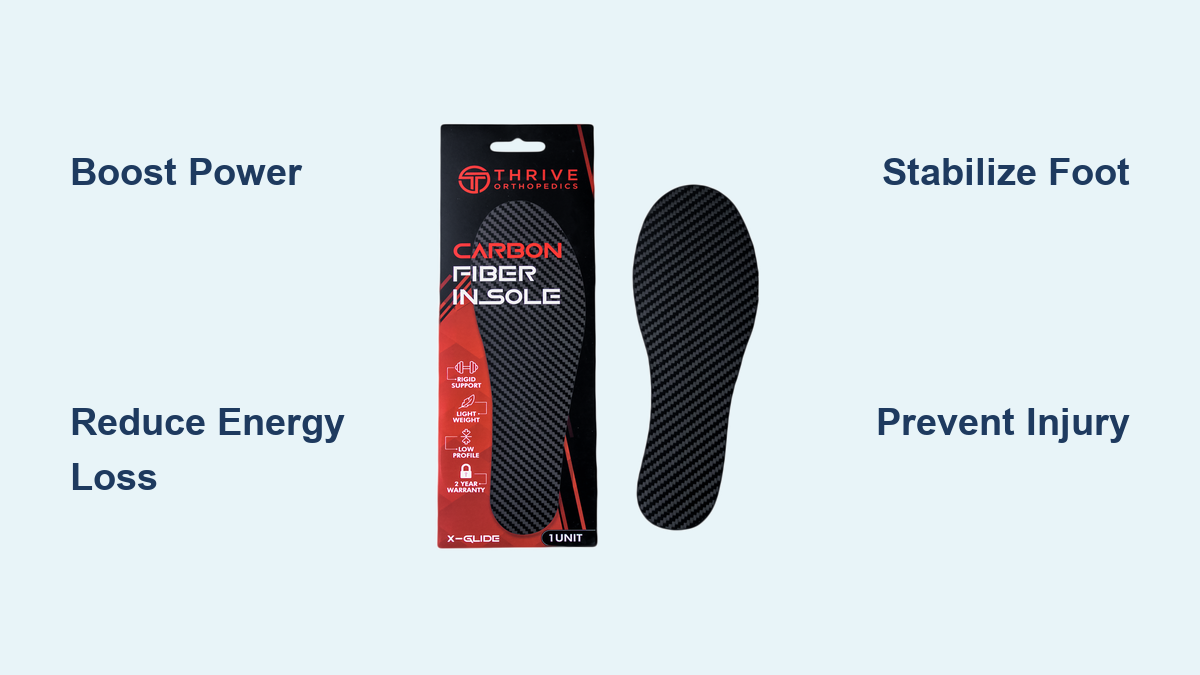
If your feet are the foundation of athletic performance, then carbon fiber insoles are like high-performance shock absorbers with a built-in power boost. Engineered to stiffen the shoe’s midsole and reduce energy loss during movement, these ultra-light inserts have transitioned from elite sports labs to mainstream use. Carbon fiber insoles enhance power, speed, and stability—especially during explosive actions like sprinting, jumping, and cutting. Their rigid yet featherlight structure limits excessive motion at the big toe joint (metatarsophalangeal or MTP joint), preserving energy that would otherwise dissipate during push-off. This translates to stronger propulsion and improved athletic output.
But they’re not just for Olympians or pros. Weekend warriors, rehabbing athletes, and those managing foot pain also turn to carbon fiber insoles for support and injury protection. Whether you’re sprinting on turf, jumping on hardwood, or recovering from a foot injury, these insoles act as mechanical aids that optimize how force travels from your foot to the ground. Research shows modest gains—like a 1.5% improvement in jump distance—but the real advantage lies in consistency, control, and reduced joint strain. However, they aren’t magic: benefits depend on your sport, footwear, and biomechanics. And because they trade cushioning for rigidity, comfort can be a concern. Understanding what carbon fiber insoles do—and don’t do—helps athletes make smarter choices about when and how to use them.
Boosting Explosive Power and Athletic Efficiency

How Carbon Fiber Minimizes Energy Loss During Push-Off
During running or jumping, your foot bends at the big toe joint to push off the ground. But that bending absorbs energy instead of returning it—like pressing a spring that doesn’t bounce back. Carbon fiber insoles combat this inefficiency by stiffening the forefoot, reducing dorsiflexion at the MTP joint. With less flex, more force transfers directly into forward or upward motion. Studies show this can improve mechanical efficiency, especially during explosive tasks. In one trial, athletes wearing carbon fiber insoles increased standing long jump distance by 1.5% compared to standard foam inserts. Though small, such gains matter at competitive levels.
The principle mirrors that of carbon-plated running shoes, where a rigid plate stores and returns energy. However, most flat carbon fiber insoles don’t act like springs. Bench tests reveal many lack sufficient deflection to generate meaningful elastic recoil. Instead, their main benefit comes from reducing negative work at the MTP joint. By limiting motion, they decrease energy dissipation, allowing muscles to work more effectively during propulsion.
Enhancing Mechanical Leverage for Stronger Push-Offs
Carbon fiber insoles change how force is applied by increasing the ankle’s effective lever arm. When the foot is stiffer, the ground reaction force acts farther from the ankle joint center, creating a longer moment arm. This mechanical advantage allows the calf muscles (gastrocnemius and soleus) to produce greater torque with less shortening velocity—aligned with the muscle’s force-velocity relationship. The result? Stronger push-offs and improved power in jumps and accelerations.
This concept, known as “gear ratio” enhancement, explains why some athletes feel a noticeable pop during takeoff. Even without significant energy return, the improved leverage supports faster starts and sharper cuts—key in sports like basketball, soccer, and football. However, this benefit depends on shoe compatibility. In already stiff shoes, adding a carbon fiber insert may offer minimal extra gain. In flexible footwear, the effect is more pronounced.
Sport-Specific Gains Across Key Disciplines

Different sports benefit differently from carbon fiber insoles. In hockey, Superfeet’s EVOLyte®-equipped insoles claim up to 11% better acceleration on ice, thanks to enhanced energy transfer and edge control. Skaters rely on rapid crossovers and tight turns—movements demanding stable foot platforms. A rigid insole prevents foot splay inside the boot, translating leg drive directly into forward motion.
In basketball and volleyball, vertical jump performance improves slightly—by about 0.7 cm in one study—due to optimized propulsion mechanics. While not revolutionary, even marginal gains can mean the difference between making or missing a block or rebound. Similarly, agility drills like the 5-10-5 shuttle show minor improvements (~1%) due to better stability during direction changes.
For runners, benefits are less consistent. No significant improvement was found in 50-meter sprint speed, possibly because stiffer insoles increase ground contact time and muscular effort. Endurance runners may not gain much, but sprinters and jumpers could see advantages in short bursts.
Preventing and Managing Forefoot Injuries

Reducing Painful Motion in Key Joints
Carbon fiber insoles are widely used to manage conditions involving the forefoot and midfoot, particularly when joint motion causes pain. By restricting dorsiflexion at the MTP joint, these inserts protect injured or arthritic areas. This is crucial for hallux rigidus (stiff big toe), where cartilage degeneration limits movement and causes pain. A rigid insole reduces joint stress, allowing athletes to remain active without aggravating symptoms.
They’re also essential in treating turf toe, a sprain caused by hyperextension of the big toe joint during sports played on artificial turf. Left untreated, turf toe can lead to chronic instability. Carbon fiber insoles act like internal braces, preventing excessive bending during push-off and enabling safer return to play. Similar benefits apply to Freiberg’s disease and midfoot osteoarthritis, where motion control reduces mechanical irritation.
After metatarsal fractures or Lisfranc injuries, rigid carbon fiber inserts provide structural support comparable to walking boots. Athletes transitioning out of immobilization can wear these insoles to maintain stability while gradually resuming activity. Their strength—over twice that of steel by weight—makes them ideal for load-bearing protection.
Supporting Recovery After Surgery or Injury
Post-surgery, carbon fiber insoles help protect healing tissues. Following 5th metatarsal fracture repair, for example, a stiff insert prevents twisting forces and bending that could compromise fixation. Semi-rigid versions allow controlled motion as rehabilitation progresses, bridging the gap between casted immobility and full function.
In pediatric cases, such as idiopathic toe-walking, carbon fiber inserts don’t eliminate the behavior but improve gait mechanics. A six-week trial showed increased plantar contact area and normalized timing between footstrike and push-off, suggesting potential for long-term gait retraining.
However, experts caution against using rigid carbon fiber insoles for conditions requiring shock absorption. Unlike plantar fasciitis or Achilles tendinopathy, which benefit from cushioned, contoured orthotics, forefoot-stiffening inserts may worsen heel and midfoot strain. A hybrid solution—placing a small carbon leaflet under the first MTP joint within a standard orthotic—can offer targeted support without sacrificing overall foot function.
Biomechanical Impact: Stability vs. Sensory Feedback
Do They Really Return Energy—or Just Improve Efficiency?
There’s a common misconception that carbon fiber insoles work like springs, storing and releasing energy with every step. While pre-curved carbon plates in elite running shoes do this effectively, most standalone insoles are flat and rigid—functioning more as stabilizers than springs. Testing shows many flat carbon inserts deform minimally under load, meaning little elastic energy is stored or returned.
Their real value lies in mechanical efficiency, not springiness. By reducing soft tissue and joint deformation, they streamline force transfer from muscle to ground. Think of it like replacing a spongy floor with a solid one: your movements become more direct and powerful. This efficiency is especially useful in multidirectional sports where rapid force application matters more than endurance economy.
Still, design matters. Insoles with a slight upward curve (longitudinal arch pre-load) can enhance energy return. Future models incorporating high-rebound foams—like Levation™ PU or Pulsion® ETPU—may better balance stiffness with responsiveness.
Stability Gains vs. Reduced Ground Feel
Carbon fiber insoles enhance torsional and longitudinal rigidity, reducing foot splay and midfoot collapse during dynamic movements. This improves control during cutting, pivoting, and landing. In sports like soccer and tennis, where sudden direction changes are frequent, a stable foot platform reduces slippage inside the shoe and enhances precision.
Full-length carbon fiber inserts offer continuous support from heel to toe, unlike traditional orthotics that stop short of the forefoot. This integration strengthens the shoe’s structure, improving overall biomechanical alignment. However, too much stiffness can backfire. In overly rigid shoes, the insole may add no benefit—or even restrict natural foot function.
The interaction between insole and shoe is critical. A flexible trainer gains more from a carbon insert than a performance shoe already built with a stiff plate. Matching the insole to the footwear ensures optimal performance without compromising comfort or adaptability.
While rigidity improves power, it dampens sensory feedback from the foot. The plantar surface contains thousands of mechanoreceptors vital for balance and injury prevention. Rigid insoles reduce this proprioceptive input, potentially impairing dynamic stability. In court sports requiring fine foot adjustments—like basketball or martial arts—diminished ground feel may increase reliance on ankle, knee, and hip joints to compensate. Over time, this could elevate injury risk, especially in fatigue-prone conditions.
Final Note: Carbon fiber insoles are not magic—but they are powerful when used correctly. They enhance athletic performance by reducing energy loss, improving force transfer, and stabilizing the foot. They also play a key role in managing forefoot injuries and aiding recovery. However, they increase muscle effort, reduce comfort, and may impair proprioception. Success depends on matching the insole to your sport, footwear, and biomechanics. For explosive, multidirectional activities, they can offer a real edge. For endurance or flexibility-focused sports, traditional options may be better. Always prioritize professional guidance over marketing hype—and let your feet decide what works best.