Walk into any shoe store or browse any online listing and you will quickly notice that insoles come in different lengths. The two most common options are full length insoles and 3/4 length insoles. At first glance the difference looks small, but choosing the wrong one can leave you with cramped toes, slipping inserts, or support that does not reach the part of your foot that needs it most.
This guide explains exactly how each type works, what each one is best for, and how to decide which one fits your feet, your shoes and your daily routine. By the end, you will be able to choose with confidence instead of guessing.
Quick Answer: Which One Should You Choose?
If you want the short version, here it is:
- Choose a full length insole if your shoe has a removable factory insole, you want cushioning under your toes, or you need all-day support for standing, walking or running.
- Choose a 3/4 length insole if your shoes are snug, you mainly need heel and arch support, or you want to keep the shoe’s original insole in place.
The rest of this article explains the reasoning behind those rules so you can apply them to your own situation.
What Is a Full Length Insole?
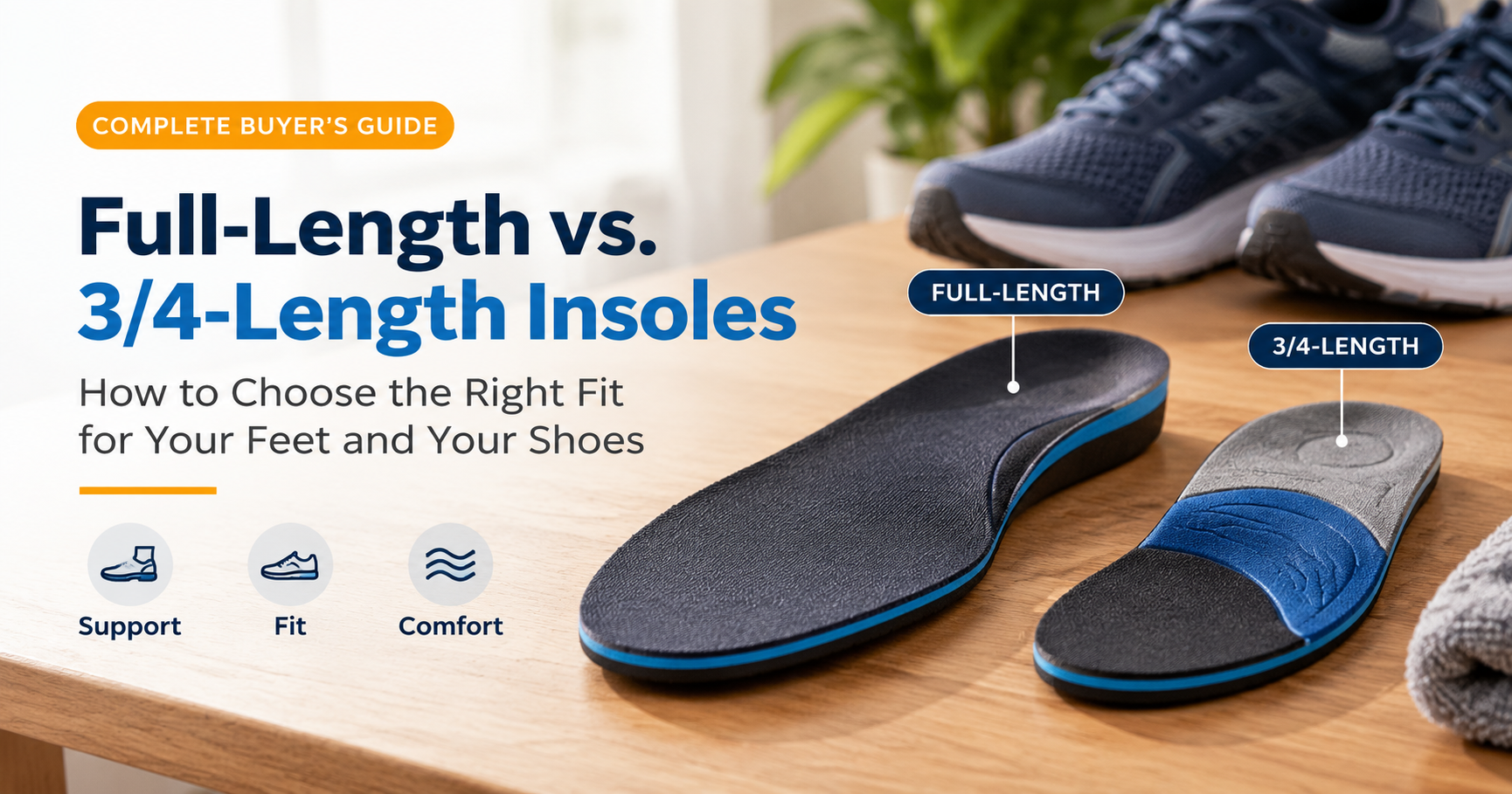
A full length insole runs from the back of your heel all the way to the tips of your toes. It is designed to replace the shoe’s existing insole (also called a sockliner or footbed) or, in some cases, to sit on top of it. Because it covers the entire foot, it gives you a continuous surface of cushioning and support from heel to toe.
Full length insoles are usually cut to a general shoe size, and many can be trimmed with scissors using the original insole as a template. This makes it easy to get a neat, precise fit.
Key features of full length insoles
- Complete coverage: Heel, arch, ball of foot and toes are all supported or cushioned.
- Replaces the original insole: Most are meant to be swapped in, which keeps the shoe’s internal height more consistent.
- Even pressure distribution: Weight is spread across the whole foot rather than concentrated in a few spots.
- Wide range of designs: You can find them for sports, work boots, walking shoes, flat feet, high arches and general comfort.
What Is a 3/4 Length Insole?
A 3/4 length insole, sometimes called a three-quarter insole or a “stop short” insole, covers the heel and arch and ends just behind the ball of your foot. As the name suggests, it is roughly three-quarters of the length of a full insole. Your toes and the front of your foot rest directly on the shoe’s original footbed.
These insoles are designed to add support where many people feel discomfort, namely the heel and arch, without taking up space in the front of the shoe. That makes them a smart choice for shoes that are already a close fit.
Key features of 3/4 length insoles
- Targeted support: Focuses on the heel and arch, the areas that bear much of your weight and stress while walking.
- Slim, space-saving design: Because they stop before the toes, they do not crowd the toe box.
- Works with the original insole: You keep the shoe’s front cushioning and do not need to remove the factory footbed.
- Often used in dress shoes: Many people choose them for loafers, oxfords, flats and other low-volume footwear.
Full Length vs 3/4 Length Insoles: Side-by-Side Comparison
Use this table to compare the two types at a glance.
| Feature | Full Length Insole | 3/4 Length Insole |
|---|---|---|
| Coverage | Heel to toes | Heel to just behind the ball of the foot |
| Toe cushioning | Yes | No (uses the shoe’s original footbed) |
| Fit in tight shoes | Can feel crowded if the shoe is snug | Usually the better choice |
| Replaces original insole? | Usually yes | Usually no, it sits on top |
| Best for | Running, walking, work boots, hiking, long hours on your feet | Dress shoes, loafers, cleats, tight or low-volume shoes |
| Support focus | Whole foot | Heel and arch |
| Trimming needed? | Often, to match your shoe size | Rarely, since they are sized by shoe range |
Advantages and Disadvantages of Each Type
Full length insoles: pros and cons
Pros
- Cushioning and support under the entire foot, including the toes and forefoot.
- Can be trimmed to match your exact shoe shape.
- Often include more advanced features such as deep heel cups, metatarsal pads and shock-absorbing layers.
- Generally the better fit when you are replacing a worn-out factory insole.
- Well suited to athletic shoes and work footwear built for long hours.
Cons
- Takes up more space inside the shoe, which can make a snug shoe feel tighter.
- May need trimming, and a poor cut can leave edges that curl or bunch up.
- Not ideal if the shoe’s footbed is glued in and cannot be removed.
3/4 length insoles: pros and cons
Pros
- Slim and discreet, which works well in dress shoes and other close-fitting footwear.
- Does not crowd the toe box, so your toes keep their natural room.
- Easy to add without removing anything from the shoe.
- Delivers targeted heel and arch support where many people need it most.
- Usually requires no trimming.
Cons
- No cushioning or support beneath the toes and front of the foot.
- Can slide forward or backward in some shoes if it does not have a grippy base.
- Less suitable if you need full-foot correction, such as for certain forefoot conditions.
- If the shoe’s original insole is thin or worn, the front of your foot gets no extra relief.
7 Factors That Help You Choose the Right Length
1. The type of shoe you are putting them in
This is often the deciding factor. Shoes with a roomy interior and a removable insole, such as running shoes, walking shoes, work boots and hiking boots, usually pair well with full length insoles. Shoes with a slim, low-volume design, such as dress shoes, loafers, flats and cleats, usually pair better with 3/4 length insoles because there is little spare room.
2. How snug your shoes already fit
Try a simple test. Pull out the shoe’s factory insole and stand on it. If your toes sit comfortably inside the outline with a little room to spare, you likely have space for a full length insole. If your foot already fills the entire insole with no room around the edges, a 3/4 length insole is the safer option because it will not add bulk at the front.
3. Where you feel discomfort
Think about where your feet hurt:
- Heel and arch pain or fatigue: A 3/4 length insole may be enough, as it targets exactly these areas.
- Pain across the ball of the foot or under the toes: A full length insole is the better pick because it cushions the forefoot.
- Overall tired, achy feet: A full length insole gives more complete support and cushioning.
4. Your foot type and arch height
People with flat feet or low arches often benefit from the continuous support of a full length insole, especially if they spend long hours standing. People with high arches commonly want cushioning across the whole foot to absorb impact, which also points toward full length. Those with normal arches who simply want a bit of extra heel and arch comfort can do well with either type.
5. Your daily activity
For running, brisk walking, hiking and jobs that keep you on your feet all day, full length insoles generally provide the cushioning and impact absorption you need. For office wear, formal events and situations where appearance and fit matter more than athletic performance, 3/4 length insoles keep your shoes looking and feeling natural.
6. Whether the factory insole is removable
If you can easily lift out the original insole, a full length insole can take its place and keep the shoe’s interior height consistent. If the footbed is fixed in place, a 3/4 length insole is easier because it sits on top without the need for removal, and it avoids pushing your foot too high in the shoe.
7. How much volume you can spare
Every insole adds some thickness. In shoes with limited depth, a thick full length insole can make your heel slip out or press your toes against the top of the shoe. A slimmer 3/4 length insole adds less overall bulk, which helps keep the original fit intact.
Best Insole Length by Shoe Type
Here is a practical breakdown of the most common footwear and the insole length that tends to work best.
Running and athletic shoes
Athletic shoes are built with removable insoles and usually have enough interior space. A full length insole gives consistent cushioning and support for repeated impact. Look for one with good shock absorption and a supportive heel cup.
Walking shoes and everyday sneakers
For daily wear, a full length insole is typically the most comfortable option, especially if you walk long distances. If your sneakers are slim or fit snugly, a 3/4 length insole is a reasonable alternative.
Work boots and safety shoes
Long shifts on hard floors put steady stress on your feet. Full length insoles offer the whole-foot cushioning and support that help reduce fatigue. Make sure the insole matches the boot’s interior shape so it lies flat.
Hiking boots
Hiking involves uneven ground, long distances and varied terrain. A full length insole with a firm heel cup and arch support helps stabilise the foot and cushion each step.
Dress shoes, oxfords and loafers
These shoes are designed with a close, tailored fit and limited space. A 3/4 length insole adds heel and arch comfort without altering the shoe’s profile or pushing your toes forward.
Flats and low-volume casual shoes
Shallow shoes leave little room for bulky inserts. A thin 3/4 length insole improves comfort and helps prevent your heel from sliding without making the shoe feel tight.
Cleats and performance sports shoes
Cleats are meant to fit very closely, so a 3/4 length insole is often preferred because it adds support while preserving the tight, responsive feel.
How to Check the Right Fit Before You Commit
- Remove the original insole (if it is removable) and place it on top of the new insole. Compare the length and shape.
- For full length insoles, trim along the outline of the original insole using sharp scissors. Cut a little at a time and test the fit between cuts, since you cannot add material back.
- Place the insole in the shoe and make sure it lies completely flat, with no bunching at the toes or curling at the edges.
- Put the shoe on and check that your heel sits snugly without lifting out and your toes are not pressed against the top.
- Walk around for several minutes on a hard floor. The insole should not slide, and you should not feel pressure points.
Common Mistakes to Avoid
- Stacking insoles on top of the original one: Using a full length insole over a thick factory insole can make the shoe too tight and raise your foot too high.
- Choosing by size alone: Shoe size is only part of the picture. Interior volume, shoe shape and your foot type matter too.
- Ignoring the break-in period: New insoles can feel different at first. Wear them for a few hours at a time and build up gradually.
- Picking a 3/4 insole for a forefoot problem: If your pain is under the ball of the foot or toes, a shorter insole will not reach it.
- Buying the thickest option: More cushioning is not always better. Excess thickness can reduce stability and alter how your foot sits in the shoe.
- Never replacing worn insoles: Cushioning breaks down with use. Many insoles lose effectiveness after several months of regular wear, so check them periodically.
Can You Use Both Types?
Absolutely. Many people keep full length insoles in their athletic shoes and everyday sneakers, and use 3/4 length insoles in their dress shoes and other close-fitting pairs. Since shoes differ so much in shape and interior space, matching the insole length to each pair is often the best way to get comfort across your whole wardrobe.
When to See a Professional
Over-the-counter insoles can make a real difference for general comfort, mild arch fatigue and everyday foot strain. However, they are not a substitute for medical care. If you have persistent foot, heel, knee or back pain, numbness, swelling, a diagnosed condition such as severe plantar fasciitis or diabetes-related foot problems, or pain that does not improve after a few weeks, speak with a podiatrist or another qualified healthcare provider. They can assess your foot structure and recommend whether off-the-shelf or custom insoles are right for you.
Frequently Asked Questions
Is a full length or 3/4 length insole better for plantar fasciitis?
Both types can be used, but many people with plantar fasciitis prefer full length insoles because they provide continuous arch support and cushioning across the whole foot. The right choice depends on your shoes and symptoms, so it is wise to confirm with a healthcare professional.
Do 3/4 length insoles fit in all shoes?
They fit most closed shoes, but the fit still depends on the shoe’s depth and shape. Because they are slimmer and shorter, they tend to work in a wider range of snug or low-volume shoes than full length versions.
Can I cut a 3/4 length insole to make it shorter?
It is generally not recommended. These insoles are shaped and sized with their length in mind, and cutting them can affect the heel cup and arch positioning. Choose the correct size range instead.
Should I take the original insole out before adding a new one?
With full length insoles, yes, in most cases. Replacing the original keeps the shoe’s interior height consistent. With 3/4 length insoles, you normally leave the original insole in place.
How long do insoles last?
It varies with materials, your body weight and how often you wear them. Many people replace everyday insoles every six to twelve months, or sooner if the cushioning feels flat, the surface is cracked, or you notice a return of discomfort.
Will insoles make my shoes feel tighter?
Any insole adds some volume. A full length insole generally adds more overall bulk than a 3/4 length one. If your shoes already fit snugly, try a slim 3/4 length insole or a thin full length option before choosing a thick, heavily padded one.
Which is better for flat feet?
People with flat feet often do well with a full length insole that has solid arch support, because it supports the foot as a whole. If your shoes are tight, a 3/4 length insole with firm arch support is a practical alternative.
Final Thoughts
The choice between a full length and a 3/4 length insole comes down to three simple questions: how much room your shoes have, where your feet need support, and what you do in those shoes every day. If you want complete cushioning from heel to toe and your shoes have the space, a full length insole is usually the right call. If your shoes are snug or you mainly need heel and arch support, a 3/4 length insole delivers comfort without the extra bulk.
Test the fit carefully, give your feet a short adjustment period, and do not hesitate to use different lengths in different pairs of shoes. With the right match, you will notice the difference in comfort with every step.