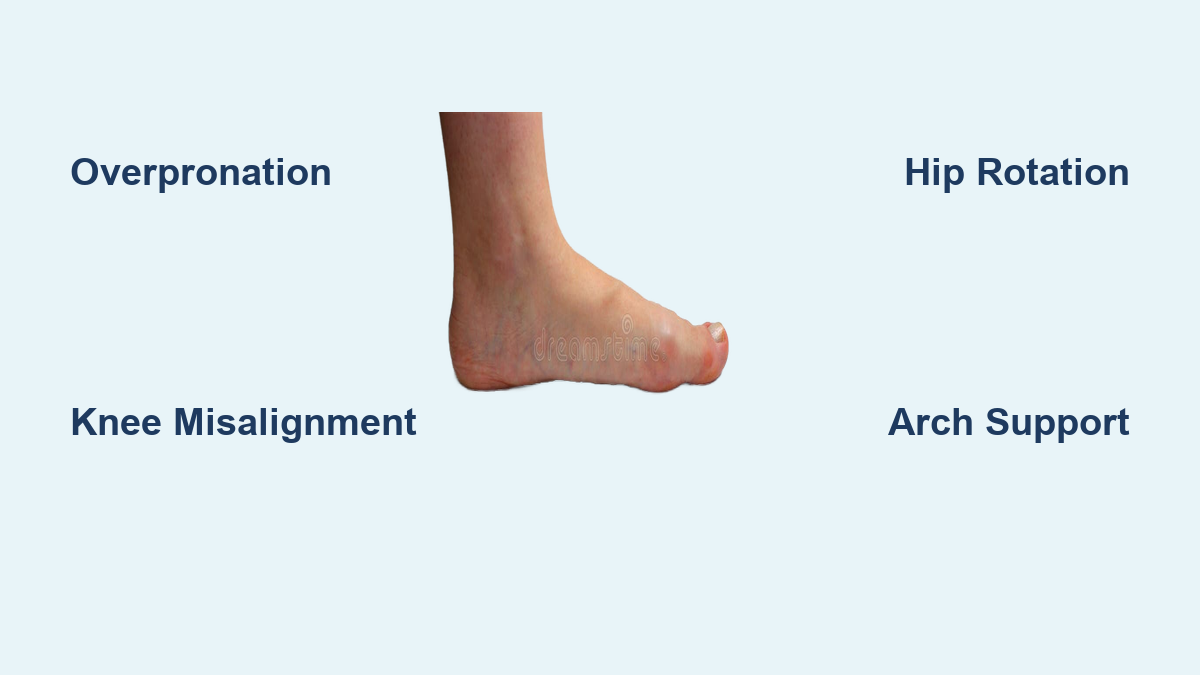
If you’ve been dealing with nagging knee or hip pain that flares up after walking, standing, or climbing stairs, the source might not be where you think. Flat feet—a condition where the arches collapse under weight—don’t just cause foot fatigue. They trigger a biomechanical chain reaction that misaligns your entire lower body, sending stress up the kinetic chain to your knees, hips, and even lower back. Research shows people with flat feet are 1.4 times more likely to develop medial knee cartilage damage and frequent joint pain. This isn’t a minor issue—it’s your foundation failing, and the rest of your body is paying the price. In this guide, you’ll learn exactly how flat feet disrupt alignment, the science behind the pain, and what you can do to stop the damage before it becomes irreversible.
How Overpronation Disrupts Lower Body Alignment

The Collapse of the Arch and Its Immediate Effects
When your foot flattens during weight-bearing, it’s not just sinking—it’s overpronating, a complex motion involving inward heel tilt, talar shift, and forefoot dorsiflexion. This triplanar movement destroys the foot’s natural ability to act as a shock absorber. Instead of distributing force evenly, the collapsed arch transfers excessive pressure to the inner side of the foot, destabilizing the entire leg.
This instability starts with navicular drop, a measurable descent of the navicular bone that signals arch failure. As the foot rolls inward, the ankle joint everts, forcing the tibia (shinbone) to rotate internally. That twist doesn’t stop at the ankle—it travels upward, disrupting alignment at every joint above.
The Kinetic Chain: From Foot to Hip
Your body operates as a unified system—the kinetic chain—where dysfunction at one level affects everything above. Flat feet initiate a cascade:
1. Overpronation pulls the tibia inward.
2. The tibia’s rotation forces the femur (thighbone) into internal rotation.
3. This shifts the hip joint, tilts the pelvis, and alters spinal posture.
This means a problem in your feet becomes a knee, hip, and posture problem. Even if your hips and knees are healthy, the abnormal mechanics from flat feet can overload these joints over time, leading to chronic pain and early degeneration.
How Flat Feet Lead to Knee Pain
Tibial Rotation and Patellar Maltracking
As the tibia rotates inward, it pulls the patella (kneecap) off its normal path. The kneecap is designed to glide smoothly in the femoral groove, but internal rotation forces it to track laterally, increasing pressure on the outer edge. This misalignment causes:
– Patellofemoral pain syndrome (PFPS): Aching pain in the front of the knee, especially when climbing stairs or sitting for long periods.
– Cartilage irritation: Repeated friction wears down the smooth surface behind the kneecap, leading to inflammation and early degeneration.
Even without full arthritis, this constant maltracking creates chronic discomfort and sets the stage for long-term joint damage.
Increased Stress on the Medial Knee
Flat feet don’t just affect the kneecap—they also overload the inner (medial) compartment of the knee:
– The inward pull of the tibia shifts weight toward the medial tibiofemoral joint.
– This stretches the medial collateral ligament (MCL) and contributes to genu valgum (knock-kneed posture).
– Over time, this uneven loading compresses the medial meniscus and cartilage.
The result? Cartilage thinning, meniscus degeneration, and early osteoarthritis—especially in the medial compartment, where the Framingham Study found a 1.4x higher risk of damage.
Framingham Study: The Evidence Is Clear
A landmark study of 1,903 adults revealed a strong, dose-dependent link between flat feet and knee problems:
– Feet with the flattest arches had 1.3x higher odds of knee pain.
– 1.4x higher odds of medial tibiofemoral cartilage damage.
– The risk increased steadily with arch collapse—proving flat feet are an independent risk factor, even after adjusting for BMI, age, and knee alignment.
Key takeaway: This isn’t correlation—it’s causation. Flat feet directly contribute to joint damage, not just discomfort.
What Makes Knee Pain Worse?
Certain factors amplify the damage:
– Weight gain: Every extra pound increases knee load by 4x during walking.
– High-impact activities: Running, jumping, or prolonged standing worsen joint stress.
– Pregnancy: Hormones like relaxin loosen ligaments, increasing overpronation and knee instability.
How Flat Feet Contribute to Hip Pain

Internal Femoral Rotation and Hip Impingement
As the tibia rotates inward, the femur follows, pulling the femoral head out of optimal alignment in the acetabulum. This misalignment creates femoroacetabular impingement (FAI), where bone rubs against bone at the front of the hip. FAI leads to:
– Labral tears
– Cartilage wear
– Early hip osteoarthritis
Many patients diagnosed with “hip arthritis” actually have underlying biomechanical issues rooted in foot dysfunction.
Hip Muscle Overuse and Pain
To counteract internal rotation, hip muscles work overtime:
– Deep external rotators (piriformis, gemelli, obturators) become tight and painful.
– Gluteus medius and minimus fire constantly to stabilize the pelvis, leading to tendinopathy or trochanteric bursitis.
Patients often report lateral hip pain that worsens with walking, standing, or lying on the affected side—classic signs of muscle fatigue and inflammation.
Reduced Shock Absorption and Joint Damage
The medial longitudinal arch normally absorbs 30–50% of impact during walking. In flat feet, this function fails, sending greater force up the leg with each step. Over time, this leads to:
– Microtrauma in hip cartilage
– Chronic inflammation
– Accelerated joint degeneration
This is especially dangerous for active individuals or those with standing jobs, where repetitive impact adds up quickly.
Signs Your Feet Are Causing Joint Pain
Red Flags to Watch For
You may have foot-driven knee or hip pain if:
– Pain improves with supportive shoes or orthotics
– Shoes wear out on the inside heel or midsole
– Pain increases after long walks or standing
– One-sided pain matches your flatter foot
– You also have arch pain or plantar fasciitis
Key Physical Findings
- Navicular drop >10mm: A clear sign of arch collapse.
- Rearfoot eversion: Heel tilts inward when standing.
- Knee valgus: Knock-kneed appearance, especially on single-leg stance.
- Positive foot strapping test: Taping the arch into place reduces knee or hip pain—proof the foot is the culprit.
Diagnostic Tools
- Pedobarography: Pressure mapping shows excessive medial loading.
- MRI with WORMS scoring: Detects early cartilage damage in knee compartments.
- Long-limb X-rays: Measure Hip-Knee-Ankle (HKA) angle to assess alignment.
- Gait analysis: Reveals abnormal joint motion during walking.
What the Research Tells Us—and What It Doesn’t
What We Know for Sure
- Flat feet are independently linked to medial knee cartilage damage and frequent knee pain.
- The effect is dose-dependent: flatter feet = higher risk.
- The link holds even after adjusting for BMI, age, and knee alignment.
Unanswered Questions
- No strong link to patellofemoral cartilage damage was found, despite biomechanical predictions.
- Possible reason: Flat feet may need combined factors like femoral anteversion or high Q-angle—known as “miserable malalignment”—to damage the patella.
- Cavus feet (high arches) weren’t studied due to measurement limits.
- This leaves open the possibility of a J-shaped risk curve: both extremely flat and high arches may increase joint stress.
Proven Treatments That Work

Custom Orthotics: The Gold Standard
- Arch support and rearfoot control correct overpronation.
- Studies show immediate reduction in knee and hip pain.
- Custom-made orthotics outperform over-the-counter inserts, especially for severe cases.
- Last 2–5 years with regular use.
Best Shoes for Flat Feet
Choose motion control or stability shoes with:
– Rigid heel counter to limit rearfoot motion
– Dual-density midsole (firmer on the medial side)
– Full-length shank for arch support
– Labels: “motion control,” “structured cushioning,” or “stability”
Cost: $130–$160. Replace every 300–500 miles.
Stretching to Relieve Tension
Hold each stretch 30 seconds, 2–3 reps per side:
– Figure 4 stretch: Targets piriformis and deep hip rotators.
– Knee to opposite shoulder: Stretches glutes and external rotators.
– Butterfly stretch: Opens adductors and hips.
– Seated internal hip rotator stretch: Reduces tightness from overcompensation.
Strengthening for Stability
Perform 10–15 reps, 2–3 sets, 3x/week:
– Side-lying clamshells: Activates gluteus medius.
– Banded hip external rotation: Strengthens deep rotators.
– Lateral squat with resistance band: Builds functional hip control.
– Heel raises (eccentric focus): Supports tibialis posterior.
Physical Therapy Essentials
A PT can help with:
– Gait retraining: Teach neutral foot strike.
– Neuromuscular control: Improve foot and hip coordination.
– Intrinsic foot muscle training: “Short foot” exercises to rebuild arch support.
– Core stabilization: Enhance whole-body alignment.
Weight Management Impact
- Every 5% body weight loss reduces knee load by 20%.
- Even modest weight loss slows cartilage degeneration and reduces pain.
- Combine with orthotics for maximum joint protection.
Special Cases
Children with Flat Feet
- Flexible flat feet are common and often resolve by age 10.
- Intervene if:
- Pain is present
- Gait is abnormal (toe-walking, in-toeing)
- Overpronation persists beyond age 5–6
Treatment: Supportive shoes, in-shoe arch supports, foot strengthening.
Pregnant Women
- Hormonal laxity worsens overpronation, especially in the third trimester.
- Symptoms often improve postpartum, but some develop chronic issues.
Solutions: Pregnancy-safe orthotics, low-impact exercise (swimming, cycling), pelvic stabilization exercises.
Athletes and Active People
- High-impact sports increase joint stress.
- Prevention is key:
- Wear sport-specific stability shoes
- Use custom orthotics
- Cross-train to reduce repetitive loading
- Focus on eccentric strengthening (e.g., slow heel drops)
Final Note: Flat feet are more than a foot issue—they’re a root cause of joint pain up the kinetic chain. The evidence is clear: flatter feet increase the risk of knee and hip damage. But the good news? Early action—custom orthotics, proper shoes, and targeted exercises—can stop the cycle, reduce pain, and protect your joints for life. Don’t ignore your foundation. Fix your feet, and you may just fix your knees and hips too.