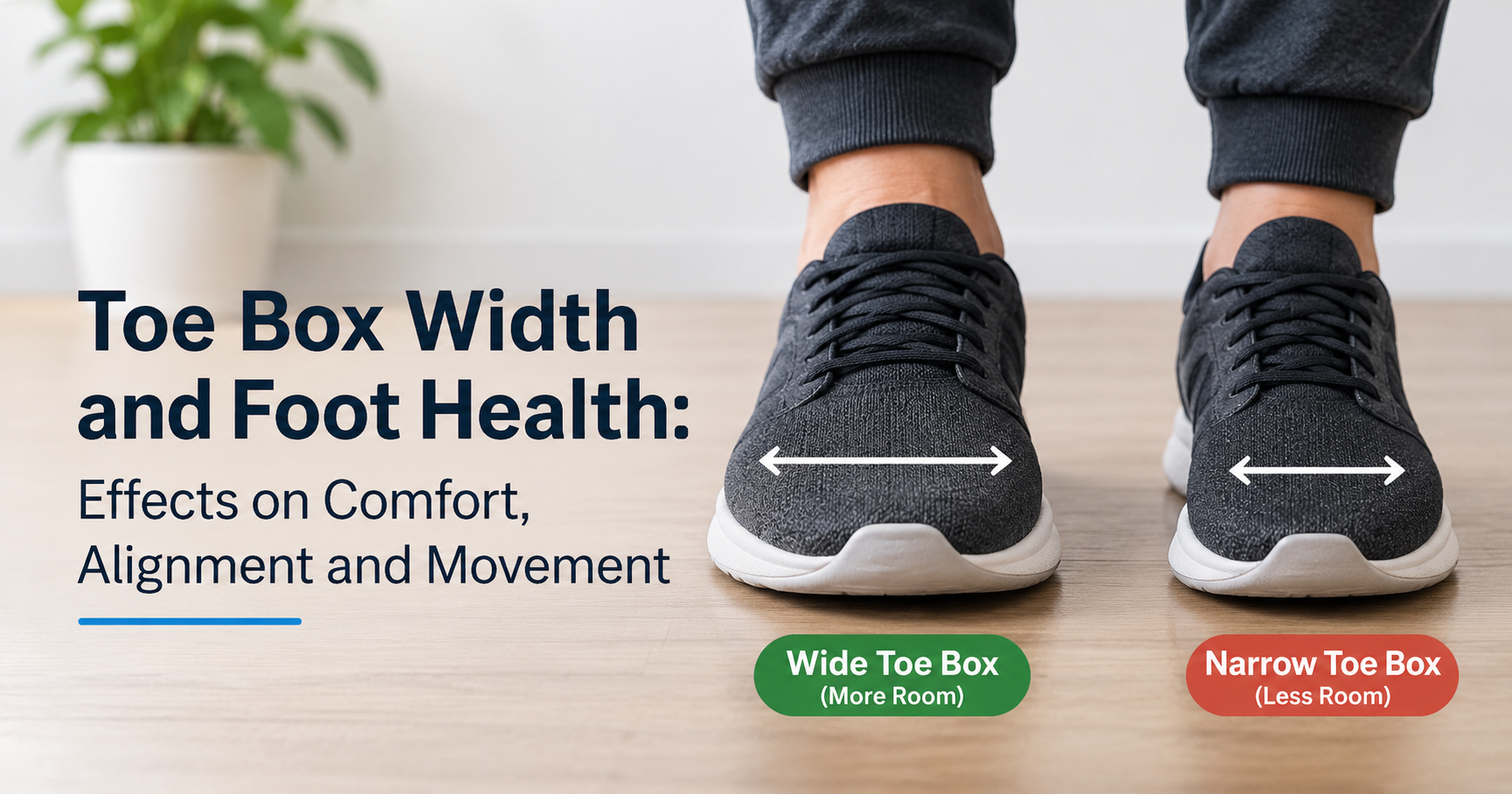
Most people choose shoes by length and style, and then wonder why their feet ache by the end of the day. One factor is easy to overlook: the width and shape of the space around your toes. This space is called the toe box, and it has a bigger effect on foot health than many people realize.
In this guide you will learn what a toe box is, how your feet are designed to work, which foot problems are linked to narrow shoes, how to test and measure your own feet, and how to choose footwear that gives your toes room to do their job.
What Is a Toe Box, and Why Does Its Width Matter?
The toe box is the front section of a shoe that surrounds your toes. Its width, height and shape decide whether your toes can lie flat and spread out, or whether they are pressed together and pushed upward.
Width matters because the front of your foot is not shaped like the front of most shoes. In many feet, the toes are the widest part of the forefoot, with the big toe pointing straight ahead. A large number of everyday shoes do the opposite. They narrow toward a point, which forces the toes into a shape they would never take on their own. Wearing that shape for hours every day, for years, adds up.
How Your Feet Are Designed to Work
Each foot contains 26 bones, many joints and a network of muscles and tendons. The toes are not just passengers at the end of the foot. They help you balance, push off the ground and absorb shock every time you take a step.
To do this well, the toes need space. When you stand, your toes spread slightly and grip the ground. The big toe in particular acts as a stable anchor during walking and running. If it is angled inward by a tapered shoe, it cannot push off as efficiently, and the joint at its base carries uneven stress.
Wide Fit vs. Wide Toe Box: They Are Not the Same Thing
This is a common point of confusion. A shoe sold as “wide fit” is made with a larger measurement across the ball of the foot, but its toe area may still taper. A shoe with a wide toe box is shaped so the front stays broad and rounded, giving the toes room to spread, even if the rest of the shoe is a standard width.
Many people with bunions or wide forefeet buy wide-fit shoes and still feel squeezed, because the shape at the toes has not changed. When you shop, look at the outline of the front of the shoe, not only the width label.
Foot Problems Linked to Narrow Toe Boxes
Shoes are rarely the only cause of foot problems. Genetics, foot structure, injury, age, body weight and medical conditions all play a role. Still, long-term pressure from tight, tapered footwear is widely recognized as a contributing factor to several common complaints.
1. Bunions
A bunion is a bony bump at the base of the big toe, where the toe angles toward the second toe. Narrow shoes do not automatically cause bunions, but they can make an existing tendency worse and make the bump more painful by pressing on it all day.
2. Ingrown Toenails
When the sides of the toe box press inward on the big toe, the nail edge can be pushed into the skin. This leads to redness, swelling and sharp pain, and it can become infected.
3. Hammertoes and Claw Toes
If a shoe is too short or too shallow, the toes are forced to bend. Over time the muscles and tendons can adapt to that curled position, and the toe stays bent even when the shoe is off.
4. Corns and Calluses
Repeated rubbing on the tops, tips and sides of the toes causes the skin to thicken as protection. These patches can become hard, painful and sometimes cracked.
5. Nerve Irritation Between the Toes
Squeezing the front of the foot from the sides can compress the small nerves that run between the long bones of the forefoot. This may cause burning, tingling or a feeling like standing on a pebble. A common form of this problem is known as Morton’s neuroma.
6. Weaker Toes and Poorer Balance
Toes that are always held in place by a rigid, tapered shoe get little chance to move, spread and grip. Reduced toe movement is associated with weaker foot muscles, and strong, mobile toes are important for steady balance, especially as we age.
Signs Your Toe Box Is Too Narrow
You do not need a diagnosis to notice that your shoes are working against you. Watch for these signs:
- Your toes feel squeezed together or overlap when the shoes are laced.
- You get numbness, tingling or burning in the front of the foot after walking.
- Red marks or indentations appear on the sides of your feet or toes when you take your shoes off.
- Your toenails turn dark, become sore or lift after a long walk or run.
- You get blisters or corns in the same spots again and again.
- You feel relief the moment you take your shoes off and wiggle your toes.
- The upper of the shoe bulges outward at the sides, usually near the big toe or little toe.
The Insole Outline Test You Can Do at Home
This simple test takes about two minutes and works for any pair of shoes you already own.
- Stand on a sheet of paper and trace around your foot, keeping the pencil upright so the line follows the true edge of your foot.
- Take the removable insole out of the shoe and place it on top of your tracing.
- Check the edges. If your foot outline extends beyond the insole anywhere, especially around the big toe or little toe, the shoe is narrower than your foot.
Remember that your foot spreads and flattens slightly when you stand and put weight on it, which is why you should trace it while standing.
How to Measure Your Feet Properly
Many people have not measured their feet since childhood. Feet can change in length and width with age, pregnancy, weight changes and years of activity. A careful measurement gives you a better starting point.
- Measure later in the day. Feet swell a little through the day, so late afternoon or evening gives the most realistic size.
- Stand with your weight on both feet. Trace each foot separately, since it is common for one foot to be slightly larger.
- Measure length. Mark the longest toe and the back of the heel, then measure the distance between the two marks.
- Measure width. Find the widest part of the forefoot (the ball of the foot) and measure straight across. Also note the width across your toes, because this is the figure that matters most for toe box comfort.
- Use the larger foot. Always fit shoes to the bigger foot.
What to Look for When Choosing Shoes
Once you know your measurements, use this checklist to evaluate any pair of shoes, whether you are buying for walking, running, work or everyday wear.
Shape of the Toe Box
Look at the shoe from above. The widest part of the front should be near the toes, not the ball of the foot, and the tip should be rounded rather than pointed. A good test is to place the shoe sole-down next to your foot tracing. Your tracing should fit inside the outline of the sole with a little room to spare.
Length and Space in Front of the Toes
You want about a thumb’s width between the end of your longest toe and the end of the shoe when you stand. This allows your foot to move forward slightly when you walk, especially downhill, without hitting the front.
Height of the Toe Box
The toes also need vertical space. If your toenails touch the top of the shoe, or you see the upper pressing on the top of your toes, the toe box is too shallow, which is a particular problem for people with hammertoes.
Flexibility
Try bending the shoe at the forefoot. It should flex roughly where your toes bend. A very stiff shoe can limit natural toe movement, while a shoe that folds in the middle of the arch may not give enough support.
Secure Heel and Midfoot
A roomy toe box should not mean a loose shoe. If the heel slips or the foot slides forward, your toes will bang into the front. Choose a shoe that holds the heel and midfoot securely and use the lacing to adjust the fit across the top of the foot.
Materials and Seams
Soft, stretchy or breathable uppers are kinder to bunions and sensitive toe joints. Check the inside of the shoe for hard seams or stitching over the toe joints and the little toe.
Is It Possible for a Toe Box to Be Too Wide?
It is, if the rest of the shoe does not support the foot. A very wide shoe with a loose heel and a floppy upper can cause the foot to slide, creating friction and blisters. The goal is not extra space everywhere. It is space where your toes need it, with a secure hold around the heel and midfoot.
Switching to Wider Shoes: How to Make the Change Comfortably
If you have worn narrow shoes for many years, a sudden switch can feel strange. Your toes may not be used to spreading, and the muscles in your feet may be a little weak. A gradual approach works best.
- Start with short periods. Wear your new shoes for an hour or two at first, and then add time each day.
- Mix old and new. Alternate between shoes in the first couple of weeks, especially if you are active.
- Expect some adjustment. Mild muscle tiredness in the feet is normal, but sharp pain is not.
- Keep the heel secure. Use heel-lock lacing if your heel slips in a roomier shoe.
- Do not ignore pain. If discomfort continues for more than a few weeks, talk to a foot health professional.
Simple Foot Exercises to Support Healthy Toes
Shoes with a wider toe box give your toes room. Exercises help your feet use that room. These movements are gentle and can be done at home while sitting or standing.
- Toe spreading. Sit with your feet flat on the floor. Spread your toes as wide as you can without curling them, hold for five seconds, and relax. Repeat ten times.
- Big toe lifts. Keep your heel and the other four toes pressed down and lift only the big toe. Then do the reverse, lifting the four small toes while the big toe stays down. This is hard at first, and that is normal.
- Short foot exercise. Without curling your toes, try to draw the ball of the foot toward the heel so the arch lifts slightly. Hold for five seconds and repeat ten times.
- Towel scrunches. Place a small towel flat on the floor and use your toes to pull it toward you.
- Toe spacers. Some people find that soft silicone toe spacers worn for short periods at home help their toes feel more aligned. Start with a few minutes at a time and stop if they cause discomfort.
Who Benefits Most from a Wider Toe Box?
- Runners and walkers. Feet swell during long efforts, and toes need room to avoid blisters and black toenails.
- People who stand all day. Nurses, teachers, retail staff and factory workers spend many hours on their feet, so any pressure is repeated thousands of times.
- People with bunions or hammertoes. A roomier shape reduces pressure on sore spots, even if it does not reverse the shape of the toes.
- Older adults. Comfortable toes and good balance support safer walking.
- Children. Growing feet are flexible, and tight shoes during childhood can influence how the foot develops. Always leave room to grow and check the fit often.
- People with diabetes or poor circulation. Tight shoes can cause skin damage that goes unnoticed, so well-fitted, roomy footwear is especially important. Speak with a healthcare professional about suitable shoes.
When to See a Foot Health Professional
Better shoes can help, but they are not a cure for every foot problem. See a podiatrist, orthopedic specialist or your doctor if you notice any of the following:
- Pain that lasts for more than a few weeks even after changing footwear.
- Numbness, burning or tingling in the toes that keeps returning.
- A bunion or toe deformity that is getting worse or making it hard to walk.
- Signs of infection around a toenail, such as heat, swelling, redness or pus.
- Any foot wound, blister or sore if you have diabetes.
Frequently Asked Questions
Can wide toe box shoes fix a bunion?
Wider shoes cannot reverse a bunion that has already formed, because the change involves the bone and joint. They can, however, reduce pressure and pain, and they may help slow down further irritation. A foot specialist can advise you on other options.
How much room should I have in front of my toes?
About a thumb’s width, roughly 1 to 1.5 centimeters, between the longest toe and the end of the shoe while you are standing.
Are narrow shoes always bad for you?
Occasional wear of a dressy or pointed shoe for a few hours is unlikely to cause lasting harm for most people. The concern is long-term, daily wear of shoes that squeeze the toes, especially during walking, standing or exercise.
Do I need to size up to get a wider toe box?
Not always, and sizing up can lead to a shoe that is too long and loose at the heel. It is better to look for shoes designed with a broader, rounded toe area in your actual size.
How long does it take to get used to wider shoes?
Most people feel comfortable within a couple of weeks if they build up wear time gradually. If your feet have been in narrow shoes for many years, it may take a little longer for your toes and foot muscles to adapt.
Are barefoot-style shoes the same as wide toe box shoes?
Not exactly. Many minimalist shoes have a wide toe box, but a wide toe box is also available in shoes with cushioning, arch support and a more traditional build. You can choose the level of cushioning and support that suits you.
Final Thoughts
Your toes carry out a lot of important work with every step, and they do it best when they have room. A toe box that is wide, rounded and roomy enough lets your toes spread, helps your big toe stay straight and reduces pressure on the sensitive areas of your forefoot.
Start with simple steps: trace your feet, check the shoes you already own, and use the checklist above next time you shop. If you have pain or a changing foot shape, ask a foot health professional for personal advice. Small changes in footwear can make a real difference to your comfort and long-term foot health.
Disclaimer: This article is for general information only and is not medical advice. If you have foot pain, a deformity, diabetes or any other health concern, please consult a qualified healthcare professional.