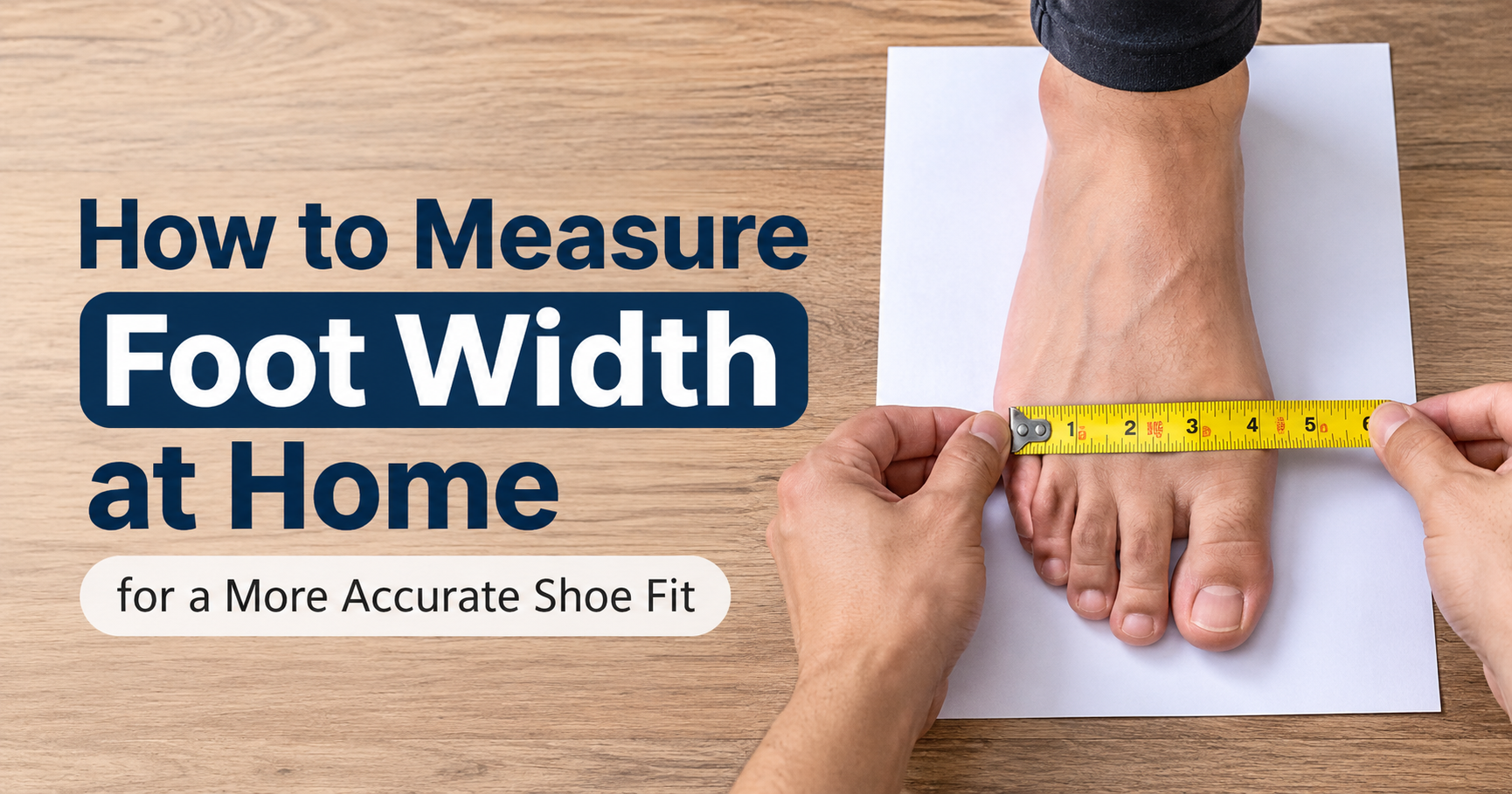
If your shoes pinch at the sides, leave red marks, or slide around at the heel, the problem may not be the length at all. It may be the width. Most people only know their shoe length, yet foot width decides whether a pair feels roomy and comfortable or tight and tiring by lunchtime.
The good news is that you don’t need a shoe store or a special device. Learning how to measure foot width at home takes about ten minutes, a sheet of paper, and a ruler. In this guide you’ll find five easy methods, a plain-English width chart, the most common mistakes to avoid, and tips for choosing shoes once you know your number.
Quick answer
Stand on a sheet of paper, trace around your foot, and mark the two widest points of the ball of your foot. Measure straight across between those marks with a ruler. Do this for both feet, use the larger measurement, and compare it with a shoe width chart for your size and gender.
Why foot width matters
Shoe length gets all the attention, but width is just as important. A shoe that is the right length and the wrong width will still hurt. When the forefoot is squeezed, you may notice:
- Pressure or burning at the ball of the foot
- Blisters or calluses on the sides of the big toe and little toe
- Toes that feel crowded, numb, or tingly
- Bunions or other bumps that rub against the shoe
On the other hand, a shoe that is too wide lets your foot slide sideways, which can cause blisters and make you grip with your toes. Knowing your real width helps you buy the right fit the first time and cuts down on returns, especially when you shop online.
What you need before you start
Gather a few simple items. Everything here is probably already in your home.

- A blank sheet of paper that is larger than your foot
- A pen or sharp pencil
- A ruler with centimetres or inches (a metal or hard plastic one is best)
- A soft measuring tape for the girth method (optional)
- A wall and a hard, flat floor so the paper doesn’t slip
Prepare your feet first
A few small habits make your measurement far more accurate:
- Measure in the evening. Feet swell during the day, so they are usually largest in the late afternoon or evening. Measuring then helps you avoid shoes that feel tight later on.
- Wear the socks you’ll wear with the shoes. Thin socks for dress shoes, thicker socks for boots or running shoes. For a baseline reading, go barefoot.
- Stand up. Your foot spreads out under body weight, so a seated measurement will read too narrow.
- Measure both feet. It is very common for one foot to be slightly larger than the other. Always fit the larger foot.
Method 1: The paper tracing method (most accurate at home)
This is the classic way to measure your foot width and length, and it works well for adults and older children.

- Place the paper on a hard floor. Put it against a wall so it can’t slide. A carpeted floor will give a less accurate result.
- Stand on the paper. Place one foot flat with your heel gently touching the wall. Keep your weight evenly distributed.
- Trace around your foot. Hold the pen straight up (not tilted under your foot) and follow the outline closely. Ask a friend to help if you can, since tracing your own foot while standing is awkward.
- Step off and find the widest points. Look at the ball of the foot, just behind the base of your toes. Mark the outermost point on the big-toe side and the outermost point on the little-toe side.
- Draw two straight lines. Use the ruler to draw one line from the heel to the tip of your longest toe (this is your length). Then draw a second line straight across between the two widest points (this is your width). The width line should sit at a right angle to the length line.
- Measure and record. Write down both numbers in centimetres or inches.
- Repeat with the other foot. Use the larger number for each measurement.
Pro tip
Trace each foot two or three times and average the results. Small wobbles in the pen can shift the outline by a few millimetres, and that is enough to change your width category.
Method 2: The two-books method (no tracing needed)
If you don’t want to trace, this quick method works with objects you already own.
- Stand barefoot on a flat floor with your feet at a comfortable, natural width.
- Slide one hardcover book (or a box) up against the outer side of your foot at the widest point, and another against the inner side.
- Step out carefully without moving the books.
- Measure the gap between them with a ruler. That gap is your foot width.
This method is fast, but it relies on you placing the books exactly at the widest point, so it can be a little less precise than tracing.
Method 3: The measuring tape (girth) method
Some brands, especially for boots, sandals, and sports footwear, use the girth of the foot instead of the straight-across width. Girth is the distance around the ball of the foot.

- Sit with your foot flat on the floor, or stand if you can reach comfortably.
- Wrap the soft tape around the ball of your foot, passing over the same two widest points you would use for the tracing method.
- Keep the tape snug and flat, but don’t squeeze.
- Read the number where the tape meets its starting end.
Remember that girth is not the same number as width. Girth is always larger because it measures all the way around. Only compare it with charts that clearly say they use girth.
Method 4: The smartphone photo method
If you have a smartphone and a bank card, you can get a surprisingly good estimate.
- Place a sheet of plain paper on the floor and stand on it, with a standard bank or ID card lying flat next to your foot. These cards are about 85.6 mm wide, which gives you a reliable reference size.
- Hold your phone directly above your foot, pointing straight down, and take a clear photo.
- On a computer or in a photo editor, compare the distance across the widest part of your foot with the width of the card, then convert to millimetres.
Camera angle makes a big difference here. If the phone is tilted, the measurement will be off, so treat this method as a rough check rather than your final answer.
Method 5: A foot measuring device or in-store scan
If you want to double-check your home result, many shoe stores have a sliding foot-measuring device that reads length and width at once. Some stores also use 3D foot scanners. It takes only a minute and is a great way to confirm what you measured at home, especially if you are buying expensive shoes or have a foot condition.
How to read your result: what is a narrow, standard, or wide foot?
Once you have your width in millimetres or inches, compare it to a size chart. Width is described by categories, and the right category depends on both your shoe length and whether you buy men’s or women’s shoes.

Shoe width letters explained
In the US system, width is shown as a letter after the size, for example 9D or 8B. The same letter means different things for men and women, which causes a lot of confusion.
| Width category | Women’s letter | Men’s letter |
|---|---|---|
| Narrow | A (or 2A for very narrow) | B |
| Standard / medium | B | D |
| Wide | D | 2E |
| Extra wide | 2E | 4E |
| Extra-extra wide | 4E | 6E |
As a rule of thumb, each step from one letter to the next adds roughly 3/16 of an inch (about 5 mm) of width across the ball of the foot. Note that a men’s D is a standard width, while a women’s D is a wide width.
Example widths in millimetres
Width in millimetres increases as shoe length increases, so a size 6 and a size 9 have different measurements for the same letter. The examples below come from one popular brand’s published size guide. Other brands may differ by a few millimetres, so always check the chart for the exact brand you plan to buy.
| Size | Narrow | Standard | Wide | Extra wide |
|---|---|---|---|---|
| Men’s US 6 | 93 mm (B) | 97 mm (D) | 101 mm (2E) | 104 mm (4E) |
| Men’s US 9 | 100 mm (B) | 104 mm (D) | 107 mm (2E) | 110 mm (4E) |
| Women’s US 6 | 80 mm (2A) | 84 mm (B) | 87 mm (D) | 90 mm (2E) |
To use a chart, find your shoe size, then look across the row for the width closest to your measurement. If your result falls between two categories, choose the wider one. A little extra room is much easier to live with than a tight fit.
Signs you may have wide feet
Your measurements are the best guide, but these everyday clues can also point to a wider foot:
- Your shoes feel comfortable in length but tight across the sides
- The upper material bulges over the sole
- You go up a size, but the shoe is then too long and your heel slips
- Your little toe or big toe joint gets sore or rubbed
- You often choose sandals or stretchy shoes because closed shoes feel restrictive
Common mistakes to avoid
- Measuring while sitting. Your foot spreads when you put weight on it.
- Tracing with a tilted pen. Angling the pen under your foot makes the outline too small.
- Measuring at the wrong spot. The width must be taken at the widest part of the ball, not at the toes or the arch.
- Measuring only one foot. Always check both and fit the larger one.
- Mixing up width and girth. They are different measurements and use different charts.
- Using a men’s chart for a women’s shoe (or the other way round). The letters mean different things.
- Measuring once and forgetting. Feet can change over time, so remeasure every year or two.
How to choose shoes once you know your width
With your width and length in hand, shopping becomes much easier. Keep these points in mind:
For wide feet
- Look for brands that offer the same shoe in several widths, such as standard, wide, and extra wide.
- Choose a roomy, rounded toe box instead of a pointed one.
- Soft, stretchy uppers (like knit or flexible mesh) give more forgiveness than stiff leather.
- Removable insoles let you swap in a thinner insole or an orthotic to adjust the volume.
- Adjustable closures such as laces or straps help you fine-tune the fit.
For narrow feet
- Look for shoes with a snug midfoot and a secure heel cup.
- Choose laces or straps that can be tightened properly.
- Thicker socks or a cushioned insole can help reduce extra space.
Useful accessories
- Shoe stretchers can add a little room to leather shoes that are slightly tight.
- Cushioned insoles or orthotic inserts can improve comfort and support, particularly if you stand for long periods.
- Toe spacers and bunion pads may reduce rubbing for people with sensitive forefeet.
Measuring children’s feet
Children’s feet grow quickly, so it’s worth checking every two to three months for young children. Use the same tracing method, and ask the child to stand still with weight evenly on both feet. Leave a little growing room in the length, but don’t assume that a bigger size will fix a width problem. If a shoe is too narrow, a longer shoe in the same width will still pinch.
Frequently asked questions
Is foot width the same as shoe width?
Not exactly. Foot width is the measurement of your actual foot across the ball. Shoe width is the category a brand assigns to a shoe, such as B, D, or 2E. You use your foot width to choose the right shoe width.
Where is the widest part of the foot?
For most people it is the ball of the foot, which sits just behind the base of the toes. It runs from the joint at the base of the big toe to the joint at the base of the little toe.
Can foot width change over time?
Yes. Age, weight changes, pregnancy, swelling, long periods of standing, and certain medical conditions can all make feet wider or flatter. That’s why it’s a good idea to remeasure every year or so.
Should I measure in the morning or evening?
The evening is better. Feet swell slightly through the day, so measuring later gives you a more realistic size for all-day comfort.
Do I need wide shoes if my feet are only slightly wider than average?
Not always. A small difference might be solved with a different style, a stretchier material, or a roomier toe box. If shoes often feel tight even when the length is right, a wide size is worth trying.
What if my two feet are different widths?
This is very common. Buy for the wider foot, and use an insole or thicker sock on the narrower foot if needed.
What if my width falls between two sizes?
Choose the wider option. You can always add a thin insole to take up extra room, but you can’t easily make a tight shoe bigger.
When to see a professional
If you have persistent foot pain, swelling, numbness, bunions, or you live with diabetes or circulation problems, talk to a podiatrist or another healthcare professional before choosing footwear. Home measurements are a helpful starting point, but they cannot replace medical advice.
Final thoughts
Learning how to measure foot width at home is one of the simplest ways to improve comfort and avoid wasted money on shoes that don’t fit. All it takes is a piece of paper, a ruler, and a few careful minutes. Measure both feet in the evening, stand while you do it, mark the widest points of the ball of the foot, and compare your result with a size chart for your gender and size.
Once you know your width, you can shop with confidence, whether you’re buying running shoes, work boots, sandals, or everyday sneakers. Write your measurements down, keep them on your phone, and recheck them every year or two. Your feet will thank you.