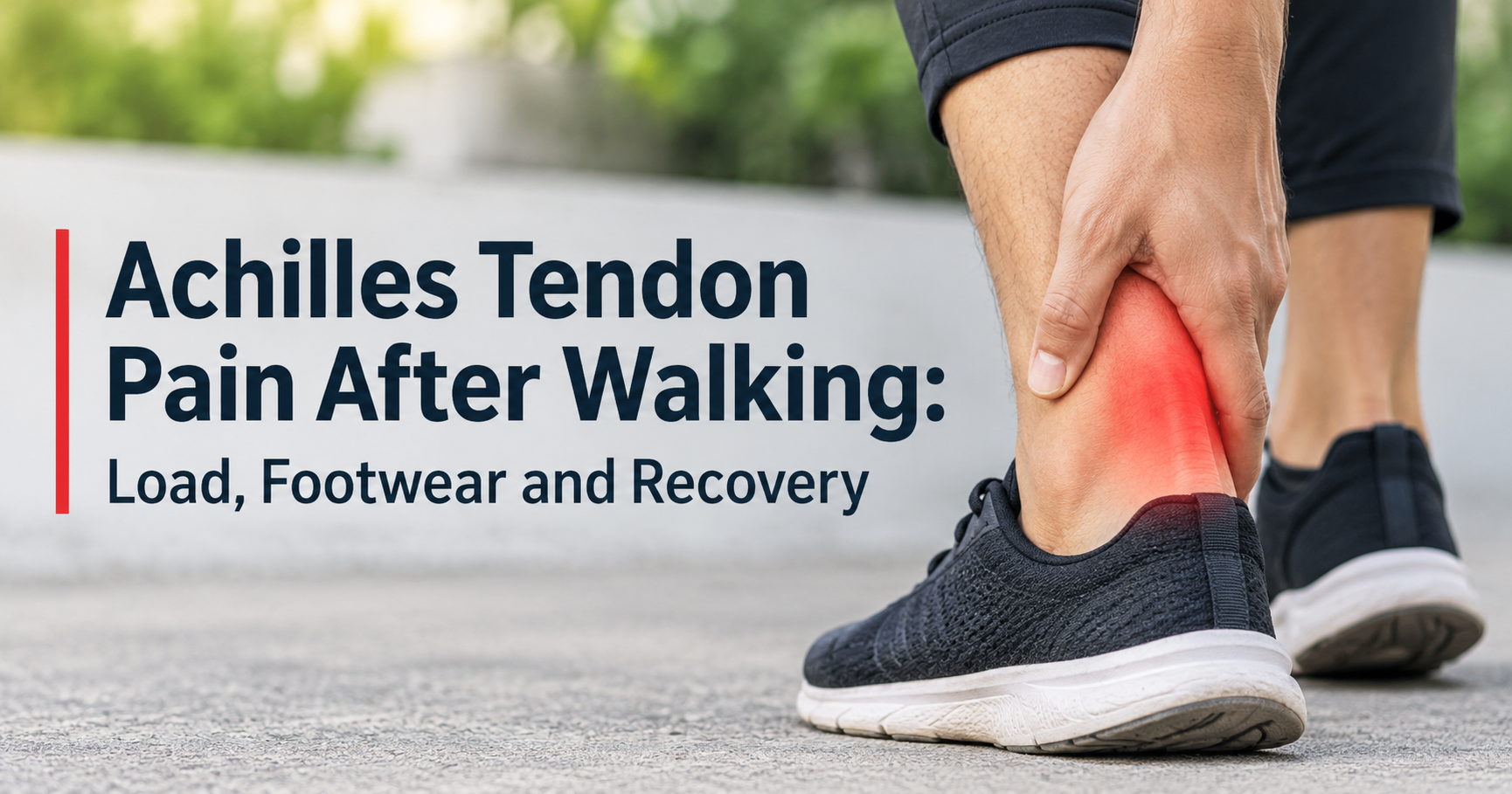
You finish a walk that felt perfectly fine, and an hour later the back of your ankle starts to ache. Maybe it is a dull tightness when you step out of bed the next morning. Maybe it is a sharp, hot spot just above your heel. Either way, Achilles tendon pain after walking is one of the most common reasons active adults cut their walks short, and it is a problem that tends to get worse when it is ignored.
The good news is that most cases respond very well to the right mix of load management, simple exercises and better footwear. This guide explains what is happening inside the tendon, the most common causes, the warning signs that need a doctor, and a practical step-by-step plan to get you walking comfortably again.
- Pain after walking usually points to an overloaded tendon (tendinopathy), not a sudden injury.
- Sudden increases in distance, tight calves and unsupportive shoes are the three biggest triggers.
- Slow, controlled calf strengthening is the most evidence-supported long-term fix.
- A sudden pop, severe weakness or calf swelling needs urgent medical attention.
- Most people improve over 6 to 12 weeks with consistent care.
What Is the Achilles Tendon and What Does It Do?
The Achilles tendon is the thick cord that connects your two main calf muscles, the gastrocnemius and the soleus, to your heel bone. Every time you push off the ground to take a step, this tendon stores and releases energy like a spring. It is the strongest tendon in the body, yet it also has a relatively limited blood supply, which is one reason it can be slow to heal when irritated.
During a normal walk, the tendon handles a load of roughly two to three times your body weight with each step. Over a long walk, that adds up to thousands of repetitions. When the load is greater than the tendon has been trained to handle, tiny areas of strain and irritation can build up faster than the tendon can repair them.
Why Does My Achilles Tendon Hurt After Walking?
Pain that shows up after activity, rather than during it, is a classic pattern of Achilles tendinopathy. This is a term for tendon irritation and structural change caused by overload. Many people still call it tendinitis, but current understanding is that it is less about pure inflammation and more about the tendon struggling to cope with the demands placed on it.
It generally appears in two forms:
- Midportion tendinopathy: pain and often a small, thickened lump in the middle of the tendon, roughly 2 to 6 centimeters above the heel bone.
- Insertional tendinopathy: pain right where the tendon attaches to the back of the heel. This type is often tied to tight shoes, a bony bump on the heel, or too much stretching of the tendon over the heel edge.
Typical symptoms
- A dull ache, burning or tightness at the back of the ankle or heel after a walk
- Morning stiffness that eases after a few minutes of moving around
- Tenderness when you pinch the tendon between your thumb and finger
- Mild swelling or a thickened area along the tendon
- Pain that increases with hills, stairs or brisk walking
- A creaky or crackling feeling when you move the ankle
Common Causes of Achilles Tendon Pain After Walking
Rarely is there just one cause. Most cases come from several factors stacking up at the same time.
1. Doing too much, too soon
This is the number one trigger. A new walking routine, a holiday with long days on foot, or a jump from 3 kilometers to 8 can overwhelm a tendon that has not had time to adapt. Tendons strengthen slowly, much more slowly than muscles, so they need gradual progression.
2. Tight or weak calf muscles
When your calf muscles are stiff or lack endurance, the Achilles tendon takes on more of the work. Weak calves also fatigue earlier in a walk, so the tendon absorbs forces the muscle should have handled.
3. Unsuitable or worn-out footwear
Shoes with very flat soles, no heel cushioning or a soft, collapsing heel cup can increase strain on the tendon. Worn-out shoes lose support long before they look old. Stiff heel tabs that rub on the tendon can also cause irritation on their own.
4. Hills, stairs and hard surfaces
Walking uphill and climbing stairs force the ankle through a bigger range of motion, which stretches the tendon further. Long distances on concrete add repeated impact on top.
5. Foot mechanics
Flat feet, high arches and overpronation (the foot rolling inward) can change how force travels through the tendon. Some people notice the heel tilting inward at the end of each step.
6. Age and health factors
Tendons gradually lose elasticity with age, and the problem is most common in adults in their 30s to 60s. Certain health conditions and medicines also raise the risk, including fluoroquinolone antibiotics, long-term corticosteroid use, diabetes, high cholesterol and inflammatory conditions. If you take any of these and develop tendon pain, tell your doctor promptly.
Other Conditions That Can Feel Similar
Not every pain at the back of the heel is tendinopathy. Knowing the difference helps you choose the right next step.
| Condition | Where it hurts | Clue that points to it |
|---|---|---|
| Midportion tendinopathy | Middle of the tendon | Thickened, tender spot; stiff first steps |
| Insertional tendinopathy | Where tendon meets heel | Pain worsens with tight shoes or uphill walking |
| Retrocalcaneal bursitis | Just in front of the tendon, near the heel | Swelling on both sides of the heel, pain when the area is squeezed |
| Haglund’s deformity | Back of the heel | A visible bony bump that rubs on shoes |
| Partial tendon tear | Anywhere along the tendon | Sudden sharp pain, noticeable weakness |
| Plantar fasciitis | Underside of the heel | Stabbing pain with the first steps of the day |
When to See a Doctor Right Away
- A sudden “pop” or a feeling of being kicked in the back of the leg
- Inability to rise onto your toes or push off when walking
- Significant swelling, bruising or a visible gap in the tendon
- Calf pain with swelling, warmth or redness in one leg (this can signal a blood clot)
- Pain that wakes you at night or does not improve after two weeks of home care
- Pain that started shortly after taking a fluoroquinolone antibiotic
A clinician or physiotherapist can examine the tendon, confirm the diagnosis and, when needed, order an ultrasound or MRI. Early assessment makes recovery faster and reduces the chance of a rupture.
How to Ease Achilles Tendon Pain at Home
These steps are for mild to moderate pain without any of the warning signs above.
- Adjust, don’t stop completely. Reduce walking distance, pace and hills to a level that keeps pain mild (about 3 out of 10 or less) and settles within 24 hours. Complete rest tends to leave the tendon weaker.
- Use a cold pack for comfort. Ten to fifteen minutes wrapped in a thin cloth can help calm soreness after activity.
- Add a small heel lift. Placing a soft heel raise inside both shoes shortens the calf slightly and reduces tension on the tendon while it settles. Use it short term.
- Choose supportive footwear. Avoid walking barefoot or in flat sandals on hard floors while it is sore.
- Be gentle with stretching. Light calf stretching can feel good for midportion pain. For pain at the heel attachment, avoid stretching with the heel hanging over a step, because it can compress the sore area.
- Don’t massage hard into the painful spot. Work the calf muscle instead of the tendon itself.
- Use over-the-counter pain relief carefully. If you choose to use any, follow the label and ask a pharmacist whether it is suitable for you.
The Most Effective Exercises for Achilles Pain
Research on tendinopathy consistently supports progressive loading, which means slowly training the calf and tendon to handle more. Start gently and build over several weeks.
Step 1: Isometric calf holds (for early, sore tendons)
Stand with both feet flat, rise onto your toes to a comfortable height and hold for 30 to 45 seconds. Repeat 4 to 5 times. Isometrics are often easier to tolerate when pain is high.
Step 2: Eccentric heel drops
This is the best-known exercise for midportion Achilles pain. Rise onto both toes, shift your weight to the painful leg, then lower the heel slowly over about three seconds. Use the other leg to help you back up. Aim for 3 sets of 15 repetitions once or twice a day.
If your pain is at the very bottom of the tendon, do heel drops on flat ground rather than off the edge of a step. Dropping below the step can aggravate insertional tendinopathy.
Step 3: Slow calf raises with added weight
Once heel drops feel easy, perform raises with a backpack or light dumbbells. Move for three seconds up and three seconds down. Bent-knee versions target the soleus, which also matters for walking.
Step 4: Supporting exercises
- Single-leg balance to improve ankle control
- Hip and glute strengthening, such as bridges and side-lying leg lifts
- Foam rolling the calf muscle (not the tendon) for a few minutes
What Recovery Usually Looks Like
Tendons respond to steady, consistent loading rather than quick fixes. Many people notice improvement within 3 to 6 weeks, but full recovery often takes around 12 weeks, and sometimes longer when symptoms have been present for months.
Choosing the Right Walking Shoes and Gear
The right equipment will not fix a tendon on its own, but it removes unnecessary stress while you heal and helps prevent a relapse. Here is what to look for in each category.
Walking shoes
- Firm heel counter: The back of the shoe should resist squeezing, which keeps the heel stable.
- Moderate heel-to-toe drop: A drop of around 8 to 12 millimeters reduces tension on the tendon compared with very flat shoes.
- Cushioned midsole: Responsive foam absorbs impact on pavement.
- Soft padding around the heel collar: Avoid hard edges that dig into the tendon.
- Slight rocker sole: A curved sole helps the foot roll forward with less ankle effort.
- Room in the toe box: Cramped toes can change how you push off.
Heel lifts and wedges
Soft gel or foam heel lifts raise the heel by a few millimeters and are a cheap, low-risk way to offload the tendon in the short term. Choose a pair that stays in place and fits both shoes evenly.
Supportive insoles and orthotics
If you have flat feet or your heel rolls inward, arch-supporting insoles may improve alignment. For persistent problems, a podiatrist can recommend custom options.
Compression sleeves
Calf and ankle compression sleeves provide warmth and a feeling of support during walks. They will not cure tendinopathy, but many people find them comfortable on longer days.
Recovery tools
- Resistance bands: useful for ankle strengthening and warm-ups
- Foam roller or massage ball: for calf muscle release
- Reusable cold packs: handy after longer walks
- Adjustable ankle weight or a small backpack: to progress calf raises safely
Some product types mentioned here may be available through affiliate partnerships, which means a small commission may be earned at no extra cost to you. Our recommendations are based on the features that matter for tendon comfort.
How to Prevent Achilles Pain When Walking
- Increase gradually. Add no more than about 10% to your weekly walking time or distance.
- Warm up first. Five minutes of easy walking and ankle circles prepares the tendon.
- Strengthen your calves twice a week. Heel drops and calf raises build tendon capacity.
- Replace worn shoes. Many walking and running shoes lose cushioning after roughly 300 to 500 miles.
- Vary your surfaces. Mix paths, tracks and grass with pavement.
- Take hills carefully. Shorten your stride and slow your pace on steep slopes.
- Cross-train. Swimming, cycling and strength work give your tendons a break.
- Cool down and stretch gently. Finish with a light calf stretch.
- Manage body weight. Less body weight means less load on the tendon with every step.
Frequently Asked Questions
Is it okay to keep walking with Achilles tendon pain?
In most mild cases, yes, as long as the pain stays low and settles within a day. Shorter, flatter walks are usually better than complete rest. Stop and seek advice if pain is sharp or you notice weakness.
Should I use ice or heat?
Ice can ease soreness after walking, while gentle warmth before activity can reduce stiffness. Neither one treats the underlying cause, so use whichever feels better and focus on gradual strengthening.
How long does Achilles tendon pain take to heal?
Mild, recent cases may settle in a few weeks. Long-standing tendinopathy often needs 3 months or more of consistent exercise.
Why is it worse in the morning?
The tendon tightens while you sleep with your foot pointed down. The first steps load it suddenly, which causes stiffness that usually eases after a few minutes.
Can the wrong shoes cause Achilles pain?
Yes. Flat, unsupportive or worn shoes, as well as shoes with hard heel tabs, can contribute to irritation or make existing pain last longer.
Will Achilles tendon pain go away on its own?
Sometimes mild irritation fades once the cause is removed, but without addressing training load and calf strength, it often returns. A structured plan gives the best results.
Final Thoughts
Achilles tendon pain after walking is a signal that the tendon is being asked to do more than it can currently handle. It does not mean your walking days are over. By trimming the load temporarily, strengthening your calves, wearing supportive shoes and progressing slowly, most people get back to comfortable walks. Be patient, stay consistent, and see a healthcare professional if your symptoms are severe or not improving.
This article is for general information only and is not a substitute for professional medical advice, diagnosis or treatment. Always seek the advice of a qualified health provider with any questions about a medical condition.