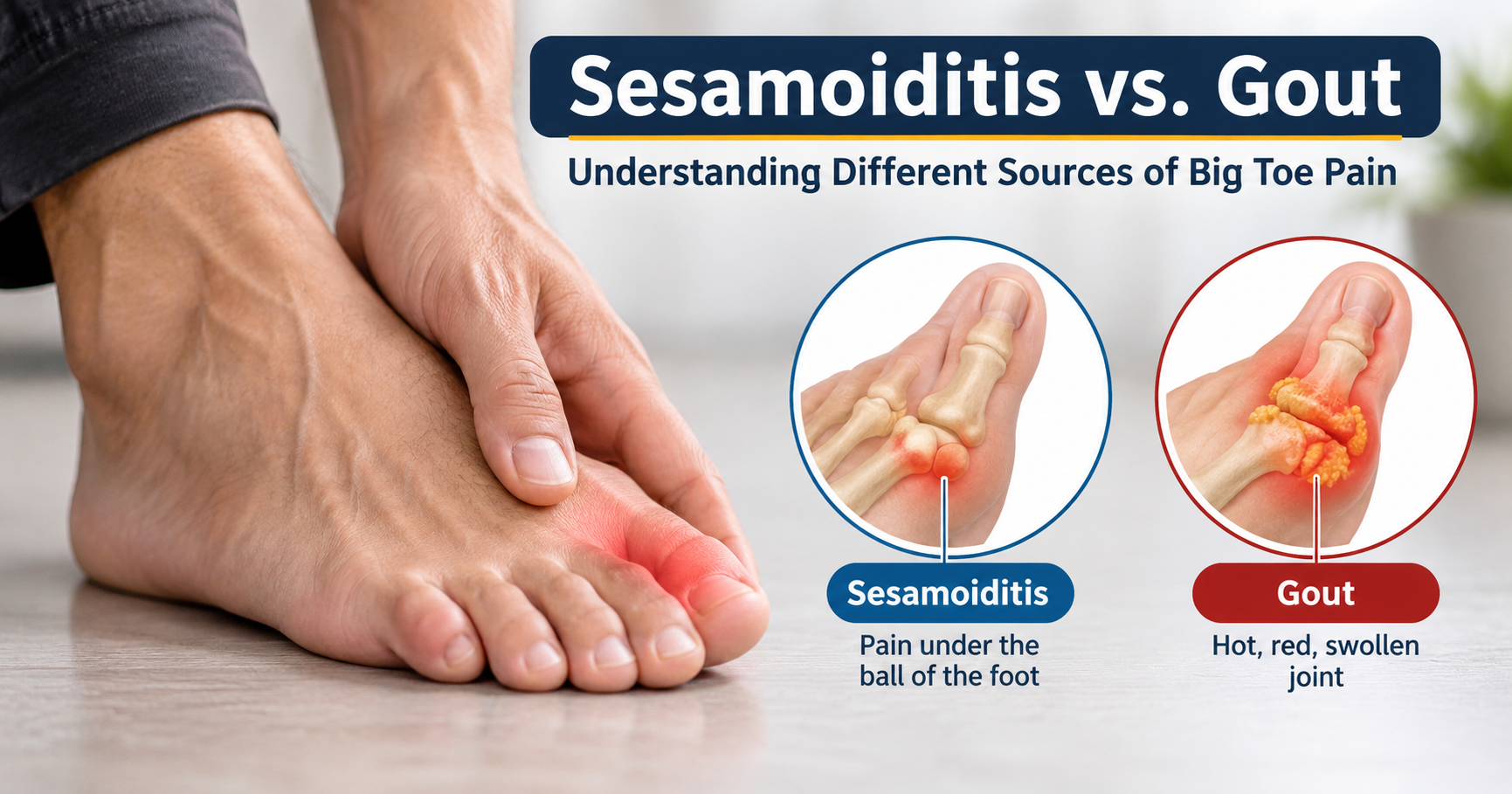
A sharp, throbbing pain at the base of the big toe can turn every step into a negotiation. It can also wake you at night, make shoes unbearable and leave you wondering what is going on. Two of the most common explanations are sesamoiditis and gout. They can feel surprisingly similar at first, because both can cause pain, swelling and tenderness near the big toe joint. Yet they have different causes, different warning signs and very different treatments.
This guide explains how to tell sesamoiditis vs gout in the big toe, what each condition is, how doctors confirm the diagnosis, what helps at home, and how footwear can make a real difference. It is written for educational purposes, so you can have a clearer conversation with your doctor or podiatrist.
Quick Answer: The Main Differences
- Sesamoiditis is an overuse inflammation of two tiny bones under the big toe joint. The pain sits under the ball of the foot, builds gradually and gets worse with push-off, pressure and walking.
- Gout is an inflammatory arthritis caused by uric acid crystals in the joint. The pain is usually sudden and severe, often starts at night, and the joint becomes red, hot and swollen. Even a bedsheet can feel unbearable.
- Only a clinician can confirm which one you have. A hot, red, swollen toe with fever or chills needs urgent medical care.
Why Sesamoiditis and Gout Get Confused
The big toe joint (the first metatarsophalangeal, or MTP joint) carries a huge share of your body weight every time you walk, run or climb stairs. When something goes wrong in this small area, the result is often the same: pain, swelling and trouble pushing off. Because both conditions affect the same neighborhood, people often assume that any big toe pain is gout. In reality, many cases of ball-of-foot pain behind the big toe are mechanical problems such as sesamoiditis.
To understand the difference, it helps to look at the anatomy first.
The Anatomy Behind the Pain
Under the head of your first metatarsal bone (the long bone that leads to the big toe) sit two small, pea-sized bones called sesamoids. They are embedded in a tendon and act like tiny pulleys. They absorb pressure when you push off the ground and help the big toe move smoothly. Unlike most bones, they are not connected to other bones. They float inside the tendon, which makes them easy to overload.
The big toe joint itself, just above and between these structures, is also the most common site for gout attacks. That is why the two conditions can seem like neighbors with very different personalities.
What Is Sesamoiditis?
Sesamoiditis is irritation and inflammation of the sesamoid bones and the tendons around them. It is considered an overuse injury. Repeated pressure on the ball of the foot gradually inflames the tissue, and the pain tends to grow over days or weeks rather than appear in a few hours.
Common causes and risk factors
- Repetitive forefoot loading: running, jumping sports, dancing, basketball, tennis and long hours on hard floors.
- High heels or thin-soled shoes: they push more weight onto the ball of the foot.
- High arches: a high-arched foot places more pressure on the forefoot.
- Sudden increases in activity: a rapid jump in training volume, a new sport or a long hike.
- Direct impact or injury: a hard landing or a stub can bruise or even fracture a sesamoid.
- Tight calf muscles and foot mechanics: these can shift extra load to the big toe.
Typical symptoms
- A dull or sharp ache under the big toe joint on the ball of the foot
- Pain that gets worse when you push off, bend the big toe upward or press on the spot
- Mild to moderate swelling, sometimes with slight bruising
- Pain that eases with rest and returns with activity
- Difficulty wearing flat, thin-soled shoes or going barefoot on hard floors
Significant redness and heat can occur, but they are usually less dramatic than in a gout flare.
What Is Gout in the Big Toe?
Gout is a form of inflammatory arthritis. It happens when too much uric acid builds up in the blood and forms sharp, needle-like crystals inside a joint. The immune system reacts strongly to these crystals, producing the sudden, intense inflammation that gout is known for. When gout affects the big toe joint, it is sometimes called podagra. The big toe is the first joint involved in a large share of first-time gout attacks.
Common triggers and risk factors
- High uric acid levels: caused by the body making too much or the kidneys clearing too little.
- Diet: red meat, organ meats, some seafood, sugary drinks sweetened with fructose, and especially beer and spirits.
- Medical factors: obesity, high blood pressure, diabetes, kidney disease and some heart conditions.
- Medications: some water pills (diuretics) and certain other drugs can raise uric acid.
- Dehydration, crash dieting or a sudden illness can also set off a flare.
- Genetics and sex: gout runs in families and is more common in men, although the risk rises in women after menopause.
Typical symptoms
- Sudden, severe pain that often begins at night or in the early morning
- A joint that looks red or purplish, feels hot and is visibly swollen, sometimes with shiny skin
- Extreme tenderness, where even light contact such as a sheet or sock hurts
- Pain that peaks within about 12 to 24 hours
- A flare that may last several days to around two weeks, then fades, only to return later
- Over time, repeat attacks may involve other joints, and chalky lumps called tophi can form under the skin
Where Does It Hurt? A Visual Guide
Location is one of the best clues. Sesamoiditis tends to hurt in a very specific spot on the sole, under the big toe joint. Gout involves the joint itself, so the swelling and redness tend to wrap around the top and sides of the toe.
Sesamoiditis vs Gout: Side-by-Side Comparison
| Feature | Sesamoiditis | Gout (big toe) |
|---|---|---|
| Underlying cause | Overuse and pressure inflaming the sesamoid bones and tendons | Uric acid crystals triggering joint inflammation |
| Onset | Gradual, over days to weeks | Sudden, often within hours, frequently at night |
| Pain location | Under the ball of the foot, behind the big toe | The whole big toe joint, especially top and sides |
| Appearance | Mild swelling, sometimes slight bruising; usually little redness | Marked redness, heat and swelling, shiny skin |
| Pain triggers | Walking, push-off, bending the toe, direct pressure | Can hurt at rest; even light touch is painful |
| Pain at rest or night | Usually eases with rest | Often severe at night |
| Duration | Weeks to months if the load continues | Days to about two weeks per flare, with recurrences |
| Who is affected | Runners, dancers, high-heel wearers, people with high arches | People with high uric acid, obesity, kidney disease, certain diets or medications |
| Key test | Exam and imaging (X-ray, MRI, bone scan) | Joint fluid analysis; blood uric acid; imaging |
| Main treatment focus | Offloading pressure, rest, supportive footwear | Calming the flare, then lowering uric acid long term |
How the Pain Pattern Differs Over Time
Another helpful clue is how the pain behaves over the first couple of weeks. Gout is dramatic and fast. Sesamoiditis is slower, quieter and strongly tied to how much you use your foot.
A very red, hot, swollen joint together with fever, chills or feeling generally unwell can be a joint infection (septic arthritis), which is a medical emergency. This can look just like gout. Seek urgent care instead of waiting it out.
Other Conditions That Can Mimic Both
Big toe pain has many possible causes, so it is worth knowing the other suspects a doctor will consider:
- Sesamoid fracture: a break in one of the sesamoids from a sudden injury or repeated stress. Pain is sharper and may start after a specific event.
- Hallux rigidus: arthritis of the big toe joint that causes stiffness, a bony bump on top and pain when bending the toe.
- Bunion (hallux valgus): the big toe drifts toward the second toe, and the joint becomes prominent and sore.
- Turf toe: a sprain of the ligaments around the big toe joint, often from athletic hyperextension.
- Pseudogout: a different crystal arthritis that can look much like gout.
- Cellulitis or septic arthritis: skin or joint infections that need prompt treatment.
- Nerve irritation or a stress fracture of a nearby bone.
It is also possible to have more than one problem at once, for example gout flares in a foot that already has sesamoid irritation.
A Simple Way to Think It Through
The chart below is not a diagnostic tool, but it shows the kind of questions a clinician will ask first.
How Doctors Diagnose Each Condition
Diagnosing sesamoiditis
- Physical exam: the doctor presses under the big toe joint, moves the toe and watches how you walk.
- X-rays: these help rule out a fracture, arthritis or a bone that has split into two parts (a bipartite sesamoid, which is a normal variation in some people).
- MRI or bone scan: used when the cause is unclear or the pain does not improve, because they can show inflammation, stress injury or damage to the cartilage.
Diagnosing gout
- Joint fluid test: the most reliable method. Fluid is drawn from the joint and checked under a microscope for urate crystals.
- Blood uric acid test: useful, but not perfect. Levels can be normal or even low during an attack, so a normal result does not rule gout out.
- Imaging: ultrasound or dual-energy CT can reveal crystal deposits, and X-rays may show joint damage in long-standing gout.
- Medical history: diet, alcohol, medications, kidney health and family history all matter.
Treatment Options for Sesamoiditis
Most cases improve with conservative care, although it can take several weeks, and sometimes longer, for the tissue to settle. Typical steps include:
- Relative rest: cut back on running, jumping and long periods on your feet while the area calms down. Swap in low-impact activities such as swimming or cycling if your clinician agrees.
- Offloading pads or insoles: a cushioned pad placed just behind the sesamoids (sometimes called a dancer’s pad), or an insole with a cut-out under the big toe joint, can reduce pressure.
- Supportive footwear: stiffer soles, cushioned forefoot and a mild rocker shape reduce bending at the big toe joint.
- Ice: cold packs wrapped in a cloth for short sessions can ease soreness after activity.
- Anti-inflammatory medication: short-term over-the-counter options may help some people, but they are not suitable for everyone, so check with a pharmacist or doctor first.
- Taping or strapping: limits upward bending of the big toe.
- Walking boot or immobilization: sometimes used for several weeks in stubborn or fracture cases.
- Injections or surgery: reserved for cases that do not improve with months of conservative treatment.
Treatment Options for Gout
Gout treatment has two goals: calm the current flare, and prevent future ones.
During a flare
- Prescription or doctor-recommended medication: commonly anti-inflammatory drugs, colchicine or short courses of corticosteroids. The right choice depends on your health, kidney function and other medicines.
- Rest and elevation: take weight off the foot and raise it when you can.
- Cold compresses: a cloth-wrapped ice pack may soothe the joint.
- Plenty of water: good hydration supports the kidneys in clearing uric acid.
Long-term prevention
- Urate-lowering therapy: if you have repeated attacks, your doctor may suggest daily medicine to bring uric acid down to a safe target and keep it there.
- Diet changes: limit alcohol (especially beer), sugary drinks and heavy portions of red or organ meat. Many people do well with more vegetables, whole grains, low-fat dairy and water.
- Healthy weight: gradual weight loss lowers uric acid. Crash diets can trigger flares.
- Review your medicines: never stop a prescribed drug on your own, but ask whether any of them may be affecting uric acid.
Footwear and Supports That Can Help
Shoes will not cure gout or heal a sesamoid injury by themselves, but they strongly affect comfort and recovery. Here is what to look for.
If you suspect sesamoiditis
- Cushioned forefoot: thick, shock-absorbing midsoles spread pressure away from the ball of the foot.
- Rocker-bottom or stiff-soled shoes: they reduce how much the big toe has to bend when you walk.
- Metatarsal or sesamoid-relief insoles and pads: designed to lift pressure off the painful spot.
- Low heels: avoid high heels and very thin, flat shoes while you recover.
- Roomy toe box: a wide toe area lets the toes sit naturally without squeezing the joint.
If you are dealing with gout
- Soft, stretchy uppers: they avoid rubbing on a swollen joint.
- Extra width and depth: room for swelling during a flare.
- Open-toe or loose options at home: useful when the toe is too tender for closed shoes.
- Good cushioning overall: reduces impact when you start walking again after a flare.
How to Reduce Your Risk
Preventing sesamoiditis
- Increase running or jumping activity gradually rather than all at once.
- Wear supportive, cushioned shoes for sport and daily life.
- Limit time in high heels, and alternate them with comfortable shoes.
- Stretch the calves and maintain strong foot and ankle muscles.
- Replace worn-out athletic shoes on schedule.
Preventing gout flares
- Drink enough water through the day.
- Limit alcohol, sugary soft drinks and high-purine foods.
- Keep a healthy weight and manage blood pressure, blood sugar and kidney health.
- Take any prescribed uric acid medicine consistently.
- Talk to your doctor if you start a new medication and notice more flares.
When to See a Doctor
Book an appointment if your big toe pain lasts more than a week or two, keeps returning, or interferes with walking. Get medical help quickly if:
- The joint is red, hot and swollen, especially with fever or chills
- The pain began suddenly and is severe, or this is your first suspected gout attack
- You cannot put weight on the foot after an injury
- You have diabetes, poor circulation or a weak immune system and notice any new foot swelling, wound or redness
- Home care and better shoes have not helped after a couple of weeks
A podiatrist, orthopedic foot specialist, rheumatologist or your primary care doctor can all help sort out the cause.
Frequently Asked Questions
Can sesamoiditis feel like gout?
It can, because both cause pain and swelling near the big toe. But gout usually has sudden, intense pain with obvious redness and heat, while sesamoiditis builds more gradually and hurts mainly under the ball of the foot when you walk or press on it.
Can I have sesamoiditis and gout at the same time?
Yes. They are separate conditions, so it is possible for a foot with mechanical overload to also experience a gout flare. A proper exam helps separate the two.
Does a normal uric acid blood test rule out gout?
No. Uric acid levels can be normal, or even lower than usual, during a flare. Doctors often rely on joint fluid analysis, imaging and your overall history.
How long does each condition last?
A gout flare often settles within several days to about two weeks, faster with proper treatment. Sesamoiditis can take weeks to months to calm down, especially if you keep loading the foot.
Is sesamoiditis serious?
Usually it is not dangerous, but it can become a long-term problem if ignored, and a sesamoid fracture can look similar at first. Persistent pain deserves an exam.
Should I keep walking on a painful big toe?
Short, gentle movement is often fine, but pushing through sharp pain tends to prolong recovery. Reduce impact, wear supportive footwear and see a professional if it does not settle.
What kind of doctor should I see?
A podiatrist or orthopedic foot specialist is a good starting point for suspected sesamoiditis. For recurrent or suspected gout, a primary care doctor or rheumatologist can guide testing and long-term care.
Final Thoughts
Sesamoiditis and gout can both hide under the label “big toe pain,” yet they behave very differently. Sesamoiditis is a mechanical, overuse problem that hurts under the ball of the foot and responds to offloading, rest and the right footwear. Gout is a crystal-driven inflammatory attack that arrives quickly, turns the joint red and hot, and needs medical treatment and long-term uric acid control. Paying attention to the timing, location and appearance of your pain gives you a strong head start. Pair that with a proper diagnosis, and you can choose the right treatment, protect your joints and get back to comfortable walking.