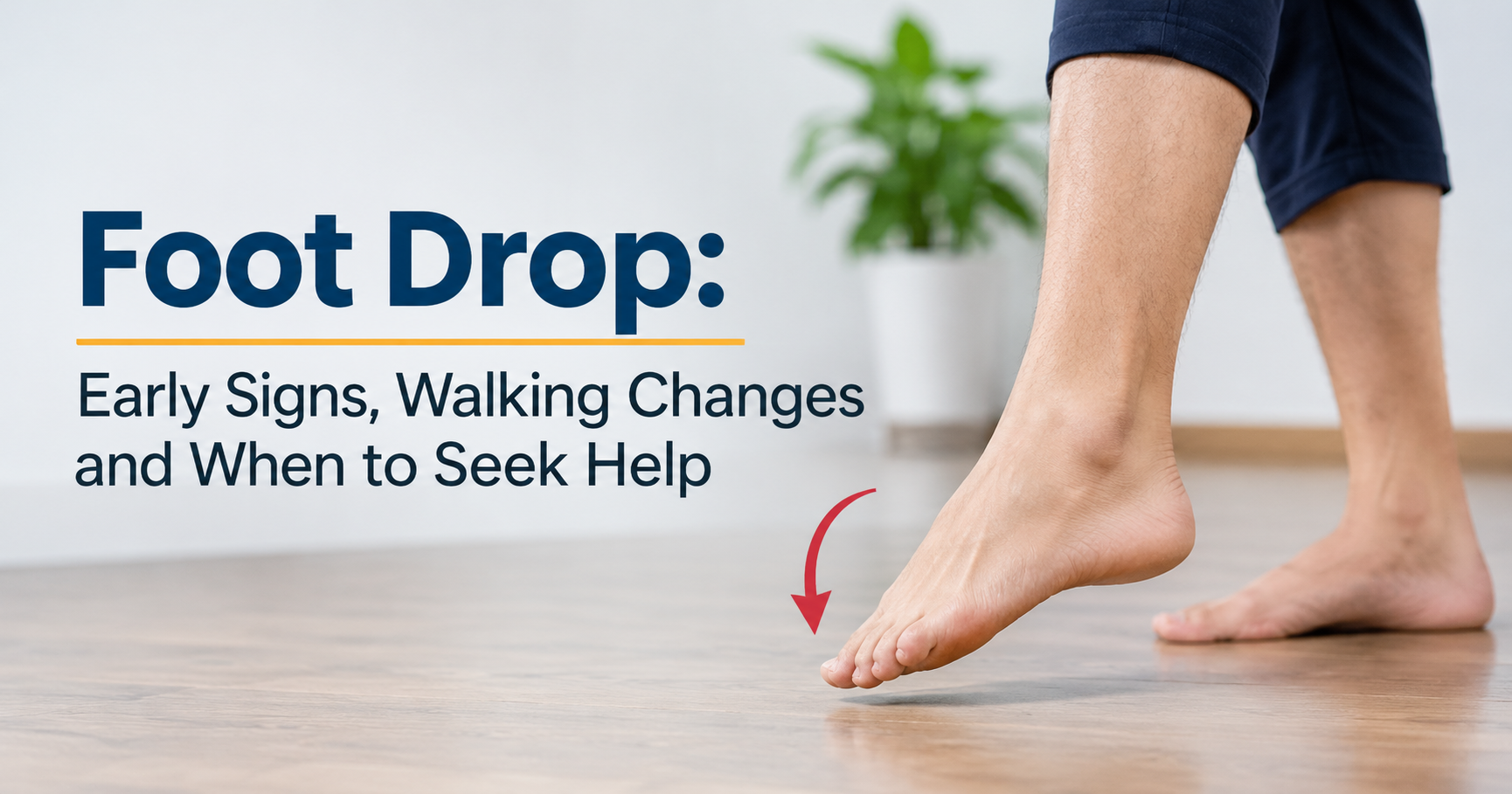
You catch your toes on the carpet. You trip over a flat pavement. Your shoe makes a slapping sound with every step. Many people brush these moments off as clumsiness or tiredness, but they can be the first signs of foot drop, a condition that makes it hard to lift the front part of the foot.
Spotting foot drop early symptoms matters because the cause is often treatable, and the sooner it is found, the better the chances of protecting the nerve and the muscle. This guide explains the early warning signs, what causes them, how to do simple self-checks, and when you should get medical help.
The earliest symptoms of foot drop are toes dragging or catching on the ground, frequent tripping, a high-stepping walk, a slapping sound as the foot lands, numbness or tingling on the top of the foot or shin, and weakness when lifting the foot or toes upward. Foot drop is a sign of an underlying problem, not a disease on its own, so it should always be checked by a doctor.
What Is Foot Drop?
Foot drop (also called drop foot) is difficulty lifting the front part of the foot and toes toward the shin. This movement is called dorsiflexion. When it is weak or lost, the toes point downward and can scrape along the ground as you walk.
It can affect one foot or both, and it can be temporary or permanent depending on the cause. Foot drop is not a disease itself. It is a symptom of a problem with the nerves, the muscles, or the brain and spinal cord that control the foot.
Foot Drop Early Symptoms: 10 Signs to Watch For
Early symptoms can be mild and easy to ignore. They often appear gradually, but in some cases, such as after an injury or a slipped disc, they can start suddenly. Here are the signs to look out for.
1. Toes dragging or catching on the ground
This is the classic early sign. As you swing your leg forward, the front of your foot does not lift enough, so your toes scuff the floor or catch on rugs, steps and uneven ground.
2. Frequent tripping or stumbling
If you trip over nothing more than a flat floor or a small kerb, and it keeps happening, the foot may not be clearing the ground. Tripping is also the main reason foot drop leads to falls.
3. A high-stepping walk
To avoid dragging the toes, many people unconsciously lift the knee higher than normal, like walking up an invisible staircase. Doctors call this a steppage gait. Family members often notice it before you do.
4. Foot slapping on the ground
Normally the heel lands first and the foot lowers gently. With weak ankle muscles, the foot falls quickly and slaps the floor, producing a clear “slap, slap” sound with each step.
5. Numbness or tingling
Many people feel numbness, pins and needles, or a burning sensation on the top of the foot, the outer shin or the area between the big toe and second toe. This suggests the nerve is irritated or compressed.
6. Weakness when lifting the foot or toes
You may find it difficult to pull your foot up toward your shin, to wiggle your toes upward, or to stand on your heels. The foot may feel heavy, like it is wearing a weight.
7. Pain in the lower back, hip, leg or shin
When foot drop comes from a pinched nerve in the spine, it is often preceded by back pain or pain shooting down the leg (sciatica). Pain at the outer knee or shin can point to compression of the peroneal nerve.
8. Swinging the leg out to the side
Some people swing the whole leg in a small outward arc (circumduction) to bring the foot forward without catching the toes. This can strain the hip and lower back over time.
9. Unusual wear on your shoes
Scuffed, worn-down toe caps or the outer front edge of one shoe are a quiet clue. Compare the wear on both shoes.
10. Muscle thinning at the front of the shin (later sign)
If the nerve problem continues, the muscles at the front of the lower leg can shrink and look flatter. This is a sign that the problem has been present for some time and deserves prompt attention.
One clumsy step does not mean you have foot drop. The pattern matters: symptoms that repeat, last more than a week or two, or are getting worse should be assessed by a doctor.
How the Foot-Lifting Nerve Works
Lifting your foot is a team effort. Signals travel from the lower spine through the sciatic nerve, then into the common peroneal nerve, which wraps around the outside of the knee close to the skin. From there the deep peroneal branch reaches the tibialis anterior muscle at the front of your shin, which pulls the foot upward.
If anything along this chain is squeezed, stretched, injured or diseased, the signal weakens and the foot drops.
Common Causes of Foot Drop
Causes fall into three main groups: nerve injury, muscle or nerve disease, and problems in the brain or spinal cord.
| Cause group | Examples | What happens |
|---|---|---|
| Nerve compression or injury | Crossing legs for long periods, prolonged squatting or kneeling, tight casts or braces, knee injury or fracture of the fibula, knee or hip surgery | The peroneal or sciatic nerve is squeezed, stretched or damaged |
| Spinal problems | Herniated (slipped) disc, spinal stenosis, pinched L4–L5 nerve root | The nerve is pressed where it leaves the spine |
| Nerve disease | Diabetes-related neuropathy, Charcot-Marie-Tooth disease, alcohol-related neuropathy | Nerves slowly lose their ability to carry signals |
| Muscle disease | Muscular dystrophy and other myopathies | The muscles themselves become weak |
| Brain and spinal cord conditions | Stroke, multiple sclerosis, cerebral palsy, motor neuron disease | The brain’s commands do not reach the muscles properly |
Who is at higher risk?
- People with diabetes, especially with long-standing or poorly controlled blood sugar
- People with back problems, disc disease or a history of sciatica
- Those who recently had knee, hip or spine surgery, or a leg fracture or cast
- People who habitually cross their legs, squat for long hours or wear very tight boots or leg wraps
- Rapid weight loss, which can remove the fat cushion around the nerve at the knee
- Athletes and workers with repeated strain at the knee or ankle
Simple At-Home Checks (Not a Diagnosis)
These quick checks can help you notice a problem. They cannot confirm or rule out foot drop, so do not rely on them in place of a medical exam.
- Heel walk: Try to walk about ten steps on your heels with your toes lifted. If one foot flops down or you cannot keep the toes up, note it.
- Seated foot lift: Sit with your legs relaxed and try to pull each foot up toward your shin. Compare both sides for strength and height.
- Shoe check: Look at the toe caps of your shoes for uneven scuffing.
- Sensation check: Lightly run a finger over the top of each foot and the outer shin. Does one side feel dull, numb or tingly?
- Ask someone to watch you walk: A family member can often spot a high-stepping gait or slapping foot that you cannot feel yourself.
When to See a Doctor
Do not wait if your symptoms are sudden or severe. Some causes need urgent treatment to prevent permanent damage.
- Foot weakness appears suddenly together with face drooping, arm weakness, slurred speech or confusion (possible stroke)
- Back pain comes with numbness around the groin or inner thighs, or you lose control of your bladder or bowels (possible cauda equina syndrome)
How Doctors Diagnose Foot Drop
Diagnosis starts with a conversation about when the symptoms began, your medical history, medicines, injuries and activities. Your doctor will then check how well you can lift the foot, walk on your heels, feel light touch and move the knee, hip and back. Depending on what they find, they may order:
- Nerve conduction studies and EMG: to see how well the nerve and muscle are working and where the problem lies
- MRI or CT scan: to look for a disc problem, tumour or spinal narrowing
- Ultrasound: to examine the peroneal nerve near the knee
- Blood tests: to check for diabetes, vitamin deficiencies or other causes
Treatment Options for Foot Drop
Treatment depends on the cause. When the cause is treated early, many people recover fully or partly.
Treating the underlying cause
Relieving pressure on the nerve, managing blood sugar in diabetes, treating a disc problem, or stopping habits that compress the knee can allow the nerve to recover.
Physical therapy
Stretching and strengthening exercises keep the ankle flexible and the muscles active. A physiotherapist may also teach gait training and balance exercises to reduce falls.
Supportive devices
- Ankle-foot orthosis (AFO): a light brace worn inside the shoe that holds the foot at a right angle
- Foot-up straps and dorsiflexion assist bands: simpler options for mild weakness
- Supportive shoes: stable, lightweight shoes with a firm heel and good grip, and shoe inserts recommended by a specialist
- Walking aids: a cane or walker when balance is affected
Nerve stimulation
Functional electrical stimulation (FES) devices send small electrical pulses to the peroneal nerve at the right moment in each step to lift the foot.
Surgery
If the nerve does not recover, or if there is a clear cause such as a trapped nerve or tumour, options include nerve decompression, nerve repair or transfer, and tendon transfer surgery to restore foot lifting. Your specialist will explain which suits your situation.
Daily Tips to Stay Safe
- Remove loose rugs and clutter, and keep floors well lit
- Wear closed, supportive shoes at home, even at night when walking to the bathroom
- Take extra care on stairs and use handrails
- Avoid crossing your legs or squatting for long periods
- Check your feet daily if you have diabetes or reduced sensation
- Do the exercises your therapist gives you consistently
Frequently Asked Questions
What is the first sign of foot drop?
For most people the first sign is toes catching or dragging on the ground while walking, often along with tripping or a slapping sound as the foot lands.
Can foot drop go away on its own?
Mild cases caused by temporary pressure on a nerve, such as from leg crossing, may improve within weeks or months once the pressure is removed. Other causes need treatment, so you should still be assessed.
Is foot drop painful?
Not always. Some people only feel weakness. Others have pain, tingling or numbness, especially when a spinal nerve or the peroneal nerve is involved.
Can foot drop be a sign of a serious condition?
Yes. It can be linked to a slipped disc, diabetes-related nerve damage, stroke or other neurological conditions. That is why sudden weakness should be treated as urgent.
Can foot drop be cured?
It depends on the cause and how early treatment starts. Many people improve significantly with early care, and braces and therapy can help those with lasting weakness walk safely and confidently.
Final Thoughts
Foot drop early symptoms such as toe dragging, tripping, a high-stepping walk and a slapping foot are easy to dismiss, but they are your body’s signal that the foot-lifting pathway is not working properly. Paying attention early gives the best chance of finding the cause and protecting your mobility.
If you recognise these signs in yourself or someone you love, speak to a doctor soon, and seek emergency care if the weakness is sudden or comes with other warning signs.
Medical disclaimer: This article is for general information only and is not a substitute for professional medical advice, diagnosis or treatment. Always seek the advice of a qualified healthcare provider with any questions about a medical condition.