Your feet carry you through roughly 100,000 steps a week, yet most people never train them. If you have ever felt an ache along the inside of your foot, a burning heel in the morning, or arches that seem to collapse by the end of the day, weak foot muscles could be part of the story. The good news: the small muscles that support your arch respond well to training, and you only need a few minutes a day.
This guide explains how the arch works, what happens when it weakens, and the best foot arch muscle strengthening exercises, with clear steps, sets, reps and a simple weekly plan.
How the Arch of Your Foot Works
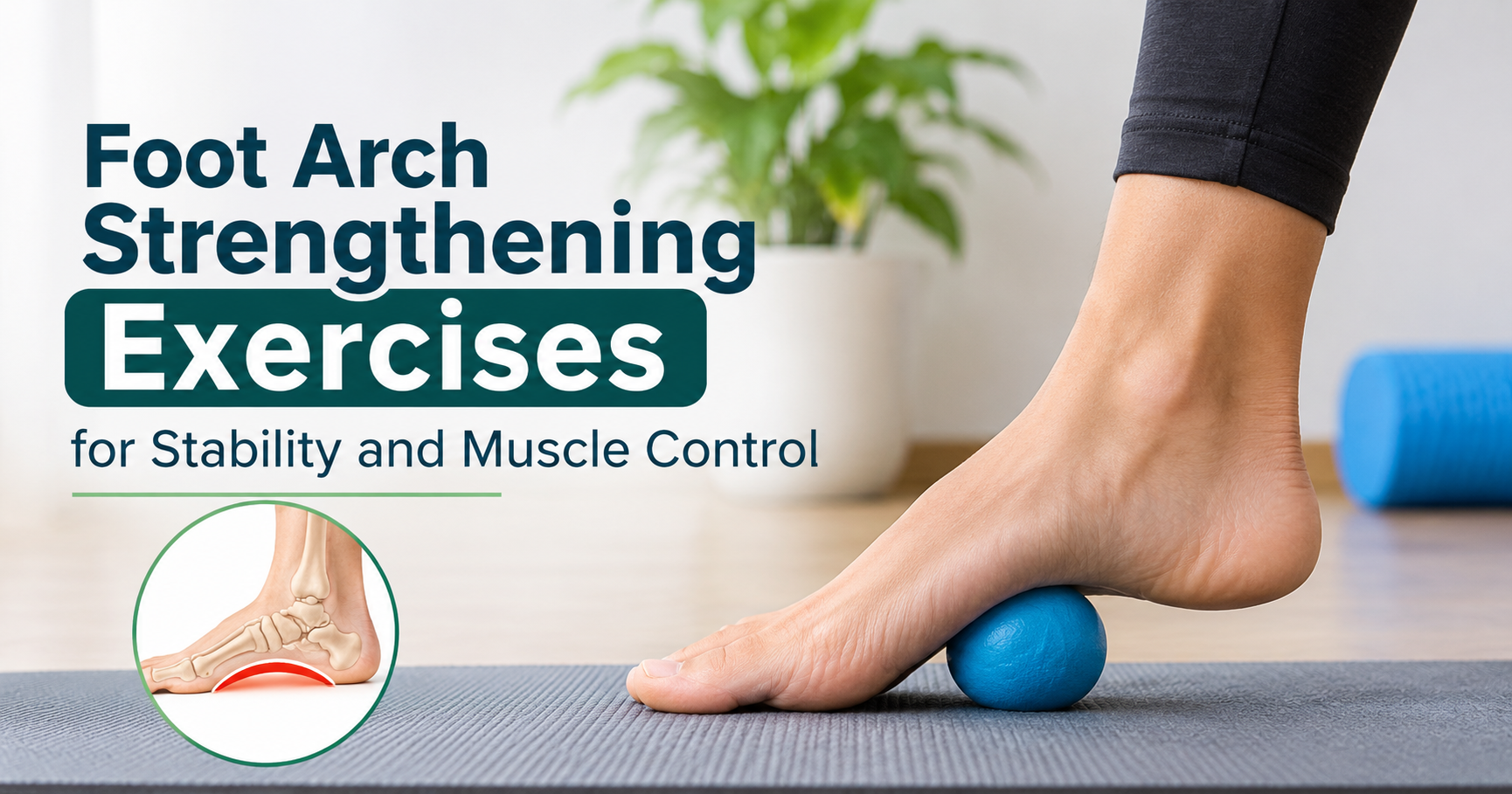
Each foot has three arches: the medial longitudinal arch (the inner curve you notice most), the lateral longitudinal arch on the outer edge, and the transverse arch across the ball of the foot. They are held up by three layers of support: bones shaped like a stone bridge, ligaments and the thick plantar fascia that act like tie-rods, and muscles that adjust tension with every step.
The muscles split into two groups. Intrinsic muscles sit entirely inside the foot (abductor hallucis, flexor digitorum brevis, quadratus plantae and others). Extrinsic muscles start in the lower leg and pull through tendons, including the tibialis posterior, tibialis anterior, peroneals and the calf muscles. Strong arches need both groups working together.
Why Strengthening Your Arch Muscles Matters
- Better shock absorption during walking, running and jumping.
- Less strain on the plantar fascia, which may help with heel and arch pain.
- Improved balance and ankle stability, especially as you age.
- Better alignment up the chain: knees, hips and lower back all feel the effects of foot mechanics.
- Greater support for flat feet, as muscle strength can partly compensate for a low arch.
Signs Your Foot Arch Muscles May Be Weak
- Aching or tiredness in the arch after standing or walking
- Heel pain, especially first steps in the morning
- Arches that flatten or ankles that roll inward (overpronation) when you stand
- Frequent shin splints, bunion irritation or foot cramps
- Difficulty balancing on one foot
A simple check is the wet footprint test: step on a flat surface with a wet foot. A full, wide print suggests a low arch, while a print with a clear gap suggests a normal or high arch. It is only a rough guide, so see a podiatrist or physiotherapist if pain persists.
Before You Start: Setup and Safety
- Exercise barefoot on a non-slip surface so the foot muscles can work freely.
- Move slowly and focus on feeling the arch muscles, not just going through the motions.
- Mild muscle fatigue is normal. Sharp or lingering pain is not, so stop and get checked.
- If you have diabetes, neuropathy, a recent injury or severe foot pain, speak to a healthcare professional first.
8 Best Foot Arch Muscle Strengthening Exercises
1. Short Foot Exercise (Foot Doming)
This is the gold standard for the intrinsic muscles. You shorten the foot without curling the toes, which lifts the arch.
- Sit or stand with your foot flat and toes relaxed.
- Without scrunching your toes, slide the ball of your foot toward your heel so the arch rises.
- Hold for 5 seconds, then relax.
Dose: 2 to 3 sets of 10 holds per foot
Coaching tip: Keep your big toe and heel pressed down. If your toes curl, you are using the wrong muscles.
2. Toe Yoga (Big Toe Lift and Press)
This trains big toe control, which is essential for a stable arch.
- Stand or sit with your foot flat.
- Lift only your big toe while pressing the other four toes down.
- Reverse it: press the big toe down and lift the other four.
Dose: 10 to 15 alternations per foot, 2 sets
Coaching tip: If it feels impossible at first, use your hand to help the toe move, then try again unassisted.
3. Towel Curls
A classic for the toe flexors that pull the arch together.
- Sit with your foot on a small towel laid flat on a smooth floor.
- Curl your toes to scrunch the towel toward you.
- Smooth it out and repeat. Add a light weight on the towel as you progress.
Dose: 3 sets of 10 scrunches per foot
Coaching tip: Keep your heel planted and move only your toes.
4. Marble or Small Object Pickups
This builds toe dexterity and arch endurance at the same time.
- Place 10 marbles or small objects and a bowl on the floor.
- Pick up one object at a time with your toes and drop it into the bowl.
Dose: 1 to 2 rounds per foot
Coaching tip: Use the foot that feels weaker first.
5. Heel Raises with Big Toe Pressure
Calf strength and tibialis posterior activation help hold the arch up under load.
- Stand tall near a wall for support.
- Rise onto the balls of your feet, pressing evenly through the big toe side.
- Lower slowly over 3 seconds.
Dose: 3 sets of 12 to 15 reps
Coaching tip: Do not let the ankles roll outward as you rise.
6. Resistance Band Ankle Inversion
This targets the tibialis posterior, the main muscle supporting the inner arch from above.
- Sit with one leg extended and loop a resistance band around the forefoot, anchored to a table leg.
- Turn the sole of your foot inward against the band.
- Return slowly and with control.
Dose: 3 sets of 12 reps per foot
Coaching tip: Move only at the ankle. Keep your knee still.
7. Single-Leg Balance
Balance drills train the arch to react quickly to changing surfaces.
- Stand on one leg with a soft knee and your arch gently lifted.
- Hold for 30 seconds, then progress by closing your eyes or standing on a folded towel.
Dose: 3 holds of 30 to 45 seconds per leg
Coaching tip: Imagine a tripod: heel, big toe and little toe all pressing the floor.
8. Toe Spreading (Toe Splay)
Spreading the toes activates the abductor hallucis and strengthens the transverse arch.
- Sit with your feet flat.
- Spread your toes as wide as possible and hold for 5 seconds.
- Relax and repeat.
Dose: 10 reps per foot, 2 sets
Coaching tip: Do not curl or grip the floor. The toes should fan out, not dig in.
Sample 4-Week Arch Strengthening Plan
| Week | Exercises | Frequency |
|---|---|---|
| 1 | Short foot, toe yoga, towel curls | 4 days |
| 2 | Week 1 plus heel raises and toe spreading | 4 to 5 days |
| 3 | Add band ankle inversion and marble pickups | 5 days |
| 4 | Full routine plus single-leg balance on a towel | 5 days |
The full routine takes about 12 to 15 minutes. Keep going for at least 6 to 8 weeks before judging the results, because muscles in the foot adapt more slowly than larger muscle groups.
Helpful Tools That Can Support Your Training
You do not need equipment, but a few inexpensive items can make progress easier. When choosing, look for these features:
- Resistance bands: choose a light to medium band with a smooth, latex-free option if you have skin sensitivities.
- Toe spacers: soft silicone or gel spacers help with toe alignment. Start with 10 to 15 minutes a day, not all-day wear.
- Massage ball: a firm rubber or spiky ball is useful for rolling the sole of the foot before exercises.
- Balance pad: a foam pad makes single-leg work more challenging as you improve.
- Supportive footwear: shoes with a firm heel counter, a stable midsole and a roomy toe box let your feet move naturally.
- Arch supports: useful for short-term comfort, but they work best alongside exercises, not as a replacement.
Daily Habits That Protect Your Arches
- Spend more time barefoot at home on safe surfaces.
- Stretch your calves daily. Tight calves increase arch stress.
- Avoid sudden jumps in walking or running volume.
- Replace worn-out shoes, usually every 500 to 800 km.
- Maintain a healthy body weight to reduce load on the arches.
When to See a Professional
Seek advice from a podiatrist, orthopedist or physiotherapist if you have persistent heel or arch pain beyond two weeks, swelling, numbness, a sudden change in arch shape, or pain that wakes you at night. They can check for conditions such as plantar fasciitis, posterior tibial tendon dysfunction or stress fractures.
Frequently Asked Questions
Can exercises really fix flat feet?
Exercises will not change your bone structure, but they can improve arch control, reduce symptoms and boost stability, especially in flexible flat feet.
How often should I do arch strengthening exercises?
Four to five days a week is ideal for most people. Short sessions of 10 to 15 minutes work better than occasional long ones.
How long until I see results?
Many people notice better control within 2 to 3 weeks and clearer strength gains after 6 to 8 weeks of consistent training.
Is it safe to do these exercises every day?
Gentle exercises like the short foot and toe yoga are fine daily. Give heavier work such as heel raises and band exercises a rest day in between.
Do I need orthotics as well?
Not always. Orthotics help some people, particularly with pain, but exercise builds your own muscular support and often works best combined with them.
Final Thoughts
Strong arches are built the same way as any other muscle: with focused, consistent practice. Start with the short foot exercise, add one new movement each week, and be patient. In a couple of months you may notice steadier balance, more comfortable walking and less end-of-day foot fatigue. Your feet do a lot for you, so give them a few minutes of attention every day.
This article is for general education and is not a substitute for professional medical advice.