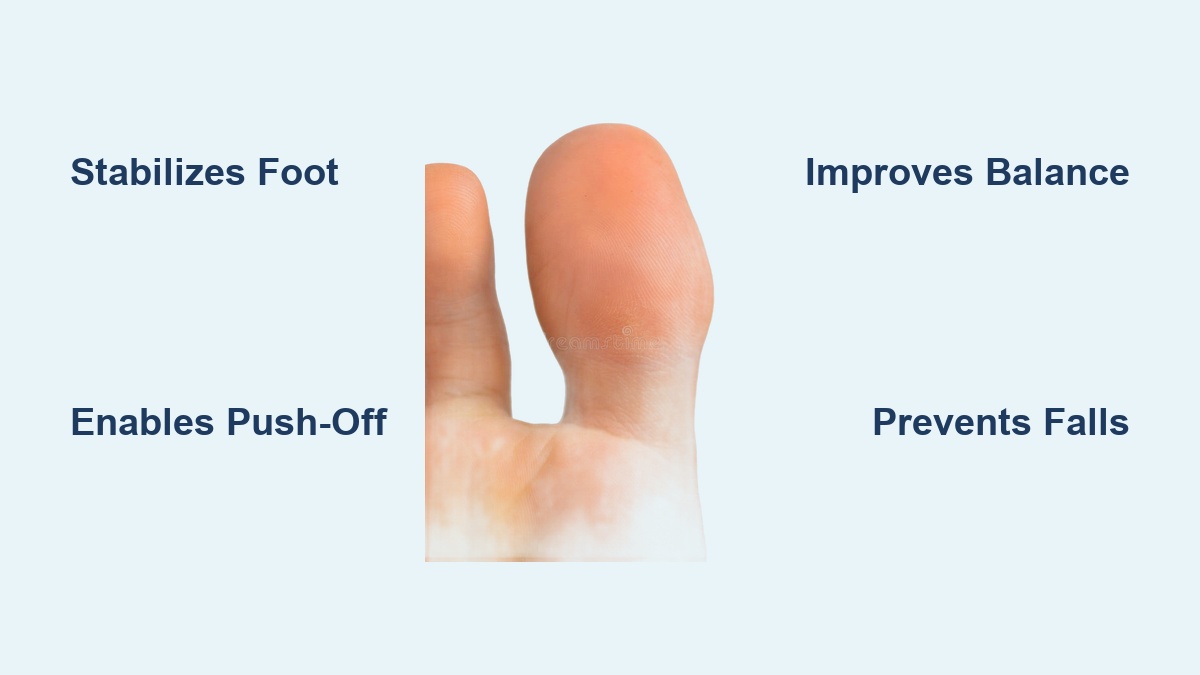
If you’ve ever wobbled while standing on one leg or lost your footing on a slippery surface, the culprit might not be weak ankles or poor core strength—it could be your big toe. Often ignored, the big toe (hallux) is a biomechanical powerhouse that plays a pivotal role in balance, stability, and efficient movement. It’s not just part of your footprint; it’s a dynamic anchor that helps you stand steady, walk smoothly, and react instantly to changes in terrain.
Research shows the big toe contributes to up to 40% of foot stability, making it essential for both static posture and dynamic motion. When its function is compromised—by tight shoes, injury, or weakness—your entire body pays the price. You may develop an altered gait, experience increased sway, or face a higher risk of falls. From elite athletes to older adults, big toe strength and mobility are directly linked to balance performance and injury prevention.
In this guide, you’ll discover how the big toe supports balance, why it’s critical for fall prevention, how dysfunction affects the entire body, and what you can do to strengthen and protect it—no matter your age or activity level.
How the 1st MTP Joint Anchors Your Stability

The Foundation of Foot Mechanics
The first metatarsophalangeal joint (1st MTP joint)—where the big toe connects to the foot—is the cornerstone of foot stability. This joint bears significant load during walking, running, and push-off phases of gait. It also helps maintain the medial longitudinal arch, which acts as your body’s natural shock absorber. When the 1st MTP joint is stiff or misaligned, the arch collapses, reducing stability and increasing strain on the plantar fascia and surrounding muscles.
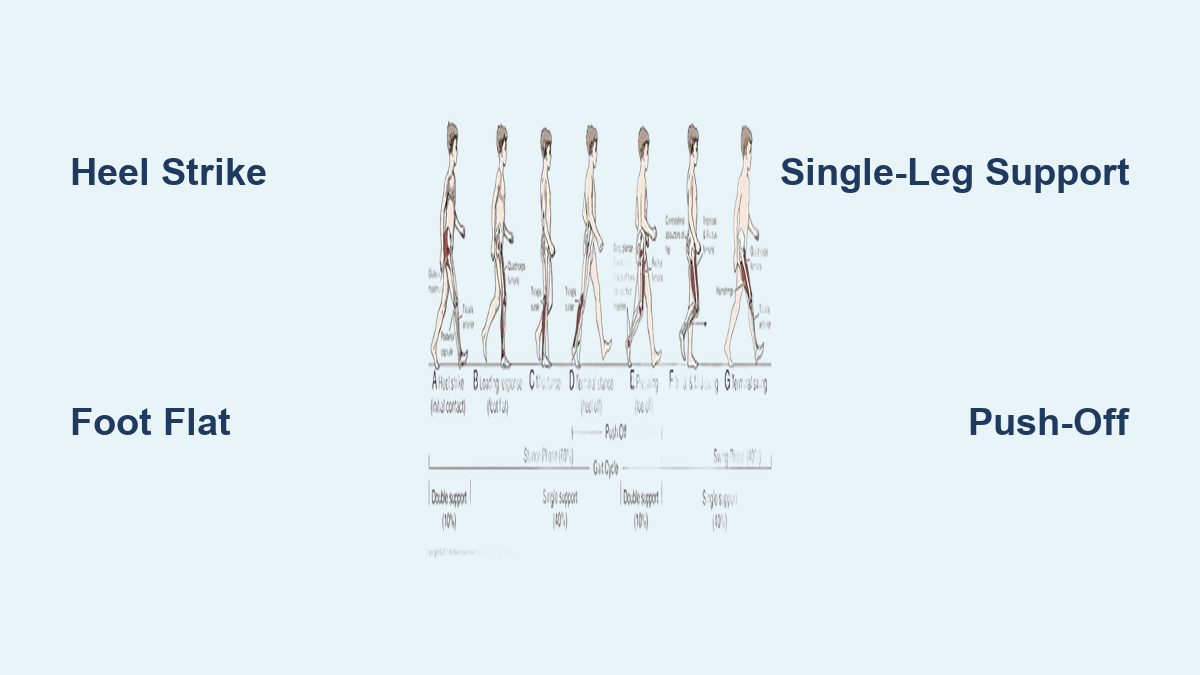
Without full range of motion in this joint, especially dorsiflexion (upward movement), your foot can’t transition smoothly from heel strike to toe-off. This leads to inefficient gait, reduced propulsion, and increased risk of overuse injuries.
Unlocking the Windlass Effect for Better Balance

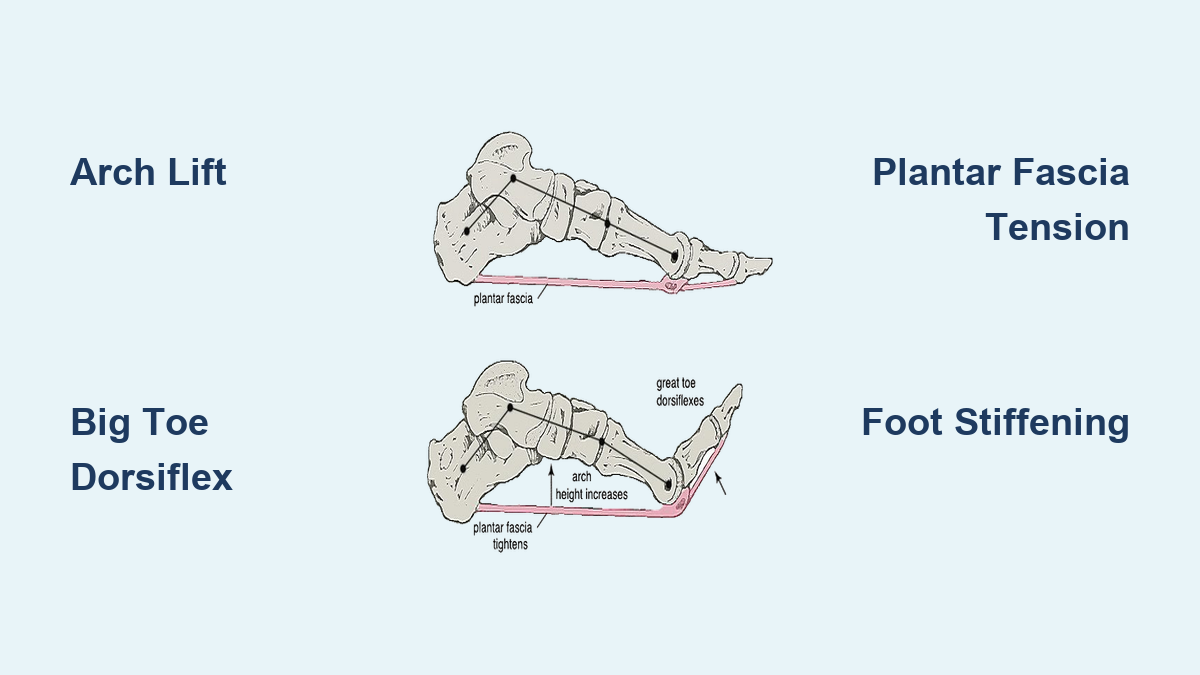
One of the most important mechanisms tied to the big toe is the windlass effect. As you push off the ground, your big toe extends upward, tightening the plantar fascia like a pulley system. This action lifts the arch, stiffens the foot, and turns it into a rigid lever for powerful, efficient propulsion.
When the big toe can’t extend properly—due to stiffness or restriction—this mechanism fails. The foot remains flat and flexible when it should be rigid, leading to a weak push-off, increased ground contact time, and higher energy expenditure. Over time, this inefficiency can contribute to plantar fasciitis, Achilles pain, and balance deficits.
Strengthening the Intrinsic Muscles for Micro-Control

Deep within the foot lie small but mighty muscles like the flexor hallucis brevis, abductor hallucis, and adductor hallucis. These intrinsic muscles control fine movements of the big toe and are essential for neuromuscular control—your body’s ability to make rapid, precise adjustments to stay balanced.
On uneven surfaces or during single-leg tasks, these muscles activate to stabilize the forefoot and fine-tune weight distribution. Weakness here leads to poor balance, increased postural sway, and delayed reactions to instability.
Why the Big Toe Is Crucial for Standing Balance
Single-Leg Stability Relies on Big Toe Function
When you stand on one leg, your base of support shrinks dramatically, demanding greater control. Studies show that restricting big toe movement significantly increases sway velocity, a key indicator of instability—even with eyes open. This proves the big toe provides both mechanical anchoring and sensory feedback critical for maintaining balance.
In contrast, during double-leg stance, the body can compensate for limited big toe motion. But as soon as balance demands increase—like standing on one leg or closing your eyes—the big toe becomes indispensable.
Sensory Feedback from the Sole Enhances Posture
The skin under your big toe is packed with mechanoreceptors—nerve endings that detect pressure, texture, and movement. These sensors send real-time data to your brain about your body’s position in space, helping you make micro-corrections without conscious thought.
Limiting big toe movement dulls this feedback loop, much like trying to balance on a numb foot. This sensory deprivation impairs postural control, especially in low-light conditions or on unstable surfaces.
Big Toe Control During Dynamic Movement
Controlling Forward and Backward Weight Shifts
During rhythmic weight shifting—especially forward and backward—the big toe plays a major role in guiding motion. Research shows that restricting its movement leads to slower, less precise shifts, particularly in the sagittal plane (front-to-back direction).
This is crucial during walking, climbing stairs, or recovering from a trip. The big toe acts as a pivot during the transition from heel to toe. If it can’t extend properly, the body may overstride, wobble, or lose control during push-off.
Reaching the Edge of Stability Without Losing Balance
In tasks where you reach just beyond your comfort zone—like grabbing an item from a high shelf—your body operates at the limit of stability. Studies show that when big toe motion is restricted, people perform worse on directional control scores, meaning they’re less accurate and more likely to lose balance.
This has real-world implications for fall prevention, sports performance, and daily functional movement.
How Strong Toes Reduce Fall Risk
The Link Between Toe Strength and Fall Prevention
The connection between toe grip strength (TGS) and fall risk is well-established:
- A Frontiers in Public Health study found older adults with weak toe grip were more likely to fall.
- PLOS ONE research linked reduced TGS to higher fall rates, especially in those with knee osteoarthritis.
- Victoria University reported people with weak toes or deformities are twice as likely to fall.
- Journal of Orthopaedic & Sports Physical Therapy: Each 1% decrease in toe strength increases fall risk by 1.4%.
This dose-response relationship shows that even small declines in big toe strength have measurable consequences.
Reactive Balance: How the Big Toe Helps You Recover from Slips
When you slip or step on uneven ground, your body relies on rapid toe activation to regain balance. The big toe generates immediate push-back force and adjusts foot position. If it’s weak or stiff, your reaction time slows—increasing the chance of a fall.
What Happens When the Big Toe Fails?
Compensations That Travel Up the Kinetic Chain
The body functions as a connected system—the kinetic chain. A problem at the foot level doesn’t stay isolated. When the big toe underperforms, compensation occurs:
- Limited 1st MTP dorsiflexion → forces midfoot collapse or ankle overuse
- Leads to overpronation, plantar fasciitis, Achilles tendinopathy
- Alters knee alignment → contributes to patellofemoral pain
- Changes hip mechanics → may cause gluteal inhibition or low back strain
Gait and Running Efficiency Depend on Big Toe Power
Efficient gait requires a smooth roll-through from heel to toe. If the big toe can’t extend, the foot “jams” at push-off, shortening stride and reducing speed. Runners lose propulsion, increase ground contact time, and expend more energy.
East African runners—renowned for endurance—often have strong, mobile big toes from growing up barefoot. Their powerful toe-off maximizes elastic energy return, a key factor in performance.
Bruce Lee’s 1-Inch Punch: Power Starts at the Toe
Bruce Lee’s legendary 1-inch punch wasn’t just arm strength—it was ground reaction force channeled through the body. The sequence began with the big toe pushing into the floor, generating force that traveled up the leg, through the core, and into the fist. This illustrates how a stable, strong big toe enables distal-to-proximal power transfer—critical in sports, martial arts, and daily movement.
Warning Signs of Big Toe Dysfunction
Common Indicators of Impaired Function
- Pain or stiffness at the base of the big toe (hallux rigidus)
- Difficulty rising onto toes or performing calf raises
- Sensation of “jamming” in the joint during push-off
- Altered gait, like limping or avoiding toe-off
- Frequent tripping on uneven ground
- Bunions (hallux valgus) altering toe alignment
If you notice any of these, your big toe may not be doing its job—putting extra stress on other joints.
Mobility Exercises to Restore Big Toe Function
Big Toe Wall Stretch
Stand with the ball of your foot against a wall, heel on the ground. Lean forward until you feel a stretch at the base of the big toe. Hold 20–30 seconds, repeat 3–5 times daily. This improves 1st MTP dorsiflexion, essential for the windlass effect.
Manual Joint Mobilizations
Sit barefoot. Use your fingers to gently move the big toe:
– Up (dorsiflexion)
– Down (plantarflexion)
– Side to side
– Small circles
Do 10 reps in each direction, 1–2 times daily. Enhances joint glide and reduces stiffness.
Toe Extension Mobilization
Sit with one foot on the opposite knee. Stabilize the foot with one hand. Use the other to gently pull the big toe upward. Hold 15–20 seconds, repeat 3 times. Improves extension range for better push-off.
Strengthening Exercises for Balance and Power
Toe Yoga: Isolate and Control
Lift only the big toe while keeping the other toes down. Then reverse: lower the big toe while lifting the others. Builds neuromuscular control. Do 2 sets of 10 reps daily. Progress by doing it while standing.
Standing Towel Scrunches
Place a towel on the floor. Use your toes to scrunch it toward you, focusing on the big toe. Strengthens the flexor hallucis longus and intrinsic muscles. Perform 2–3 sets of 15 reps.
Resistance Band Push-Downs
Loop a resistance band under your foot and around the big toe. Press the toe down against resistance. Activates the flexor hallucis brevis. Do 2 sets of 15 reps, 3 times per week.
Single-Leg Balance with Big Toe Focus
Stand on one leg. Consciously press the ball of the big toe into the ground. Hold 30–60 seconds. Progress by closing eyes or using a foam pad.
Who Should Prioritize Big Toe Health?
Older Adults: Prevent Falls
Age-related decline in toe strength and sensory feedback increases fall risk. Simple toe exercises can improve balance, reduce sway, and enhance confidence.
Athletes and Runners: Boost Performance
Strong, mobile big toes enhance propulsion, agility, and efficiency. Barefoot or minimalist training can help—but must be introduced gradually.
People with High Arches or Flat Feet
- High arches (pes cavus): Concentrate pressure on the forefoot—increasing demand on the big toe.
- Flat feet (pes planus): Lose arch support, making the big toe work harder.
Both benefit from strengthening and proper footwear.
Key Takeaways: The Big Toe Is a Balance Powerhouse
- Accounts for up to 40% of foot stability
- Sway velocity increases when motion is restricted
- 1% loss in toe strength = 1.4% higher fall risk
- Directional control drops during reaching tasks
- Great toe length correlates with body height (r = 0.553)
The big toe is a silent hero of human movement. From standing still to sprinting, it provides critical stability, propulsion, and sensory input. By improving big toe mobility, strength, and neuromuscular control, you build a stronger foundation for lifelong movement. Start with your big toe—it’s where balance truly begins.