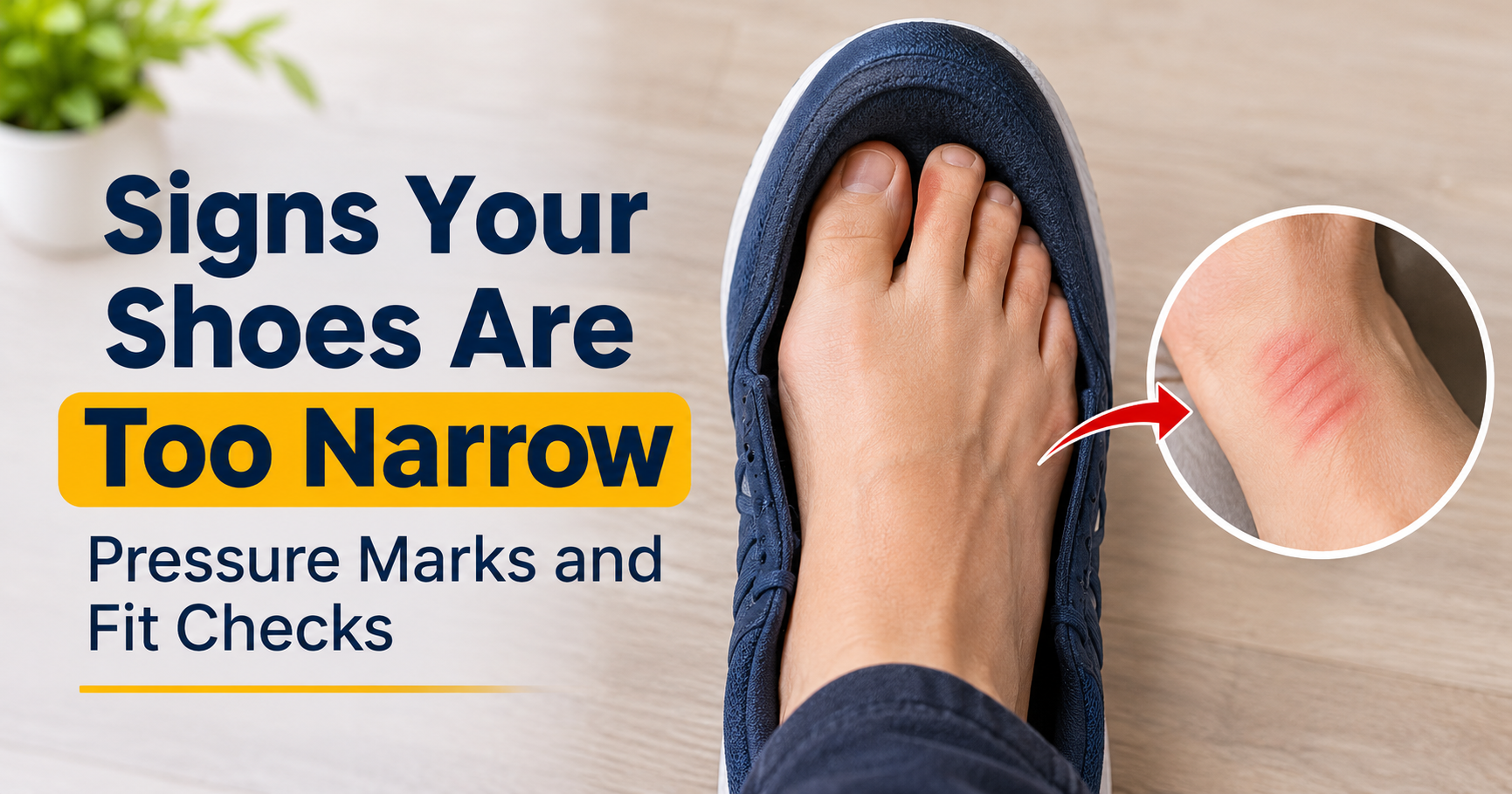
You slip on a brand-new pair, the length feels perfect, and yet something is off. Your little toe throbs, the sides of your feet burn, and by lunchtime you are counting the minutes until you can kick them off. Sound familiar? The problem is probably not the size on the box. It is the width.
Shoes that are too narrow are one of the most common and most overlooked causes of foot pain. This guide explains exactly how to tell if shoes are too narrow, what the warning signs look like, how to test your shoes at home in two minutes, and what to do if you find out your shoes do not fit.
Quick answer: Shoes are too narrow if your foot bulges over the sides of the sole, your toes feel squeezed together, or you get redness, numbness, burning, or blisters on the sides of your feet. A fast check: stand on the shoe’s insole. If any part of your foot hangs over the edge, the shoe is too narrow for you.
In this guide you will learn:
- What “too narrow” really means (and how it differs from “too short”)
- The 8 most common warning signs
- Three simple at-home fit tests
- How to measure your foot width correctly
- The health problems tight shoes can cause
- What to do and what to look for when buying new shoes
What Does “Too Narrow” Actually Mean?
Every shoe has two key measurements: length and width. Most people only think about length, which is why shoe sizes like 8 or 42 get all the attention. Width is the side-to-side space across the widest part of your foot, called the ball of the foot, and the toe box in front of it.
A shoe is too narrow when the inside space is smaller than the width of your foot. Your foot then has nowhere to go except upward and outward, so the soft tissue is compressed and your toes are forced together. This is very different from a shoe that is simply too short, where your toes hit the front. Buying a bigger size to fix a width problem often fails, because a longer shoe is usually only slightly wider, and you end up with a heel that slips and a toe area that creases in the wrong place.
Also remember that feet are not the same shape. Two people with the same length can have very different widths, and your left and right feet are often not identical either. Always judge fit by the wider foot.
8 Signs Your Shoes Are Too Narrow
1. Your toes feel squeezed together
In a well-fitting shoe, your toes should lie flat and slightly apart. If the toes are pressed against each other, or your little toe is pushed inward toward the big toe, the toe box is too tight.
2. Your foot bulges over the sides of the sole
Take a look at your shoes from behind or from above while you are standing. If the soft part of your foot pushes out over the edge of the sole, or the upper material bulges visibly at the ball of the foot, there is not enough width.
3. Red marks or dents appear after wearing them
Take off your shoes and socks at the end of the day. Red areas, deep sock lines, or dents along the sides of the foot show that the shoe was pressing too firmly against your skin.
4. Numbness or tingling in your toes
Tight shoes can compress the small nerves that run between your toes. Tingling, “pins and needles,” or a numb feeling that gets worse the longer you walk is a strong warning sign.
5. Burning pain in the ball of your foot
A burning or sharp feeling just behind the toes, sometimes described as walking on a pebble, often appears when the forefoot is squeezed from both sides.
6. Blisters, corns, and calluses on the sides
Friction and pressure on the sides of the little toe, the big toe joint, or the ball of the foot lead to blisters at first and thick, hard skin over time. Repeated spots in the same place are a clue that the shoe shape does not match your foot.
7. You cannot spread or wiggle your toes
Try this with your shoes on: spread your toes as wide as you comfortably can. If they have no room to move, or your foot feels “locked in,” the shoe is too narrow.
8. The upper looks stretched, or seams feel tight
Fabric that is pulled tight across the forefoot, seams pressing into the sides of your foot, or a stiff leather edge that digs in all point to a narrow fit. Brand-new shoes can feel firm, but they should never hurt from the first wear.
3 Easy At-Home Tests for Shoe Width
You do not need special equipment to check your fit. These three tests take only a few minutes.
Test 1: The insole test (most reliable)
Remove the insole from your shoe, or use the shoe’s sole as a guide, and place it on the floor. Stand on it with your full weight. Your foot should sit comfortably inside the outline with a small margin on all sides. If your toes, the ball of your foot, or the sides hang over the edge, the shoe is too narrow. This is the single best way to spot a problem before you buy.
Test 2: The pinch test
Wear the shoes, stand up, and gently pinch the material over the widest part of your foot. In a good fit, you can pinch a small amount of fabric or leather. If the material is drum-tight and you cannot pinch anything, there is no spare room.
Test 3: The walk and wiggle test
Wear the shoes for 10 to 15 minutes around your home on a hard floor. Walk, climb a few stairs, and rise onto your toes. Notice any rubbing, tingling, or squeezing. Do this in the afternoon or evening, because feet naturally swell during the day and a shoe that feels fine at 9 a.m. can feel too tight by 5 p.m.
Good to know: A comfortable shoe should feel right immediately. The idea that you must “break in” a narrow shoe is a common myth. Materials may soften slightly, but a shoe that is too narrow will rarely change enough to be comfortable.
How to Measure Your Foot Width at Home
If your shoes keep hurting, measuring your feet will help you shop with confidence.
- Place a sheet of paper on a hard floor and stand on it with your weight evenly on both feet.
- Trace around your foot with a pen held straight up, not at an angle.
- Find the widest point of the outline, usually across the ball of the foot, and measure that distance in centimeters or inches.
- Repeat with the other foot and use the larger number.
Then compare your numbers with the manufacturer’s size chart. Widths are usually labeled with letters. The table below shows the standard US system, though exact measurements vary by brand and by shoe size.
| Width category | Women’s label | Men’s label |
|---|---|---|
| Narrow | 2A | B |
| Medium (standard) | B | D |
| Wide | D | 2E (EE) |
| Extra wide | 2E (EE) | 4E (EEEE) |
Width labels differ between brands and countries, so always check the brand’s own size guide.
Why Narrow Shoes Are More Than Just Uncomfortable
Occasional tight shoes may only cause a sore evening. Wearing them regularly is different. Over time, constant pressure on the forefoot can contribute to or worsen several common foot problems:
- Bunions: a bony bump at the base of the big toe that can become painful when squeezed.
- Hammertoes and curled toes: toes that stay bent because they have no room to lie flat.
- Morton’s neuroma: thickened tissue around a nerve between the toes, causing burning pain or numbness.
- Corns, calluses, and blisters: skin that thickens or breaks down from repeated friction.
- Ingrown toenails: nails pressed into the surrounding skin by a tight toe box.
Shoe fit is not the only cause of these conditions, since genetics and foot structure play a role. But tight shoes can make them develop sooner and hurt more.
What to Do If Your Shoes Are Too Narrow
Stop wearing them for long periods
If a shoe hurts, do not push through the pain. Limit wear to short periods, or set them aside until you find a solution.
Try a professional stretch
A cobbler or shoe repair shop can stretch leather and some suede shoes across the forefoot. This works best for small adjustments, usually around half a size in width. It does not work well on synthetic materials, mesh, or athletic shoes with rigid structures.
Swap the insole
Many shoes come with thick insoles. Replacing them with a thinner one can free up a little extra space inside the shoe.
Adjust your socks and lacing
Thinner socks help, and loosening the laces over the widest part of your foot (or using a lacing method that skips the forefoot eyelets) can reduce pressure.
Buy the right width, not a bigger size
This is the lasting solution. Look for shoes that come in wide or extra-wide options, rather than going up half a size and hoping for the best.
What to Look For When Buying New Shoes
Whether you are shopping in a store or online, these features make it much easier to find a comfortable fit:
- A roomy, rounded toe box: Pointed or tapered toe shapes squeeze the toes, while a rounder, foot-shaped front gives them space to spread.
- Multiple width options: Many popular athletic and walking shoe brands, including New Balance, Brooks, and Altra, offer wide and extra-wide sizes in selected models.
- Soft, flexible uppers: Stretch knit, soft leather, and breathable mesh adapt to your foot better than stiff synthetic materials.
- Adjustable closures: Laces, straps, and hook-and-loop fasteners let you fine-tune the fit across the widest part of the foot.
- Removable insoles: These allow you to run the insole test and add custom support if needed.
Shopping tips that save returns: Try on shoes in the late afternoon, wear the same socks you will use with them, and fit the larger foot. When you shop online, check the return policy and read reviews that mention width, because other buyers often say whether a shoe runs narrow.
Fit by type of shoe
- Running and walking shoes: Leave about a thumb’s width in front of the longest toe, and choose a wide version if the insole test fails.
- Work and standing shoes: If you are on your feet all day, a wide toe box and good cushioning matter more than style.
- Dress shoes and heels: These are often the narrowest. Look for rounded or almond toe shapes, and wear them for shorter periods.
- Sandals: Adjustable straps and a footbed that fully supports the foot’s width prevent spillover.
When to See a Foot Specialist
See a podiatrist or your doctor if you have ongoing numbness, severe or constant pain, a bump that is growing or painful, wounds that do not heal, or any foot problem if you have diabetes or poor circulation. A professional can check your foot structure and recommend suitable footwear or supports.
Frequently Asked Questions
Can shoes that are too narrow stretch out?
Leather and some suede shoes can stretch slightly with wear or professional stretching, but synthetic and athletic shoes rarely change much. If a shoe is very uncomfortable, it is better to replace it than hope it will loosen.
Should my toes touch the sides of the shoe?
No. Your toes should sit comfortably without being pressed against the sides. There should be a little room to move them and about a thumb’s width of space in front of your longest toe.
Is it normal for new shoes to feel a little tight?
A slightly snug, secure feel around the heel and midfoot is normal. Pressure, pinching, or pain across the forefoot is not, and it is a sign the shoe is too narrow.
Do I need wide shoes if my feet are only slightly wide?
If you pass the insole test comfortably in standard-width shoes, you do not. If you notice any spillover or pressure, trying a wide size can make a big difference, even if your foot is only a little wider than average.
Can wearing narrow shoes cause permanent damage?
Long-term wear of tight shoes can contribute to foot conditions such as bunions, hammertoes, and nerve irritation. Switching to shoes with the right width early can reduce discomfort and help prevent them from getting worse.
Final Thoughts
Knowing how to tell if shoes are too narrow can save you from pain, wasted money, and long-term foot problems. Watch for the warning signs, run the simple insole test, measure your feet, and choose shoes that match your foot width, not just your length. A shoe that fits well should feel comfortable from the very first step, with room for your toes to relax and spread.
Your feet carry you through thousands of steps every day. Giving them the space they need is one of the easiest ways to feel better from the ground up.
This article is for general information only and is not medical advice. If you have persistent foot pain or a medical condition, please consult a qualified healthcare professional.