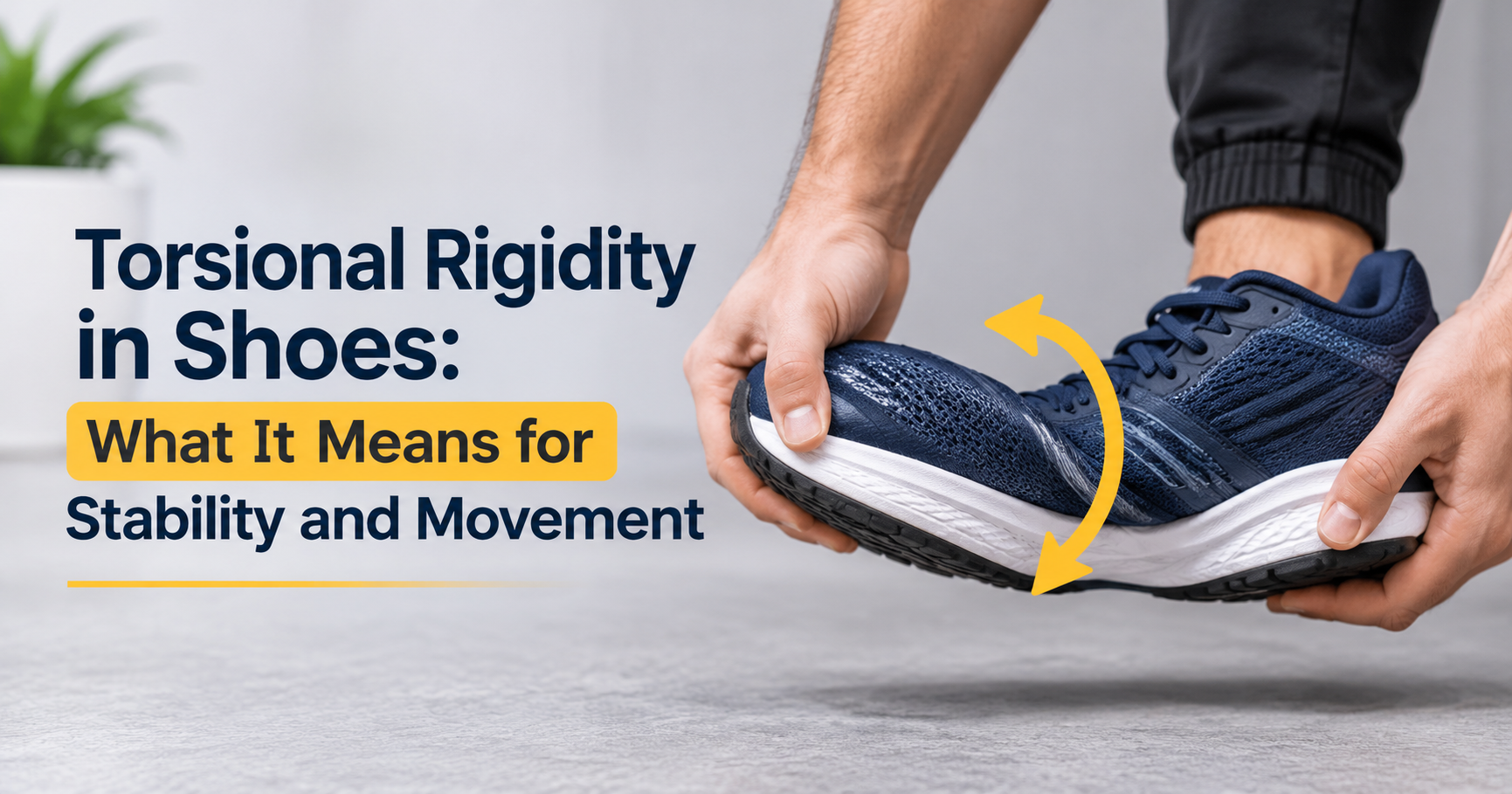
Pick up almost any shoe, hold the heel in one hand and the forefoot in the other, and twist. Some shoes wring out like a wet towel. Others barely budge. That simple difference is called torsional rigidity, and it quietly shapes how stable, supported and comfortable a shoe feels, whether you are running a trail, hiking a ridge, playing basketball or standing all day at work.
Most shoe guides focus on cushioning, weight and drop. Torsional rigidity gets far less attention, yet it is one of the most important traits behind a shoe’s stability. This guide explains it in plain language, shows how it differs across shoe types, and gives you a practical way to judge it before you buy.
- What torsional rigidity means
- Torsional vs. longitudinal flexibility
- How the foot twists while you move
- Benefits of higher torsional rigidity
- Problems with too much or too little
- Technologies that control torsion
- Ideal rigidity by shoe type
- How to test it at home
- Buying checklist and FAQs
What Is Torsional Rigidity in Shoes?
Torsional rigidity is a shoe’s resistance to twisting around its long axis, an imaginary line running from the heel to the toes. When the heel rotates one way and the forefoot rotates the other, the sole twists. A shoe with high torsional rigidity resists this motion and keeps the heel and forefoot working together. A shoe with low torsional rigidity twists easily and lets the foot move more freely.
Neither extreme is automatically good or bad. The right level depends on what you do, the surface you are on and how your foot behaves. Think of it as a dial rather than a switch.
Torsional vs. Longitudinal Flexibility
Shoppers often mix up two different kinds of stiffness, so it helps to separate them.
| Property | What it describes | Where you notice it |
|---|---|---|
| Longitudinal (bending) stiffness | Resistance to bending at the ball of the foot, up and down | Toe-off, push-off, walking comfort |
| Torsional rigidity | Resistance to twisting between heel and forefoot | Side-to-side stability, uneven ground, cutting moves |
A shoe can bend easily at the forefoot and still resist twisting well. Many running shoes are built exactly this way. They flex where your toes naturally bend, while a firm midfoot structure limits unwanted twisting. When you read reviews, make sure the reviewer is talking about the right kind of stiffness.
How the Foot Twists While You Move
Your foot is not a rigid block. It is made of 26 bones, many joints and a network of ligaments and tendons. As your heel strikes the ground and your weight rolls forward, the rearfoot and forefoot rotate slightly relative to each other. This twisting helps the foot adapt to the ground and then become firmer for push-off.
Shoes interact with this motion. A flexible sole follows the foot’s twist, while a rigid sole limits it and shifts more of the job to the shoe’s structure. On flat, predictable surfaces the foot can manage the twist on its own. On rocky trails, steep slopes or during quick direction changes, forces rise and the shoe’s midfoot structure matters much more.
Benefits of Higher Torsional Rigidity
- Better stability on uneven ground. A stiffer midfoot keeps the sole from folding around rocks and roots.
- Improved support during heavy loads. Hikers carrying backpacks benefit from a platform that does not twist under extra weight.
- Reduced foot fatigue. When the shoe handles part of the stabilizing work, small foot muscles may tire more slowly over long days.
- More precise control in sports. Quick cuts and lateral moves feel more secure when the heel and forefoot stay connected.
- Greater durability. Soles that resist twisting often keep their shape longer.
Problems With Too Much or Too Little
When a shoe is too flexible
A very soft, twisty sole can feel unstable on rough surfaces and may leave the foot working harder to stay balanced. People with weaker feet, those carrying heavy loads and athletes who change direction often may notice sore arches or a wobbly feeling.
When a shoe is too rigid
An overly stiff shoe can feel harsh and restrictive on flat ground. It may reduce natural foot movement, feel clunky for casual walking and cause discomfort in people who prefer a ground-feel experience. Stiff footwear can also make a bad fit more noticeable, since the shoe will not adapt to your foot shape.
Research on how torsional stiffness affects injury risk is still developing, and results vary between studies, activities and individuals. Treat torsional rigidity as one factor in comfort and stability rather than a guaranteed injury preventer. If you have persistent foot pain, speak with a podiatrist or physiotherapist.
Technologies That Control Torsion in Shoes
Shoe makers use several design tools to tune twist resistance without making a shoe heavy.
- Shanks: A stiff insert, usually between the midsole and outsole under the arch. Materials include nylon, TPU, fiberglass, carbon fiber and steel in work boots.
- Torsion bars and midfoot bridges: A connecting structure under the arch that links the heel and forefoot while allowing the forefoot to flex.
- Rock plates: Thin protective layers in trail shoes that add both puncture resistance and midfoot rigidity.
- Dual density midsoles: Firmer foam on the medial side adds support without changing the entire shoe.
- Wider platforms and outrigger geometry: A broader base improves stability even when the material itself is only moderately stiff.
- Outsole and upper design: Wrapped midsoles, overlays and heel counters all affect how the shoe twists as a complete system.
Ideal Torsional Rigidity by Shoe Type
| Shoe type | Recommended level | Why |
|---|---|---|
| Road running shoes | Low to moderate | Smooth surfaces and a natural gait cycle need flexibility with some midfoot support. |
| Trail running shoes | Moderate to high | Roots, rocks and slopes demand protection and steadier footing. |
| Hiking boots | High | Heavy packs and rough terrain require a firm, supportive platform. |
| Mountaineering boots | Very high | Crampons and steep ground require a very stable, stiff sole. |
| Basketball and court shoes | Moderate to high | Hard stops, cuts and landings need midfoot control. |
| Football and soccer boots | Moderate to high | Stiffer soles may help stud traction and control, but comfort varies by player. |
| Walking and everyday shoes | Low to moderate | Comfort and natural movement matter more than rigid support. |
| Work boots | High | Long standing hours and safety shanks provide support and protection. |
| Minimalist shoes | Very low | Designed to maximize foot movement and ground feel. |
How to Test Torsional Rigidity at Home or in the Store
You do not need a lab to compare shoes. A quick hands-on check tells you a lot.
Also try a second check: place the shoe on a table with the heel hanging slightly off the edge and press down on the forefoot with your palm. Notice whether the sole bends where your toes bend, which is normal, or somewhere in the middle of the arch, which suggests less midfoot support. Then, put the shoes on and stand on one foot for several seconds on a flat surface. A stable shoe should feel secure without forcing your foot into an unnatural position.
Buying Checklist: Choosing the Right Torsional Rigidity
- Define your activity. Daily walking, trail running and mountaineering call for very different levels.
- Consider the terrain. The rougher the ground, the more midfoot stability you generally want.
- Think about load. Carrying a backpack or heavy tools raises the benefit of a stiffer platform.
- Match your foot. Flexible, hypermobile feet may like firmer support, while stiff feet may prefer a freer sole.
- Check the specifications. Look for words like shank, plate, torsion bridge or stability frame in product descriptions.
- Read reviews carefully. Search for comments about twisting, wobbling or midfoot support, not just overall comfort.
- Try before committing. Walk on varied surfaces if you can, and allow a short break-in period for stiffer shoes.
- Prioritize fit first. Even the best torsional design cannot compensate for the wrong size or width.
The more unpredictable the surface and the heavier the load, the more torsional rigidity you generally need. The smoother the surface and the more natural movement you want, the less you need.
Frequently Asked Questions
Is higher torsional rigidity always better?
No. It is helpful for rough terrain, heavy loads and sports with sharp lateral movement, but it can feel stiff and unnatural for casual walking or minimalist running.
Can a shoe be flexible and torsionally rigid at the same time?
Yes. Many shoes bend easily at the toes but resist twisting through the midfoot thanks to shanks, bridges and carefully shaped midsoles.
Do stiff shoes weaken your feet?
There is no simple answer. Some experts suggest that heavily supportive shoes worn all the time may reduce foot muscle demand, while others point to benefits in specific situations. A sensible approach is to use stiffer shoes when the activity needs them and give your feet varied movement at other times.
How can I tell if my current shoes have lost support?
Do the twist test again. If an older pair twists much more easily than when it was new, or you notice arch soreness and a wobbly feel, the midsole and shank may be worn. Compressed foam and visible wear on the sole are other clues.
Is torsional rigidity the same as stability in running shoes?
They are related but not identical. Stability shoes often combine torsional rigidity with other features such as medial posts, wider bases and guiding geometry.
Does torsional rigidity affect shoe weight?
It can. Heavy materials like steel add weight, but modern TPU and carbon components offer strong twist resistance at low weight.
Final Thoughts
Torsional rigidity is the hidden factor behind how a shoe holds up under real-world forces. Too little, and the shoe can feel unstable on rough ground. Too much, and it can feel stiff and unnatural on easy surfaces. The best choice matches your activity, terrain, body and personal comfort.
Next time you shop, give each shoe a quick twist test, read the specifications for shanks and midfoot structure, and prioritize fit. A few seconds of testing can save you from weeks of sore feet and help you find footwear that supports your movement exactly where you need it.