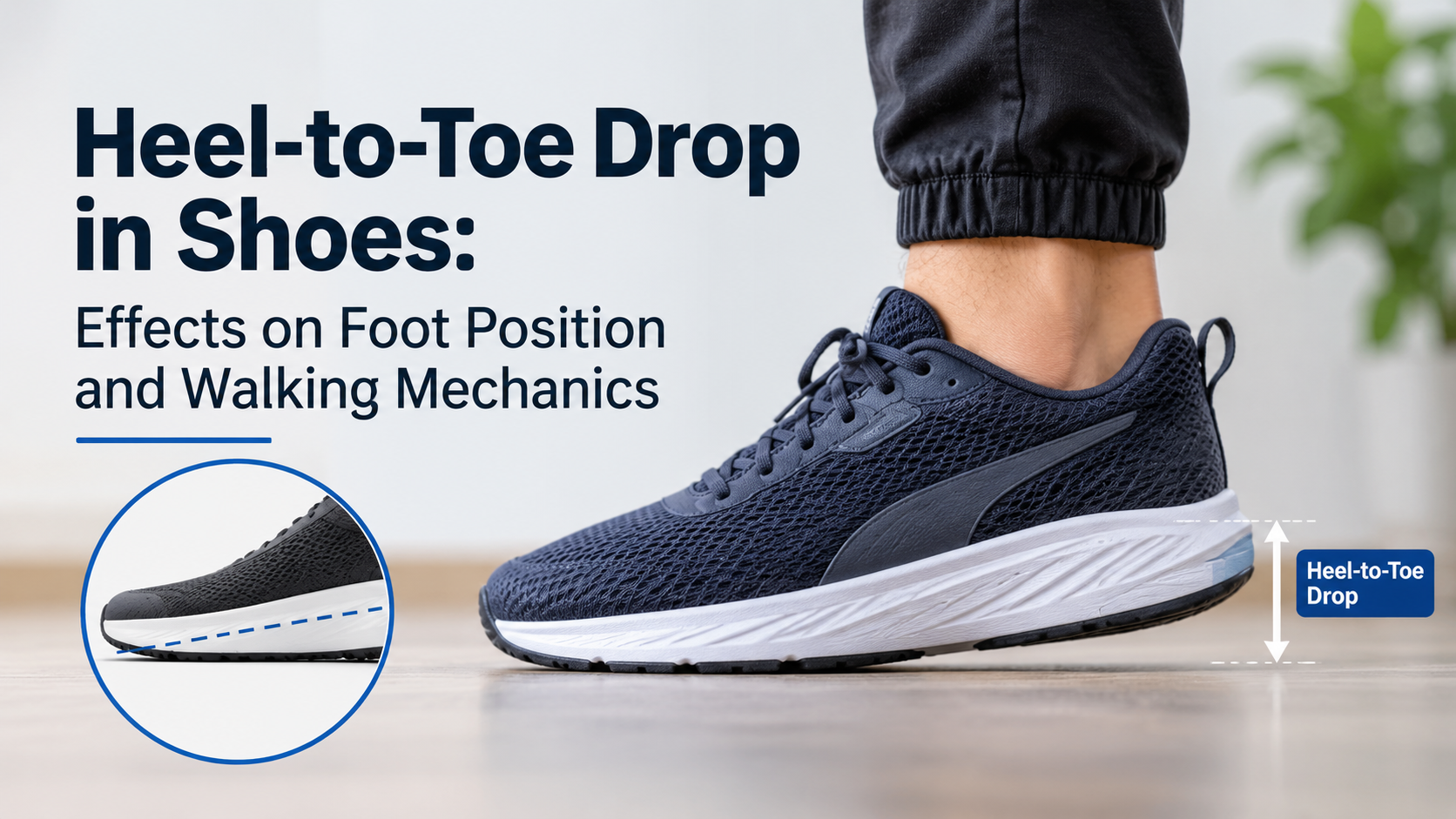
Pick up any pair of running shoes or walking shoes and you will find a number in the spec sheet that most shoppers skip over: the heel-to-toe drop. It looks like a small detail, but it quietly shapes how your foot lands, how hard your calves and Achilles tendons work, how your knees feel after a long day, and how comfortable a shoe is for standing or walking. If you have ever wondered why one pair of shoes feels “tilted forward” while another feels completely flat, drop is usually the reason.
This guide explains what heel-to-toe drop is, how it is measured, what the different drop ranges mean, how drop affects your body, and how to choose (and safely switch to) the right drop for your feet and your activities.
Quick Answer
Heel-to-toe drop (also called offset or heel-toe differential) is the difference in height, in millimeters, between the heel and the forefoot of a shoe’s midsole. A 10 mm drop means the heel sits 10 mm higher than the ball of the foot. Lower drop shoes feel flatter and place more demand on the calves and Achilles tendon, while higher drop shoes tilt the foot forward and tend to reduce that demand.
Table of Contents
- What Is Heel-to-Toe Drop?
- Drop vs. Heel Height vs. Cushioning
- Drop Categories: Zero, Low, Mid, and High
- How Drop Affects Your Body
- Drop and Foot Strike: What Is True and What Is Myth
- Which Drop Is Right for Different Activities?
- Who Might Benefit From a Higher or Lower Drop?
- How to Transition to a Lower Drop Safely
- How to Find the Drop of Any Shoe
- Common Mistakes to Avoid
- Frequently Asked Questions
- Final Thoughts
What Is Heel-to-Toe Drop?
Heel-to-toe drop is the height difference between the part of the shoe under your heel and the part under your forefoot (the ball of your foot). Manufacturers measure the thickness of the sole, including the midsole, outsole, and often the insole, at both points and subtract the forefoot number from the heel number.
For example, if a shoe has 30 mm of material under the heel and 20 mm under the forefoot, its drop is 10 mm. Your heel sits higher than your toes, so the foot rests at a slight downward angle.

You may also see this measurement called offset, heel-toe differential, heel-to-toe offset, or simply drop. They all mean the same thing. It is normally written in millimeters, such as “4 mm drop” or “0 mm drop.”
Drop vs. Heel Height vs. Cushioning
These three ideas get mixed up all the time, so it helps to separate them:
- Heel stack height is the total thickness of the shoe under your heel.
- Forefoot stack height is the total thickness under the ball of your foot.
- Drop is the difference between the two.
Because drop is only a difference, two very different shoes can share the same number. A thick, highly cushioned shoe with 40 mm under the heel and 36 mm under the forefoot has a 4 mm drop. So does a thin, minimalist shoe with 14 mm under the heel and 10 mm under the forefoot. They will feel nothing alike. Drop tells you about the angle of your foot inside the shoe. It does not tell you how soft, firm, or protective the shoe is.
That is why it is a good idea to check both the drop and the stack height when comparing shoes.
Drop Categories: Zero, Low, Mid, and High
There is no official industry standard, but most brands and reviewers group shoes into four rough categories:
| Category | Typical Drop | General Feel |
|---|---|---|
| Zero drop | 0 mm | Heel and forefoot at the same height, a flat platform |
| Low drop | 1 to 4 mm | Very slight heel lift, close to natural standing posture |
| Mid drop | 5 to 8 mm | Balanced, a popular middle ground |
| High (traditional) drop | 9 to 12 mm or more | Noticeable heel lift, the classic cushioned trainer design |

Many conventional running and walking shoes sit around 8 to 12 mm. Dress shoes and everyday casual shoes often have a much larger heel lift, and fashion heels can raise the heel dozens of millimeters above the forefoot. At the other end, barefoot-style and minimalist shoes are typically zero drop.
How Drop Affects Your Body
Your ankle, knee, and hip all work together every time you take a step. Changing the angle of your foot changes how the load is shared between those joints and the muscles around them. The effects below are general tendencies, and individual responses vary a lot from person to person.
Lower Drop: More Work for the Calves and Achilles
When the heel sits closer to the same height as the forefoot, your ankle moves through a larger range of motion, especially upward flexion (dorsiflexion). Your calf muscles and Achilles tendon have to lengthen further and absorb more force with each step. Over time, that can build strength and mobility in those structures. In the short term, it can leave you with sore calves or an irritated Achilles tendon if you change too quickly.
Higher Drop: Less Strain on the Calves, More Shift Toward the Knee
A raised heel effectively reduces how far the ankle has to bend, which lowers the stretch on the calf and Achilles. That can feel more comfortable for people who have tight calves or Achilles discomfort. Some biomechanics research suggests that a higher drop may shift a bit more of the workload toward the knee, though findings are not consistent across studies and the real-world difference for many people is small.

Posture and Balance
Low and zero drop shoes place your heel and forefoot at a similar level, which many people find feels stable and natural for standing, lifting, and balance work. A higher drop tips the body slightly forward, which some people find comfortable for walking and running, and others find unstable when standing still for long periods.
Drop and Foot Strike: What Is True and What Is Myth
A common claim is that a lower drop will automatically turn you into a forefoot or midfoot striker, and that a higher drop forces you to heel strike. The reality is more nuanced.
- Lower drop can nudge people toward landing flatter. Without a raised heel, landing hard on the very back of the heel can feel harsher, so many runners naturally shorten their stride and land closer to under their body.
- Drop alone does not decide your strike pattern. Running speed, cadence, stride length, terrain, and personal habits all matter. Plenty of runners heel strike in low drop shoes, and plenty land on the midfoot in higher drop ones.
- No single strike pattern is best for everyone. Both heel strikers and forefoot strikers run injury-free for years. What matters most is how smoothly and efficiently you move, and whether your body is adapted to the loads you ask of it.
In short, drop is one influence among many, not a switch that rewires your running form.
Which Drop Is Right for Different Activities?
There is no universal “best” number. The right drop depends on what you do in the shoes and how your body responds. Use this as a starting point, not a rule:
| Activity | Common Drop Range | Why |
|---|---|---|
| Road running | 4 to 12 mm | Wide range works; personal comfort and adaptation decide |
| Trail running | 0 to 8 mm | Lower drop can feel more stable on uneven ground |
| Everyday walking | 0 to 8 mm | Comfort and natural posture are the priority |
| Long hours on your feet | 4 to 10 mm | Moderate drop with good cushioning is often comfortable |
| Gym and strength training | 0 to 4 mm | A flat, stable base is helpful for balance and lifting |
| Hiking | 4 to 10 mm | Helps reduce calf fatigue on long climbs and descents |
Some people also keep two or three pairs with different drops and rotate them. This variety spreads the load across different tissues instead of repeating exactly the same stress every day.
Who Might Benefit From a Higher or Lower Drop?
People who may prefer a higher drop
- Runners or walkers with a history of Achilles tendon or calf discomfort
- People with limited ankle mobility (tight calves) who find flat shoes uncomfortable
- Anyone returning from an injury where a podiatrist or physiotherapist suggested more heel lift
- Beginners who prefer a familiar, traditional feel
People who may prefer a lower drop
- Runners who want to work on a lighter, midfoot-friendly landing
- People who feel unstable or tilted forward in high-drop shoes
- Gym-goers who want a flat base for squats, deadlifts, and balance work
- Anyone with healthy calves and Achilles tendons who is willing to adapt gradually
Keep in mind that this is general information. If you have persistent heel pain, Achilles pain, plantar fascia pain, knee pain, or you are managing a medical foot condition, it is worth speaking with a podiatrist, physiotherapist, or doctor before changing the drop of your everyday footwear.
How to Transition to a Lower Drop Safely
The biggest mistake people make is jumping from a 12 mm shoe straight into a zero drop one and then running or walking the same distances as before. Calves and Achilles tendons adapt slowly, and the sudden extra load is a common reason people end up with soreness or irritation.

A sensible approach looks like this:
- Step down gradually. Choose a new shoe that is only about 2 to 4 mm lower than your current one. Moving from 12 mm to 8 mm is far easier on your body than moving from 12 mm to 0 mm.
- Start with walking and short sessions. Wear the new shoes for errands, easy walks, and short, easy sessions before using them for long or fast efforts.
- Rotate pairs. Use the lower drop shoes for a small share of your weekly time, roughly 10 to 20 percent at first, and your old pair for the rest.
- Build over several weeks. Most people need around 4 to 8 weeks, and some need longer, to adapt comfortably.
- Listen to your body. Mild muscle soreness in the calves is common during adaptation. Sharp pain, pain that gets worse during activity, or discomfort at the back of the heel that lingers for days is a signal to slow down or go back to your previous drop.
- Add calf and foot strength work. Calf raises, ankle mobility drills, and short-foot exercises support the structures that take on extra work in a lower drop shoe.
The same logic works in reverse. If you are moving from a very low drop to a higher one, do it gradually, because your body has adapted to a particular angle.
How to Find the Drop of Any Shoe
- Check the product specifications. Most running and walking shoe brands list the drop, heel stack, and forefoot stack in the product details or on the box.
- Subtract the numbers yourself. If only stack heights are listed, subtract the forefoot stack from the heel stack.
- Watch for different sizes. Published numbers are usually for a specific size, often a men’s size 9 or a women’s size 8. Other sizes can differ slightly.
- Compare by feel in person. If you can try shoes on, stand on a flat floor with the shoes on and notice how much your heel is lifted compared with your forefoot, then walk around for a few minutes.
Common Mistakes to Avoid
- Chasing a number instead of comfort. The “best” drop is the one that feels good and keeps you moving without pain.
- Switching too fast. Sudden big changes in drop are one of the most common causes of calf and Achilles soreness.
- Ignoring stack height and cushioning. Two shoes with the same drop can feel completely different.
- Assuming lower is always better. Lower drop is not automatically healthier, and higher drop is not automatically harmful.
- Ignoring the rest of the shoe. Fit, width, toe box room, stability, and weight matter just as much as drop.
- Using a new drop for your longest outing first. Test any new shoe on short, easy outings before trusting it on a long one.
Frequently Asked Questions
What does 0 mm drop mean in shoes?
A 0 mm drop (zero drop) shoe has the same amount of material under the heel and the forefoot, so your foot sits flat, similar to standing barefoot on level ground.
Is a high drop or low drop better for running?
Neither is universally better. A higher drop can reduce demand on the calves and Achilles, while a lower drop encourages more ankle movement and a flatter landing. The better choice depends on your body, your running history, and how gradually you adapt.
What is the most common heel-to-toe drop?
Traditional running shoes commonly fall between 8 and 12 mm, while many modern shoes now sit in the 4 to 8 mm range. Minimalist and barefoot-style shoes are usually 0 mm.
Does heel-to-toe drop affect knee pain?
It can influence how load is shared between the ankle and knee, but the research is mixed and the effect differs from person to person. If you have ongoing knee pain, speak with a healthcare professional rather than relying on drop alone to fix it.
Can I use zero drop shoes for walking all day?
Many people do, but it is best to build up gradually. Start with short periods, increase over weeks, and pay attention to how your calves, Achilles tendons, and feet respond.
How long does it take to adapt to a lower drop?
Most people need several weeks, often 4 to 8 or more, depending on their starting point, activity level, and the size of the change in drop.
Is drop the same as heel height?
No. Heel height is the thickness under the heel only, while drop is the difference between the heel and forefoot. A very thick shoe can have a low drop, and a thin shoe can have a high one.
Do I need to change my drop if my current shoes feel fine?
No. If your shoes are comfortable and you are injury-free, there is no need to change just because of a number. Consider changing only when you have a clear reason, such as discomfort, a change in activity, or advice from a professional.
Final Thoughts
Heel-to-toe drop is a simple measurement with a meaningful influence on how a shoe feels and how your body works inside it. Lower drop shoes ask more from your calves, Achilles tendons, and ankles, while higher drop shoes ease that demand and place the foot at a more forward-tilted angle. Neither approach is right for everyone, and there is no magic number.
The smartest way to choose is to consider what you will do in the shoes, how your body currently feels, and how comfortable the shoe is during a real trial. If you decide to change your drop, do it in small steps, rotate pairs, and give your body weeks, not days, to adapt. Pair that with good fit, enough toe room, and the right cushioning for your needs, and you will be well on your way to footwear that supports you for the long run.
Note: This article is for general information and does not replace personalized medical advice. If you have persistent pain, an injury, or a foot condition, consult a qualified podiatrist, physiotherapist, or doctor before changing your footwear.