
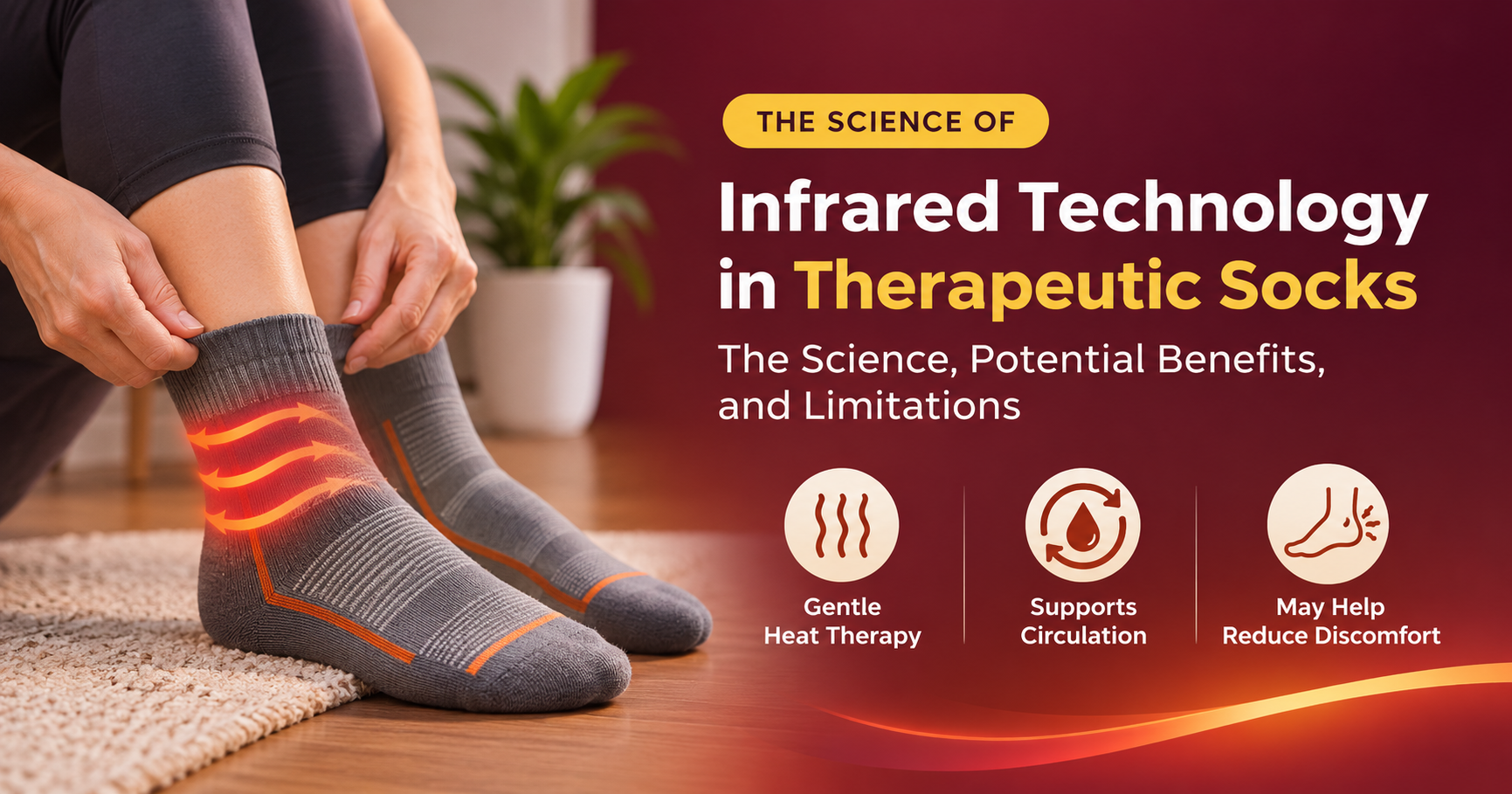
Walk through any wellness or foot-care store and you will see socks that promise “infrared technology,” “far-infrared fibers,” or “ceramic-infused warmth.” The claims sound impressive, but what is actually happening inside the fabric? This guide explains the science of infrared technology in therapeutic socks in plain language: what infrared energy is, how socks can use it, which materials make it possible, what research currently shows, and how to separate genuine technology from marketing hype.
Key takeaways
- Infrared socks are passive. They have no battery or heating element.
- They contain mineral or ceramic particles that absorb your body heat and re-emit it as far-infrared energy.
- The physics of absorption and re-emission is well established. The size of the health benefit is still being studied.
- Fiber quality, particle placement, and fit matter more than the label.
- People with diabetes, nerve damage, or circulation problems should speak with a healthcare professional first.
What Is Infrared Radiation?
Infrared (IR) is a type of electromagnetic energy, the same family that includes radio waves, visible light, and X-rays. It sits just beyond the red end of the visible spectrum, which is exactly where its name comes from: infra means “below” red. You cannot see it, but you can feel it as warmth. The heat you feel from a sunny window, a campfire, or a warm cup of tea is largely infrared radiation.
Infrared is usually divided into three bands based on wavelength:
- Near-infrared: the shortest infrared wavelengths, closest to visible light.
- Mid-infrared: a transition zone between the near and far bands.
- Far-infrared: the longest infrared wavelengths, the band that warm objects and the human body naturally radiate.
Why Far-Infrared Matters for Socks
Every object above absolute zero gives off infrared energy, and the hotter it is, the more it radiates. Human skin, at roughly 33 to 34 °C, radiates most strongly at a wavelength of about 9 to 10 micrometers. That sits squarely in the far-infrared range. Skin is also an excellent emitter and absorber, with an emissivity of around 0.98, which means it behaves almost like an ideal “black body.”
This is the foundation of the whole concept. Your feet are already constantly broadcasting far-infrared energy. A normal cotton sock lets much of that energy pass through and escape. A sock containing particles with high far-infrared emissivity can absorb part of that energy and send a share of it back toward the skin instead of letting it dissipate into the shoe and the air.
How Infrared Therapeutic Socks Work
The process can be described in five simple steps:
- Your body radiates heat. The skin of your feet continuously emits infrared energy.
- Particles absorb it. Fine mineral or ceramic particles woven into the yarn absorb part of that radiant energy.
- The fabric re-emits far-infrared. Because these minerals are efficient emitters at far-infrared wavelengths, they radiate energy back toward the foot.
- The skin absorbs it. The radiant energy is taken up by the outer layers of the skin and registers as gentle warmth.
- The body may respond. Some researchers suggest that warming of the skin surface can encourage small blood vessels near the skin to widen, which may modestly improve local blood flow.
It is important to understand what this is not. The sock does not create energy, it does not behave like an electric heating pad, and far-infrared radiation is absorbed mostly in the outer layers of the skin. Any deeper effect would come from changes in blood flow and normal heat conduction rather than the radiation itself penetrating deep into the tissues.
The Materials Behind the Technology
The “infrared” in an infrared sock comes from the minerals blended into the fiber. Manufacturers typically choose materials known for high emissivity in the far-infrared range:
| Material | What it is | Why it is used |
|---|---|---|
| Ceramic powders (such as alumina, zirconia, or silica) | Finely ground engineered minerals | High far-infrared emissivity and good stability through washing |
| Tourmaline | A natural crystalline mineral | Commonly marketed for far-infrared emission |
| Bamboo charcoal | Carbon produced from bamboo | Absorbs and re-emits heat, and also helps manage odor and moisture |
| Germanium and other mineral blends | Trace elements and mineral composites | Used in some proprietary yarn blends |
Embedded Particles vs Surface Coatings
How the particles are added to the sock is just as important as which particles are used. In better-made socks the mineral powder is mixed into the polymer before the fiber is spun, so the particles are locked inside the yarn. In cheaper products the minerals are applied as a surface finish, which can gradually wear off with washing and friction.
What Does the Research Say?
This is the part that deserves honesty. The underlying physics is solid: warm bodies emit far-infrared, and certain minerals absorb and re-emit it efficiently. Laboratory tests on far-infrared textiles commonly report higher emissivity and slightly better heat retention than ordinary fabrics.
The health-related claims are less settled. Some small studies on far-infrared emitting garments and wraps report modest increases in skin temperature, short-term changes in local microcirculation, and improved comfort or perceived warmth. Laboratory research has also explored whether far-infrared energy may influence the lining of blood vessels. However, many of these studies are small, short, or use different devices and exposure levels, and results are mixed. Larger and longer trials specifically on socks remain limited. A reasonable summary is that infrared socks are a plausible comfort tool with modest, not miraculous, effects.
Realistic Benefits You Can Expect
- Improved warmth retention: by reflecting and re-radiating body heat, the socks may help feet feel warmer in cool conditions.
- Comfort after activity or long days: many wearers describe a soothing, relaxed feeling in tired feet.
- Better moisture and odor control: mineral and charcoal blends are often combined with moisture-wicking yarns.
- Cozy support for cold-sensitive feet: a helpful extra layer for people who simply run cold.
Who May Benefit, and Who Should Be Careful
Infrared socks may appeal to people who spend long hours standing, those who live or work in cold environments, active people who want comfortable recovery wear, and anyone whose feet feel cold often.
Important safety note
If you have diabetes, peripheral neuropathy, peripheral artery disease, Raynaud’s phenomenon, or any condition that reduces sensation or circulation in your feet, speak with your doctor or podiatrist before using any warming product. Reduced sensation can make it harder to notice irritation or skin changes. Always inspect your feet regularly, and stop using the socks if you notice redness, pain, blisters, or discomfort.
How to Choose a Quality Pair of Infrared Socks
- Check the fiber details. Look for clear information on the mineral or ceramic content and whether it is embedded in the yarn.
- Look for evidence, not slogans. Reputable brands can describe independent testing of far-infrared emissivity rather than relying on vague words like “energy” or “healing.”
- Prioritize a non-restrictive fit. Socks should hold gently without squeezing. Tight cuffs can limit circulation, which defeats the purpose.
- Choose breathable, moisture-wicking blends. Wool, bamboo, or technical synthetics help keep skin dry.
- Prefer seamless toes and flat seams. This lowers the risk of rubbing and pressure spots.
- Match cushioning to your activity. Thicker padding suits walking and standing, while thinner knits work better inside fitted shoes.
- Be skeptical of cure claims. A trustworthy product never promises to treat or cure a medical condition.
Caring for Infrared Socks
- Wash in warm or cool water on a gentle cycle.
- Avoid bleach and strong chemical detergents, which can damage fibers and finishes.
- Skip fabric softener, which can coat fibers and reduce moisture-wicking performance.
- Air dry or tumble dry on low heat to protect the elastic and the yarn structure.
Common Myths About Infrared Socks
Myth: Infrared socks heat your feet like a heater. They do not. They only recycle heat your body already produces.
Myth: Infrared penetrates deep into muscles and bones. Far-infrared is absorbed mainly near the skin surface, so claims of deep tissue treatment are exaggerated.
Myth: Infrared socks cure neuropathy, arthritis, or poor circulation. No sock can cure a medical condition. They may add comfort, but they are not a replacement for medical care.
Myth: All infrared socks perform the same. Mineral type, particle quality, fiber construction, and fit all affect results.
Frequently Asked Questions
Do infrared socks need to be charged or plugged in?
No. Therapeutic infrared socks are passive. They work only with the heat your body already gives off.
Can I wear infrared socks all day?
Most healthy adults can wear them comfortably throughout the day, provided they fit well and feel comfortable. Take them off if you notice irritation or discomfort.
How long before I notice a difference?
Any warming sensation tends to be felt within minutes of wearing them. Comfort-related benefits vary from person to person, and some people feel little difference.
Will the infrared effect wash out?
It depends on the construction. Socks with particles embedded in the fiber generally keep their properties longer than those with a surface finish.
Are infrared socks safe for everyone?
They are suitable for most people, but anyone with diabetes, nerve damage, or circulation disorders should consult a healthcare professional first.
Final Thoughts
Infrared technology in therapeutic socks is built on genuine physics: your body emits far-infrared energy, and carefully engineered mineral fibers can capture and return part of it as gentle warmth. The benefits are best understood as added comfort and heat retention rather than medical treatment. By choosing socks with embedded mineral fibers, a comfortable non-restrictive fit, and honest marketing, you can enjoy the technology for what it is: a smart, passive way to keep tired and cold feet more comfortable.
Disclaimer: This article is for general information only and is not medical advice. Consult a qualified healthcare professional about any foot condition or before using a new product if you have a medical condition.