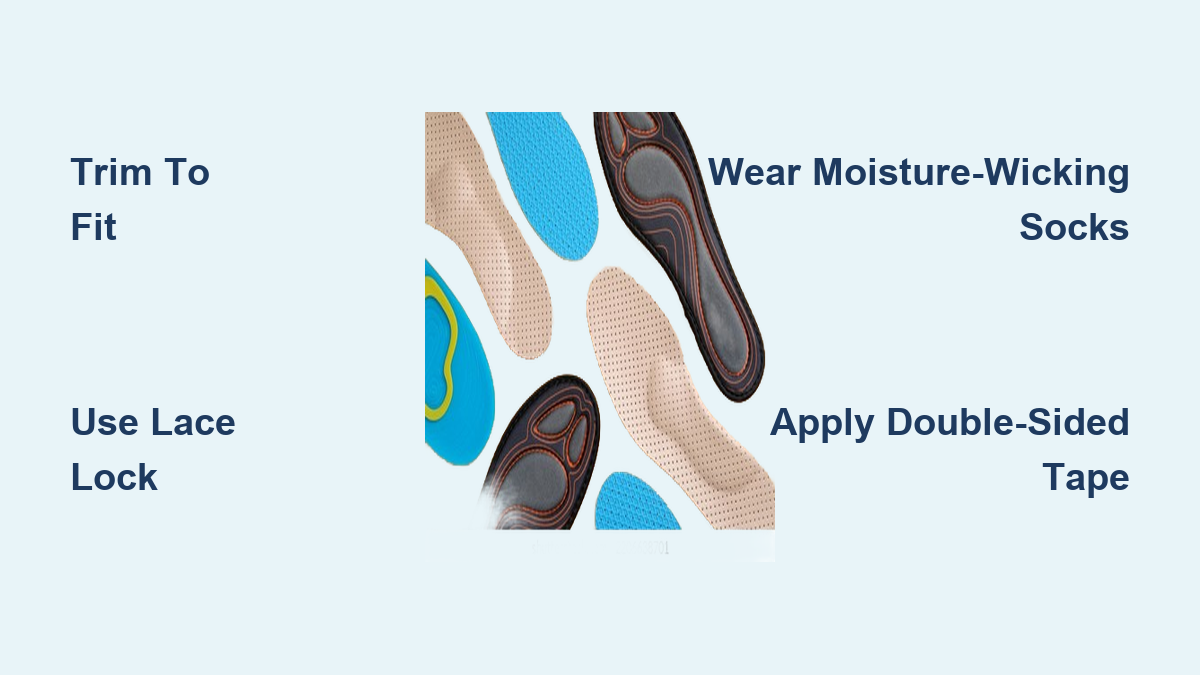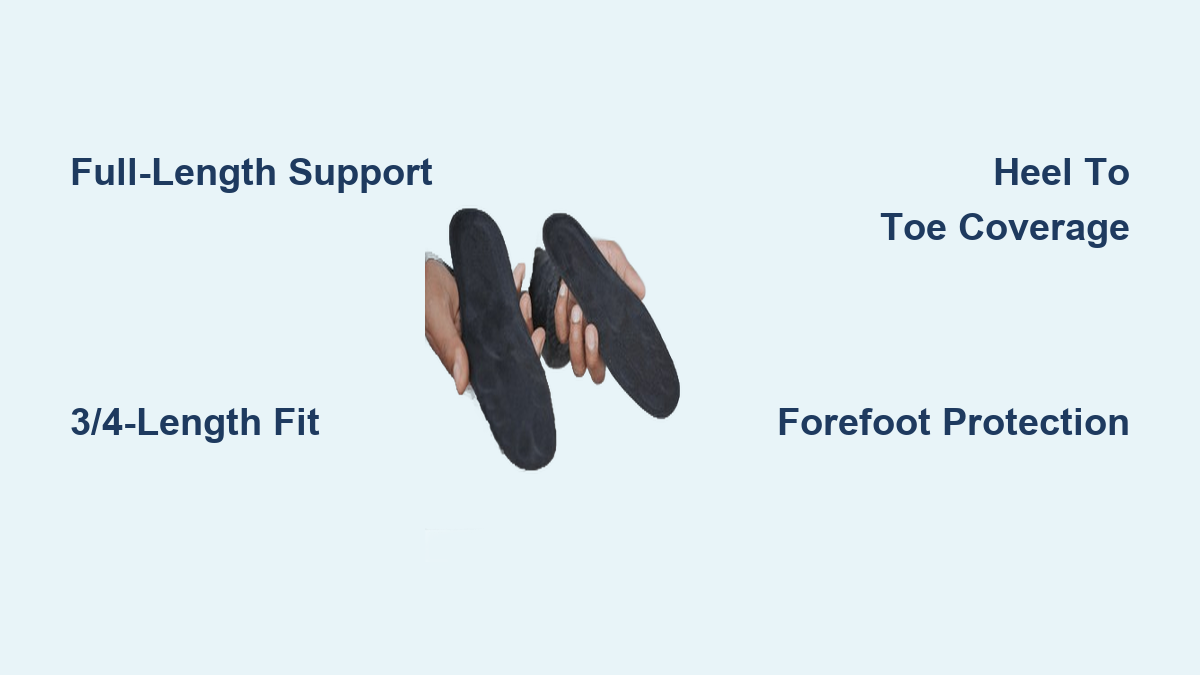
If you’ve ever stood in the drugstore aisle staring at rows of insoles, trying to decide between full-length and three-quarter (3/4) versions, you’re not alone. The choice between full-length and 3/4-length insoles isn’t just about fit—it’s about function, foot health, and long-term comfort. Whether you’re managing plantar fasciitis, flat feet, or ball-of-foot pain, picking the right insole can mean the difference between relief and ongoing discomfort.
Full-length insoles replace your shoe’s original insert and run from heel to toe, offering complete biomechanical support across your entire foot. They stabilize your arch, cushion your heel, and protect the ball of your foot—making them the gold standard for treating foot conditions. In contrast, three-quarter length insoles stop just before the forefoot, designed specifically for tight shoes like dress shoes, heels, or loafers where space is limited. While they provide arch and heel support, they offer no protection under the toes, making them more of a compromise than a cure.
In this guide, you’ll discover the key differences in design, function, and real-world performance between full-length and 3/4-length insoles. You’ll learn which conditions each type can help, which shoes they fit, and when to use one—or both. Most importantly, you’ll understand why full-length insoles are clinically preferred and when a 3/4-length version might be your best alternative.
Full-Length Insoles: Complete Biomechanical Support
Full-length insoles are engineered to support your entire plantar surface, from the heel through the arch and into the forefoot. They’re designed to replace your shoe’s factory insole, delivering continuous alignment, shock absorption, and pressure redistribution with every step.
Why Full-Length Insoles Are Clinically Superior
These insoles provide total contact support, anchoring your foot from back to front. This prevents slippage and keeps the arch support properly positioned during walking or standing. Because they extend into the toe box, they help distribute pressure away from the ball of the foot—a crucial benefit for conditions like metatarsalgia.
Key advantages:
– Prevent arch collapse throughout the gait cycle
– Reduce heel impact with deep heel cups (8–12mm)
– Cushion the forefoot and protect metatarsal heads
– Stay securely in place due to toe-box containment
Clinical Insight: “Approximately 70% of plantar fasciitis patients see significant improvement using full-length over-the-counter orthotics like PowerStep Pinnacle—especially when combined with daily stretching.”
— Dr. Tom Biernacki, DPM
Best Shoes for Full-Length Insoles
You’ll get the most benefit in footwear with removable inserts and ample internal volume, such as:
– Running and athletic shoes (e.g., Brooks, ASICS, HOKA)
– Walking and hiking boots
– Work safety shoes
– Casual sneakers with deep footbeds
Avoid forcing full-length insoles into narrow or shallow shoes—they can compress your toes, cause blisters, and reduce effectiveness.
3/4-Length Insoles: Slim Support for Tight Shoes
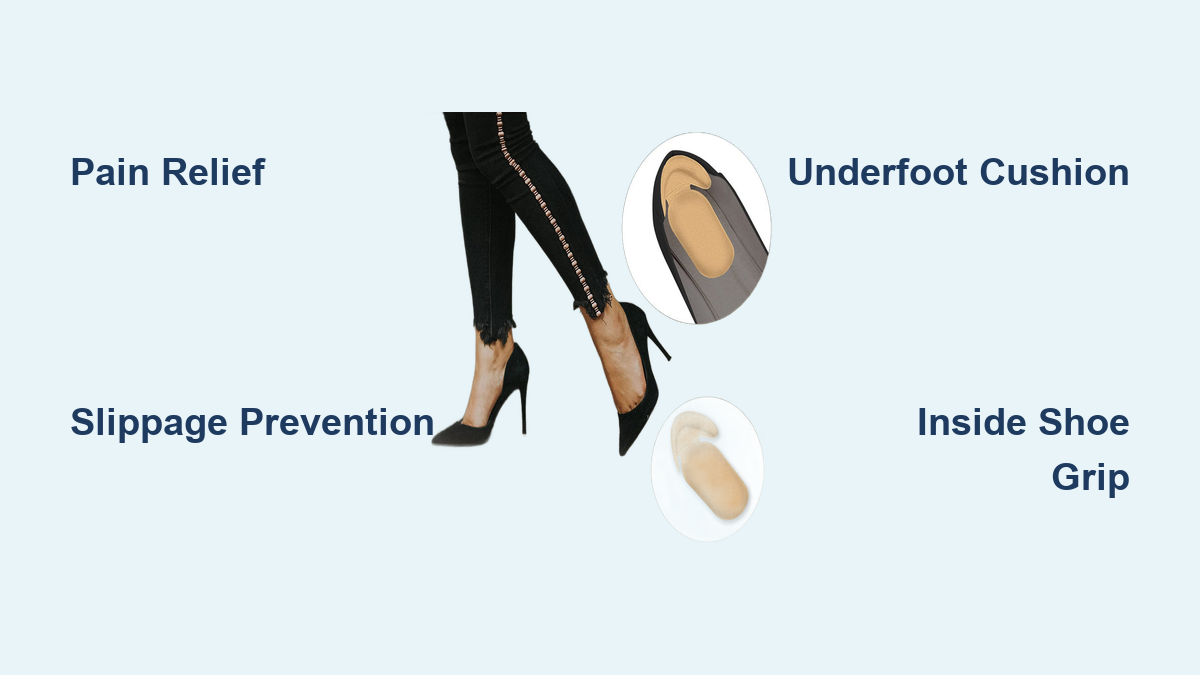
Three-quarter length insoles cover only about 75% of your foot, ending just before the ball of the foot. They’re built for low-volume footwear like dress shoes, ballet flats, or women’s pumps—where a full insert simply won’t fit.
How 3/4-Length Insoles Work
These insoles focus on arch and heel support while sacrificing forefoot protection. Since they don’t extend into the toe area, they’re often thinner and more flexible, allowing them to fit on top of existing (non-removable) insoles.
Key features:
– Ultra-thin profile (as low as 2.5mm)
– Targeted medial arch support
– Deep heel cup for calcaneal stabilization
– No forefoot cushioning or metatarsal padding
Because they lack toe-box anchoring, they can shift forward during walking, especially when new. Over time, many “settle” into the shoe’s shape, improving stability.
Podiatrist Warning: If your 3/4 insole keeps sliding, it may mean your shoe is too wide or lacks midfoot support—not just an insole issue.
Ideal Use Cases
3/4-length insoles shine in situations where full-length inserts are impractical:
– Men’s oxfords or loafers
– Women’s high heels and flats
– Shoes with permanently attached padding
– Professional settings requiring formal footwear
They’re secondary inserts, not primary treatment tools. Think of them as a support bridge—better than nothing, but not a replacement for full-length orthotics.
Key Differences: Full vs. 3/4 Length

Coverage and Support Area
| Feature | Full-Length | 3/4-Length |
|---|---|---|
| Heel to Toe Coverage | ✅ Complete | ❌ Ends before ball of foot |
| Arch Support Stability | Anchored by toe box | Can shift forward |
| Forefoot Protection | Includes metatarsal padding | No cushioning under toes |
| Heel Cup Function | Deep, stabilizing | Comparable depth |
Bottom line: Full-length insoles maintain alignment across the entire gait cycle. 3/4-length versions offer partial support and are more likely to move during activity.
Pressure Redistribution
- Full-length insoles reduce peak plantar pressure by 18–22% across heel, arch, and forefoot.
- 3/4-length insoles reduce pressure by only 12–15%, with minimal impact on forefoot loading.
This makes a big difference for conditions like metatarsalgia, where forefoot cushioning is essential.
Stability During Movement
- Full-length: Stays put due to full contact and toe-box fit.
- 3/4-length: May require taping or gel grips early on; improves after break-in.
Users often describe 3/4 insoles as feeling “floating” or unstable during prolonged walking or standing.
Which Insole Type Is Right for Your Condition?

Plantar Fasciitis: Full-Length Preferred
While 3/4-length insoles can help in dress shoes, full-length is the gold standard for treating plantar fasciitis.
Why?
– Provides continuous tension relief along the entire plantar fascia
– Deep heel cup centers the fat pad and reduces microtears at the origin
– Prevents arch collapse during push-off
Dr. Biernacki’s Tip: “Use full-length insoles in your most-worn shoes. Reserve 3/4-length versions only for formal footwear.”
Recommended: PowerStep Pinnacle (full-length), PowerStep SlimTech (3/4-length for tight shoes)
Flat Feet or Overpronation: Only Full-Length Works
If you have flat feet, you need aggressive medial posting and full-platform stability—something 3/4-length insoles cannot provide.
Why 3/4 insoles fail:
– Lack forefoot anchoring to control rearfoot motion
– Shift forward, reducing corrective power
– Do not prevent excessive internal rotation of the leg
For moderate to severe overpronation, use:
– PowerStep ProTech (aggressive posting)
– PowerStep Maxx (maximum arch support)
Metatarsalgia (Ball-of-Foot Pain): Full-Length with Padding
Pain under the metatarsal heads requires forefoot cushioning—only possible with full-length insoles that include a metatarsal pad or dome.
3/4-length insoles leave this area exposed, increasing pressure with every step.
Workaround: Pair a 3/4 insole with a separate forefoot cushion like Foot Petals Tip Toes for heels or flats.
Heel Spurs and Achilles Tendonitis: Full-Length with Heel Lift
For heel spurs, a deep heel cup reduces pressure on the inflamed site. For Achilles issues, a slight heel lift decreases tendon strain.
Both require full-length insoles to maintain consistent positioning. Some 3/4 models offer heel cups but lack the elevation and rearfoot control needed for true relief.
Diabetic Foot Care: Full-Length Only
People with diabetes must avoid pressure points that can lead to ulcers. Only full-length, uniform-support insoles are safe and effective.
They:
– Distribute pressure evenly
– Prevent hot spots
– Are often part of diabetic-approved footwear systems
Never rely on 3/4-length insoles for diabetic foot management.
When to Use Both Insole Types
The smartest approach? Own both.
Most people benefit from using:
– Full-length insoles in daily-worn shoes (athletic, walking, work)
– 3/4-length insoles in dress shoes, heels, or loafers
“Consistent support across all footwear is more effective than maximum support in just one pair of shoes.”
— Dr. Tom Biernacki
This strategy ensures your feet stay aligned and protected all day, every day—not just during workouts.
Common Mistakes to Avoid
Mistake #1: Using Only 3/4-Length for Treatment
Many patients wear supportive shoes during work hours but go barefoot or slip into unsupportive slippers at home. This breaks the healing cycle.
Fix: Use supportive house shoes or slippers with full-length inserts.
Mistake #2: Forcing Full-Length Insoles into Tight Shoes
Jamming a thick insole into a narrow pump or loafer causes toe crowding, blisters, and discomfort.
Fix: Use a 3/4-length insole instead—thin, supportive, and designed for tight spaces.
Mistake #3: Skipping the Break-In Period
Jumping straight to all-day wear can cause muscle fatigue or new pain.
Recommended protocol:
– Day 1: 2 hours
– Day 2: 4 hours
– Day 3: 6 hours
– Day 4+: Increase until comfortable with full-day use
This applies to both full and 3/4-length versions.
Mistake #4: Wearing Worn-Out Insoles
Insoles lose support over time. Replace every 6–12 months with daily use.
Signs it’s time for new ones:
– Flattened heel cup
– Soft, collapsed arch
– You can feel the shoe’s base through the foam
– 3/4-length models degrade faster due to thinner materials
Top Product Picks by Type

Best Full-Length Insoles
| Product | Best For | Key Features |
|---|---|---|
| PowerStep Pinnacle | Plantar fasciitis, general pain | Semi-rigid shell, dual-layer cushioning, deep heel cup, antimicrobial cover |
| PowerStep ProTech | Severe overpronation | Aggressive medial posting, extra-deep heel cup |
| PowerStep Maxx | High arch collapse | Maximum support, rigid platform |
| CURREX RunPro | Running and sports | Dynamic flex zones, gait-adaptive design |
Best 3/4-Length Insole
| Product | Best For | Key Features |
|---|---|---|
| PowerStep SlimTech | Dress shoes, flats, loafers | 2.5mm ultra-thin, arch support, heel cup, fits non-removable insoles |
This is the only 3/4-length insole recommended by podiatrists for maintaining support in tight footwear.
When to Upgrade to Custom Orthotics
Over-the-counter insoles work for most people—but not all. Consider custom orthotics if:
- Full-length OTC inserts fail after 6+ weeks of consistent use
- You have complex foot anatomy (e.g., rigid flatfoot, severe bunions)
- You have diabetes or arthritis needing precise pressure mapping
- Pain persists despite proper insole use and stretching
Custom orthotics are full-length, made from a 3D scan or mold, and tailored to your exact biomechanics.
Insurance Tip: Most PPO plans and Medicare Part B cover custom orthotics when prescribed by a podiatrist for a documented condition.
When to See a Podiatrist
Don’t wait months in pain. Seek professional help if:
- Foot pain continues beyond 4–6 weeks of insole use
- You feel burning, tingling, or numbness (possible nerve issue)
- Pain worsens at rest or night
- There’s swelling, redness, or warmth
- You can’t bear weight on the foot
These could signal:
– Baxter’s neuropathy
– Tarsal tunnel syndrome
– Calcaneal stress fracture
– Posterior tibial tendon dysfunction (PTTD)
– Charcot foot (in diabetics)
Frequently Asked Questions
Can I stack a 3/4 insole on top of my shoe’s insole?
Yes—that’s exactly what they’re designed for. In shoes with non-removable inserts, place the 3/4-length insole directly on top. It adds support without altering fit.
Do I need both full and 3/4-length insoles?
Yes, if you wear different types of shoes. Use full-length in daily footwear and 3/4-length in dress shoes to maintain all-day support.
Will a 3/4-length insole help plantar fasciitis?
It’s better than nothing, but not a primary treatment. Use full-length insoles in your most-worn shoes. Reserve 3/4 versions only when space is limited.
How often should I replace my insoles?
Every 6–12 months with daily use. Replace sooner if:
– Heel cup is flattened
– Arch feels soft
– Foam is compressed
– 3/4-length models wear faster due to thinness
Does insurance cover insoles?
- OTC insoles (e.g., PowerStep): Not covered.
- Custom orthotics: Often covered by PPO and Medicare Part B with a podiatrist’s prescription.
Final Recommendations
- Full-length insoles are the primary solution for foot pain—offering complete support for heel, arch, and forefoot.
- 3/4-length insoles are secondary tools for tight shoes—useful but not therapeutic.
- Consistency matters: Support your feet in every shoe, all day long.
- If pain lasts beyond 4–6 weeks, see a podiatrist—your issue may need more than an insole.
“Start with full-length for treatment. Use 3/4-length only when space is limited.”
— Dr. Tom Biernacki, DPM
Your feet carry you every day. Give them the support they need—no matter what shoes you’re wearing.