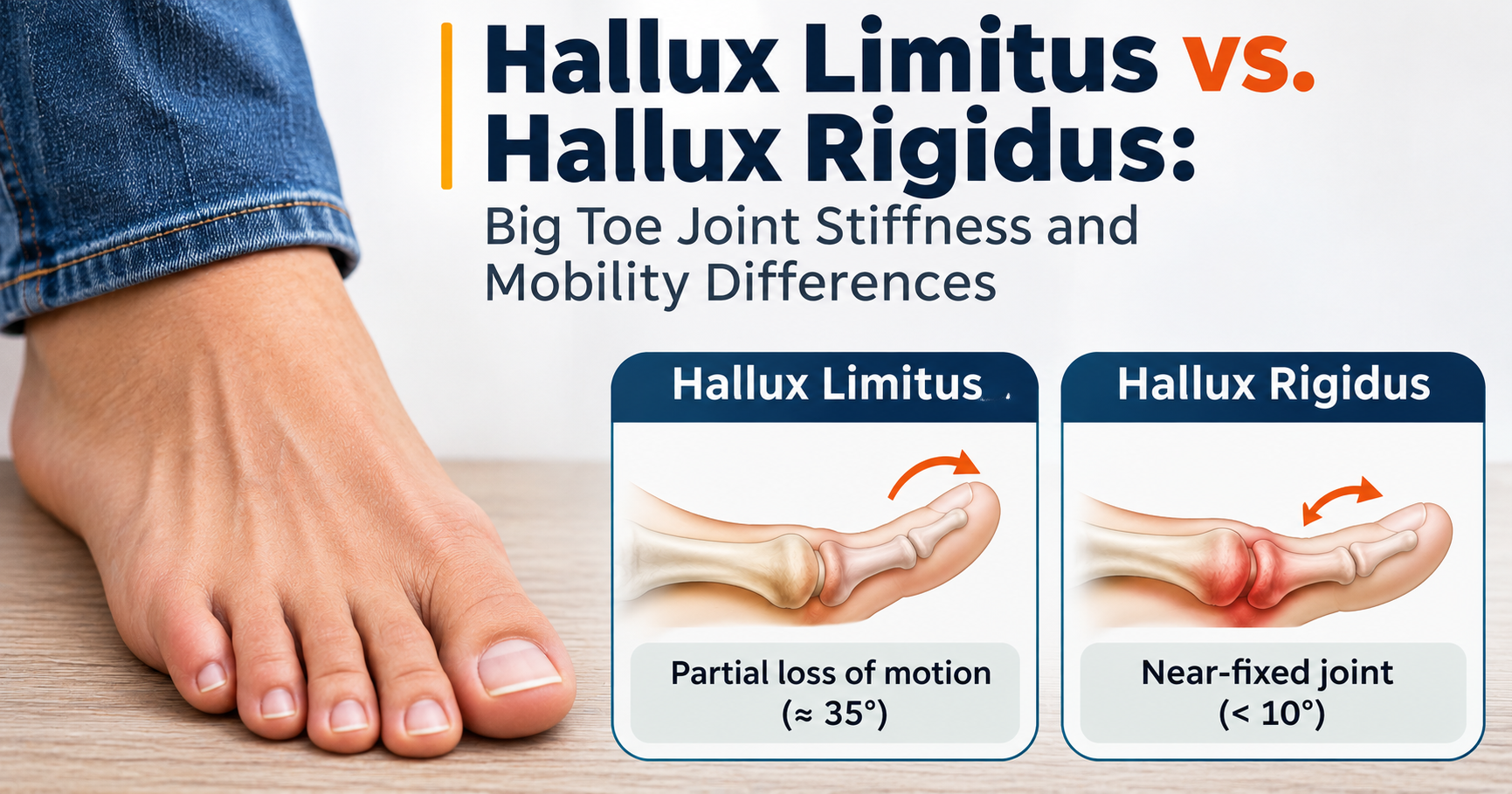
Big toe pain that makes every step feel like a negotiation is more common than most people think. If you have searched for answers, you have likely met two similar terms: hallux limitus and hallux rigidus. They affect the same joint and share many symptoms, yet they sit at different points on the same road. This guide explains hallux limitus vs hallux rigidus in plain language: what each one is, how they differ, how doctors diagnose them, and what you can do about them.
What is the big toe joint (first MTP joint)?
The word hallux is the medical name for the big toe. The joint at its base is called the first metatarsophalangeal (MTP) joint, where the long foot bone (first metatarsal) meets the toe bone (proximal phalanx). Every time you walk, this joint bends upward so your heel can lift and you can push off. A healthy joint bends roughly 65 to 75 degrees. About 60 degrees is needed for normal walking, and more for running or climbing stairs.
When that bend is lost, your foot has to find another way to move, and that is where pain, limping and secondary problems begin.
What is hallux limitus?
Hallux limitus means “limited big toe”. The joint can still move, but the upward bend is reduced, often to somewhere between 10 and 40 degrees less than normal. Motion may be limited all the time, or only when you stand and put weight on the foot. The second type is called functional hallux limitus, and it is easy to miss because the toe moves freely when you are sitting.
At this stage, the cartilage inside the joint is usually still in reasonable condition, which is why early action matters.
What is hallux rigidus?
Hallux rigidus means “stiff big toe”. It is a form of degenerative arthritis in which cartilage has worn down, the joint space has narrowed and bone spurs (osteophytes) have formed, particularly on top of the joint. The toe may bend very little or not at all. A hard bump often appears on the top of the foot and can rub against shoes.
Hallux limitus vs hallux rigidus: the key differences
Side view of the big toe joint: normal, hallux limitus and hallux rigidus
| Feature | Hallux limitus | Hallux rigidus |
|---|---|---|
| Definition | Reduced upward bend of the big toe joint; joint cartilage still partly healthy | Advanced arthritis of the big toe joint with severe loss of motion |
| Range of motion | Limited but present (often 10–40° less than normal) | Very little or none, often under 10° |
| Pain pattern | Pain at the top of the joint when pushing off, eases with rest | Pain at rest and at night, worse in cold or damp weather |
| Bone spur | Small or absent | Large, visible bump on top of the joint |
| X-ray | Mild or normal joint space | Narrowed joint space, spurs, hardening of bone |
| Main treatment | Footwear, orthotics, therapy, anti-inflammatories | Same options early on; injections or surgery if symptoms stay severe |
| Outlook | Can often be slowed or stabilised | Rarely reverses; symptoms can be controlled well |
Causes and risk factors
Both conditions share the same causes, which is why many specialists treat them as a spectrum rather than two separate diseases. Common contributors include:
- Foot structure: a long or raised first metatarsal, a flat or over-pronating foot, or a bunion can all jam the joint.
- Family history: joint shape and arthritis risk often run in families.
- Injury: a stubbed toe, sprain or fracture can damage cartilage, even years earlier.
- Repetitive stress: sports such as football, running and dance, or jobs that need long periods of squatting or standing.
- Inflammatory disease: gout, rheumatoid arthritis and other conditions can wear down the joint.
- Footwear: tight, narrow or high-heeled shoes add pressure over time.
Hallux rigidus is most often seen in adults between 30 and 60 years of age, and it is somewhat more common in women.
Symptoms to watch for
Symptoms usually creep in slowly. In hallux limitus you may notice:
- Pain or a pinching feeling at the top of the big toe joint when you push off
- Stiffness, especially first thing in the morning or after sitting
- Mild swelling or warmth around the joint
- Walking on the outer edge of the foot to avoid bending the toe
In hallux rigidus these signs become stronger and more constant:
- A visible bony bump on top of the toe joint
- Pain at rest or at night, often worse in cold weather
- Very limited or no toe movement
- Pain in the knee, hip or lower back from an altered walking pattern
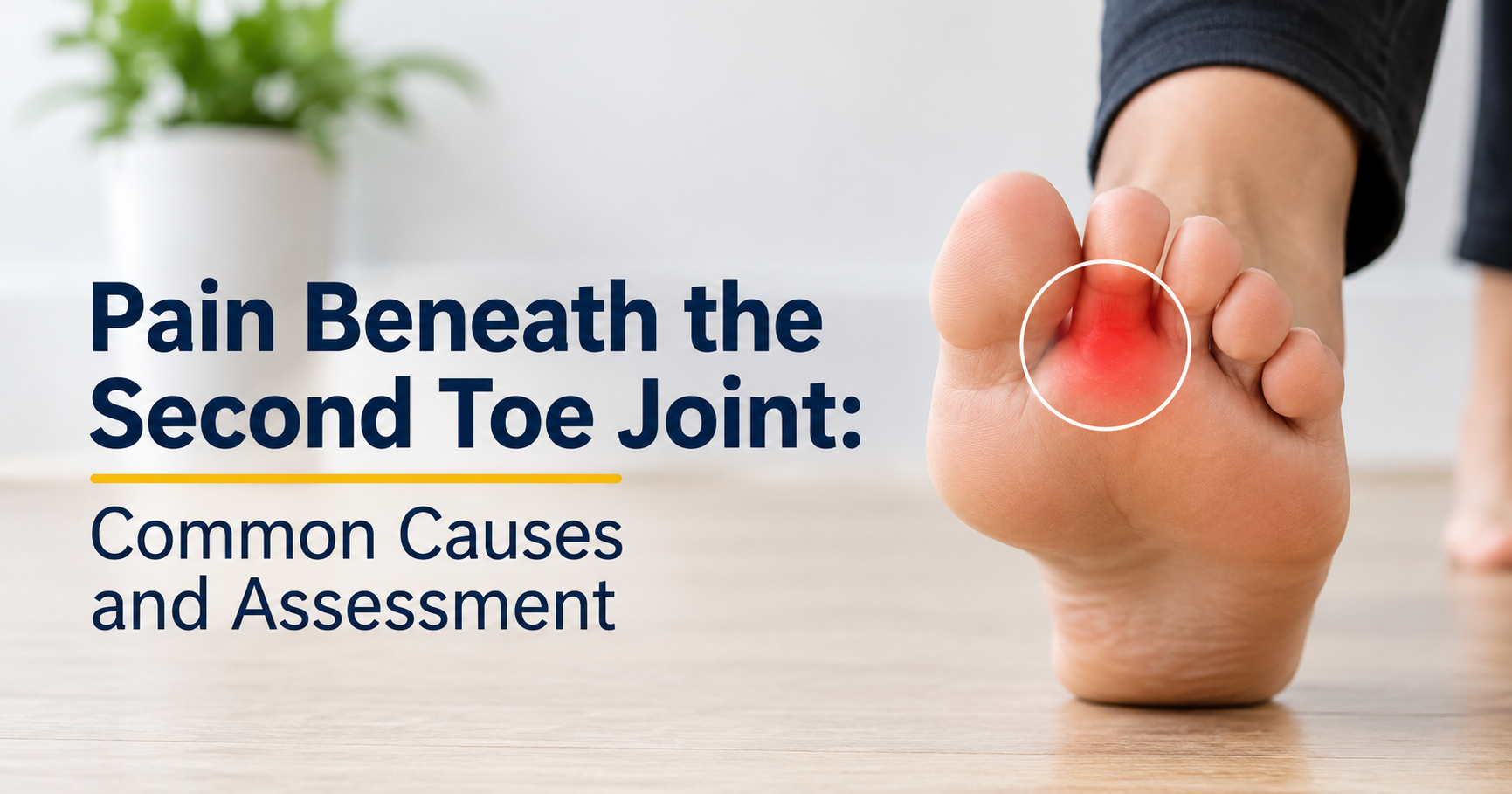
- Pain under the second toe joint because it takes extra load
- Numbness or tingling if the bump presses on a nerve
How the condition progresses
Stages of big toe joint stiffness, from early limitus to advanced rigidus
Doctors often use a five-grade system, from grade 0 (stiffness with normal X-rays) to grade 4 (severe arthritis with constant pain). Hallux limitus matches the early grades, while hallux rigidus covers the later ones. Progression is not guaranteed or fast. Many people remain in the early stages for years.
How it is diagnosed
A podiatrist or orthopaedic foot specialist will usually:
- Ask about your pain, shoes, activities and past injuries.
- Check how far the toe bends, both when sitting and when standing.
- Look for a bump, swelling and tenderness around the joint.
- Order weight-bearing X-rays to check joint space, spurs and bone changes.
- Occasionally use MRI or ultrasound if other problems are suspected.
Getting the right label matters because gout, stress fractures and sesamoid problems can feel similar.
Treatment options
A step-by-step treatment ladder, from self-care to surgery
1. Self-care and activity changes
Ice after activity, rest from painful movements and switch to lower-impact exercise like swimming or cycling. Avoid walking barefoot on hard floors and skip high heels.
2. Footwear and supports
This is the foundation of non-surgical care for both conditions. The aim is to reduce how much the big toe joint has to bend:
- Rocker-bottom shoes: a curved sole rolls you forward without bending the toe.
- Stiff-soled shoes: a firm midsole limits flexing at the joint.
- Wide toe box: gives the joint and any bump room.
- Carbon fibre or rigid insoles: add stiffness inside any shoe.
- Morton’s extension orthotics: support the big toe and limit joint motion.
- Cushioned insoles: absorb shock under the forefoot.
- Gel toe pads and bump protectors: reduce rubbing on a spur.
3. Medication and injections
Over-the-counter anti-inflammatory drugs such as ibuprofen can ease flare-ups if they are safe for you. Topical gels are another option. A corticosteroid injection can calm severe inflammation for a time, but it is not a long-term solution. Check with a doctor or pharmacist before using any medication.
4. Physical therapy
Gentle joint mobilisation, calf stretching and strengthening of the foot muscles can help early cases. Never force the toe through sharp pain.
5. Surgery
Surgery is usually considered when pain remains disabling after a fair trial of conservative care. The choice depends on the grade of arthritis, your age and your activity level:
- Cheilectomy: removes the bone spur and a portion of the joint top to restore motion. It suits mild to moderate cases.
- Moberg or other osteotomy: reshapes the toe bone to improve bending.
- Joint replacement (implant): may preserve some motion in selected patients.
- Fusion (arthrodesis): joins the bones to stop painful motion. It is a dependable option for severe rigidus.
How to prevent it from getting worse
- Choose supportive shoes with a stiff sole and room for your toes.
- Replace worn-out shoes and insoles regularly.
- Maintain a healthy weight to reduce load on your feet.
- Warm up and stretch calves before exercise.
- Treat foot pain early, rather than waiting for it to become constant.
Choosing the right products: a simple buying guide
If you are shopping for relief, look for features rather than brand names. For shoes, check that the sole resists bending when you try to fold it in half, the toe box is wide, and the heel is stable. For insoles, decide whether you need stiffness (carbon or rigid), cushioning (gel or foam) or correction (orthotic with arch support). Read return policies carefully, because comfort is personal and it can take a few days to adapt. If your pain is severe, ask a podiatrist whether custom orthotics are worth the cost.
Frequently asked questions
Is hallux limitus the same as hallux rigidus?
No. Hallux limitus is the earlier stage, where motion is reduced but the joint still moves. Hallux rigidus is the advanced form, with arthritis and a nearly stiff joint.
Does hallux limitus always turn into hallux rigidus?
Not always. Many people stay stable for years, especially with good footwear and support. Progression is more likely with ongoing joint stress, a family history or earlier injury.
Can hallux rigidus be cured without surgery?
The arthritis itself cannot be reversed, but many people control pain well with stiff-soled shoes, orthotics, medication and activity changes.
What shoes are best?
Shoes with a stiff or rocker-bottom sole, a roomy toe box and good cushioning reduce bending at the big toe joint.
Which doctor should I see?
A podiatrist or an orthopaedic foot and ankle specialist can examine the joint and order weight-bearing X-rays.
Is walking or running safe?
Low-impact activity such as cycling and swimming is usually easier on the joint. Running can be kept up in mild cases with the right shoes, but stop if pain rises.
Final thoughts
Hallux limitus and hallux rigidus are two stages of the same problem: a big toe joint that is losing its motion. Limitus is the early, more flexible stage, and rigidus is the advanced, arthritic stage with a stiff joint and bone spur. The sooner you recognise the signs, the more options you have. Supportive shoes, the right insoles and professional advice can keep most people walking comfortably, and surgery remains a reliable choice if conservative care is not enough.
Medical disclaimer: this content is for general information only and does not replace advice from a qualified healthcare professional. Always consult your doctor or podiatrist about your symptoms and treatment.