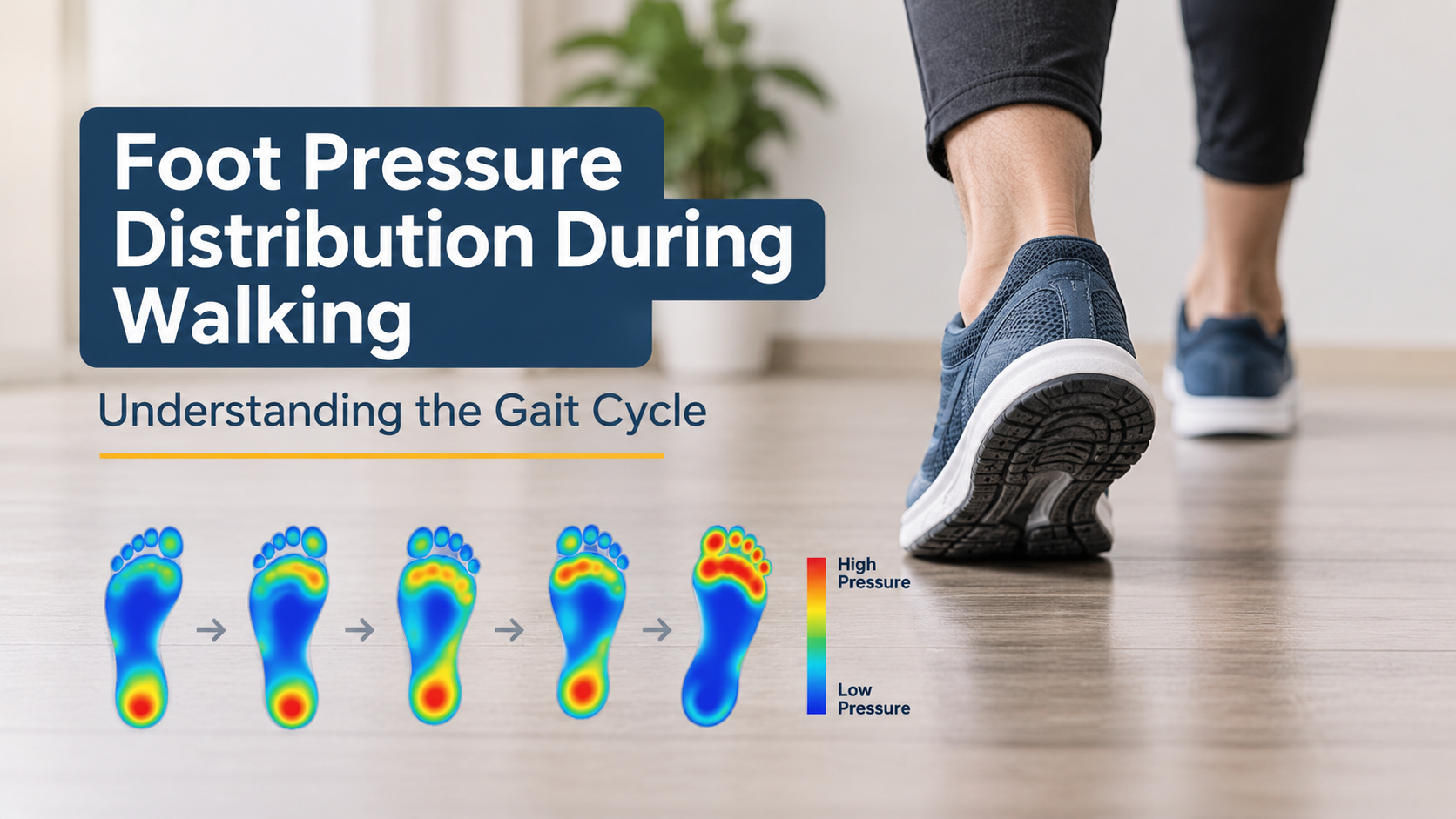
Every step you take is a carefully timed transfer of body weight across a surface smaller than a sheet of paper. Your feet are not loaded evenly, and they are not loaded all at once. Pressure starts at the heel, rolls through the outer midfoot, concentrates under the ball of the foot and finishes at the big toe. When this sequence runs smoothly, walking feels effortless. When it does not, the result can be calluses, pain, fatigue or even ulcers.
This guide explains foot pressure distribution during walking in plain language: what it is, where the highest loads occur, how foot type changes the pattern, what can go wrong, and practical ways to spread pressure more evenly.
Key takeaways
- During walking, the heel, the metatarsal heads (ball of the foot) and the big toe carry most of the load.
- The midfoot normally carries far less pressure than the heel or forefoot.
- Pressure moves in a predictable path called the center of pressure, from the outer heel to the inner forefoot.
- High arches, flat feet, extra body weight, tight calves and poor footwear all change the pattern.
- Cushioning, correct shoe fit, metatarsal support and strengthening can reduce peak pressure.
What Is Foot Pressure Distribution?
Foot pressure distribution, also called plantar pressure distribution, describes how force is spread across the sole of the foot while you stand or move. Pressure is force divided by area. A heavy load on a small area creates high pressure, while the same load spread across a larger area creates lower pressure.
This matters because tissue tolerates only so much stress. Skin thickens into calluses where pressure is repeatedly high. Fat pads thin over time. Joints and bones in overloaded regions may become painful. In people with reduced sensation, such as those with diabetic neuropathy, high-pressure spots are a leading cause of foot ulcers.
The Gait Cycle: Why Pressure Keeps Changing
A full walking step cycle runs from one heel strike to the next heel strike of the same foot. About 60% of the cycle is the stance phase (foot on the ground) and about 40% is the swing phase (foot in the air). Plantar pressure only exists during stance, and it shifts through several stages.
- Initial contact: the outer edge of the heel touches down and absorbs impact.
- Loading response: the foot lowers toward the ground while the arch and ankle absorb shock.
- Midstance: the foot is flat and supports the full body weight over a single leg.
- Terminal stance: the heel lifts and load moves to the ball of the foot.
- Pre-swing: the toes push off and propel the body forward.
Where Pressure Is Highest When You Walk
In healthy adults, peak pressure under the foot is not equal everywhere. Different measurement systems give different numbers, but the overall pattern is consistent.
| Foot region | Typical role | Relative pressure |
|---|---|---|
| Heel | Absorbs first impact and stabilizes the foot | High |
| Midfoot (outer arch) | Transfers load forward, limited contact | Low to moderate |
| Metatarsal heads (ball of foot) | Main weight-bearing and rolling area; the second and third heads often peak highest | Highest |
| Big toe (hallux) | Stabilizes balance and provides final push-off | Moderate to high |
| Lesser toes | Assist balance and grip | Low |
The forefoot usually experiences the highest peak pressure during normal walking, while the heel carries the largest early impact. Walking faster, carrying extra weight or walking on hard surfaces raises these values.
How Pressure Changes Through One Step
Pressure under each region rises and falls at different moments. The heel peaks right at the start of stance, the midfoot peaks briefly in the middle, the forefoot peaks later as the heel rises, and the big toe peaks last at push-off.
Vertical ground reaction force also follows a double-peak pattern. The first peak happens when weight is accepted onto the foot, a small dip occurs at midstance, and a second peak happens during push-off. Each peak is often close to or slightly above body weight at a normal walking speed.
The Center of Pressure Path
If you tracked the single point where the combined load acts, you would see a smooth line called the center of pressure (COP). In a typical walking step it travels along a predictable route, which clinicians use to judge how well the foot is functioning.
- Lateral heel – first touchdown
- Outer midfoot – weight travels forward
- Forefoot (metatarsal heads) – crosses from outer to inner
- Big toe – final push-off
A COP path that stays too far outside, drifts too far inside, jumps abruptly or spends too little time on the forefoot can point to instability, stiffness, weakness or pain avoidance.
How Foot Type Changes Pressure Distribution
Arch height has a strong influence on where load lands. Three broad patterns are common.
Neutral arch
Load shared across heel, forefoot and outer midfoot
High arch (cavus)
Heel and forefoot overloaded, little midfoot contact
Low arch (flat foot)
Large midfoot contact, inner-arch loading
- Neutral arch: pressure is shared between heel, outer midfoot and forefoot.
- High arch: the foot is rigid and contacts the ground mainly at the heel and ball, so pressure per square centimeter is high in those areas. Calluses under the metatarsal heads and heel are common.
- Flat foot: the arch collapses, increasing contact in the midfoot and loading the inner side of the foot. This can strain the arch, ankle and sometimes the knees and lower back.
Factors That Affect Plantar Pressure
- Body weight: more weight means more force through the same area.
- Walking speed: faster steps raise peak heel and forefoot pressure.
- Footwear: hard, thin or narrow shoes concentrate pressure, while cushioned, wide-toe-box shoes spread it.
- Walking surface: concrete and tile increase impact compared with softer ground.
- Age: fat pads thin and flexibility drops over the years.
- Calf tightness: limited ankle motion shifts load to the forefoot.
- Foot deformities: bunions, hammertoes and claw toes alter how the forefoot loads.
- Neuropathy and diabetes: reduced sensation hides high pressure, so damage can occur unnoticed.
- Muscle weakness: weak foot and calf muscles reduce control of the rolling motion.
- Leg length difference: the longer leg often carries higher load.
Signs of Abnormal Pressure Distribution
Your body often shows where pressure is too high. Look for these clues:
- Thick calluses under the ball of the foot or the heel
- Pain in the ball of the foot, especially when walking barefoot
- Shoe wear that is concentrated in one spot on the sole
- Redness or warm areas on the skin after walking
- Corns on the tops or tips of toes
- Fatigue or aching in the arch, heel or lower leg after short walks
- Blisters that keep appearing in the same location
When to see a professional
Persistent foot pain, any open sore, skin that does not heal, numbness or tingling should be checked by a podiatrist or physician. People with diabetes should treat any new callus or redness as a reason for a prompt foot check.
How Foot Pressure Is Measured
| Method | How it works | Best for |
|---|---|---|
| Pressure mat or platform | You walk across a sensor-covered mat that records pressure in each region | Detailed barefoot analysis in clinics |
| In-shoe sensors | Thin sensor insoles record pressure inside your shoes | Testing real shoes and insoles |
| Gait analysis with video | Cameras record joint motion and timing | Overall movement assessment |
| Wet footprint test (at home) | A wet foot leaves a print on paper, showing arch contact area | Quick check of arch type |
The simple wet footprint test is a good starting point. Step onto dark paper with a wet foot. A print showing the heel and forefoot with a narrow band between them suggests a neutral or high arch, while a print showing almost the entire sole suggests a low arch. It does not measure pressure, but it offers useful context.
How to Improve Foot Pressure Distribution
1. Choose the right footwear
- Pick shoes with a roomy toe box so the forefoot can spread.
- Look for good midsole cushioning that absorbs impact at the heel and forefoot.
- Consider rocker-sole shoes, which reduce forefoot loading by easing the roll to toe-off.
- Replace worn shoes before the midsole flattens.
2. Use supportive or offloading insoles
- Full-contact arch support insoles increase contact area and lower pressure per square centimeter.
- Metatarsal pads sit just behind the ball of the foot and reduce load on the metatarsal heads.
- Heel cups improve shock absorption and cushion the heel.
- Custom orthoses can be prescribed for severe or complex patterns.
3. Strengthen and stretch
- Towel scrunches and short-foot exercises train the arch muscles.
- Calf stretches improve ankle motion and reduce forefoot overload.
- Toe spreading and big toe mobility exercises support push-off.
- Single-leg balance practice improves control.
4. Manage weight and activity
Even moderate weight loss reduces the load on every step. Gradually increasing walking distance and mixing hard and soft surfaces also helps tissues adapt.
5. Care for your skin
Moisturize dry skin, manage calluses gently, and wear moisture-wicking socks with light cushioning in high-pressure zones to cut friction.
Quick Guide: Problem and Supportive Solution
| Common problem | What to look for |
|---|---|
| Ball-of-foot pain or forefoot calluses | Metatarsal pad, cushioned forefoot, rocker sole |
| Heel pain or heavy heel strike | Heel cup, shock-absorbing midsole, cushioned insole |
| Flat feet with arch fatigue | Firm arch support insole, stable shoe |
| High arches with stiff feet | Cushioned full-length insole, soft midsole |
| Friction blisters | Moisture-wicking cushioned socks, well-fitted shoes |
Frequently Asked Questions
Which part of the foot takes the most pressure when walking?
The metatarsal heads, especially the second and third, usually show the highest peak pressure. The heel takes the biggest early impact.
Is it normal for the midfoot to carry little pressure?
Yes. A healthy arch lifts the midfoot, so it carries less pressure than the heel and forefoot.
Can insoles change foot pressure distribution?
Yes. Well-chosen insoles spread load over a larger area and reduce peak pressure in problem zones.
Do flat feet always cause problems?
No. Many people with flat feet have no symptoms. Problems tend to appear when the foot is overloaded or fatigued.
Does barefoot walking increase pressure?
Usually yes, especially on hard floors. Cushioned footwear typically reduces peak pressure.
Conclusion
Foot pressure distribution during walking follows a clear pattern: heel strike, a roll through the outer midfoot, peak loading of the ball of the foot and a final push from the big toe. Foot type, body weight, footwear and health conditions all shape that pattern. By understanding it, spotting warning signs early, and using supportive footwear, insoles and strengthening exercises, you can spread load more evenly and keep every step comfortable.
This article is for general education only and is not a substitute for professional medical advice, diagnosis or treatment. Consult a qualified healthcare professional about foot pain or medical conditions.