If your heels lift in a deep squat, your knees ache when you run downhill, or your calves feel permanently tight, limited ankle dorsiflexion mobility may be the hidden cause. This guide explains what dorsiflexion is, how to measure it at home, and which stretches and exercises improve it safely.
What Is Ankle Dorsiflexion?
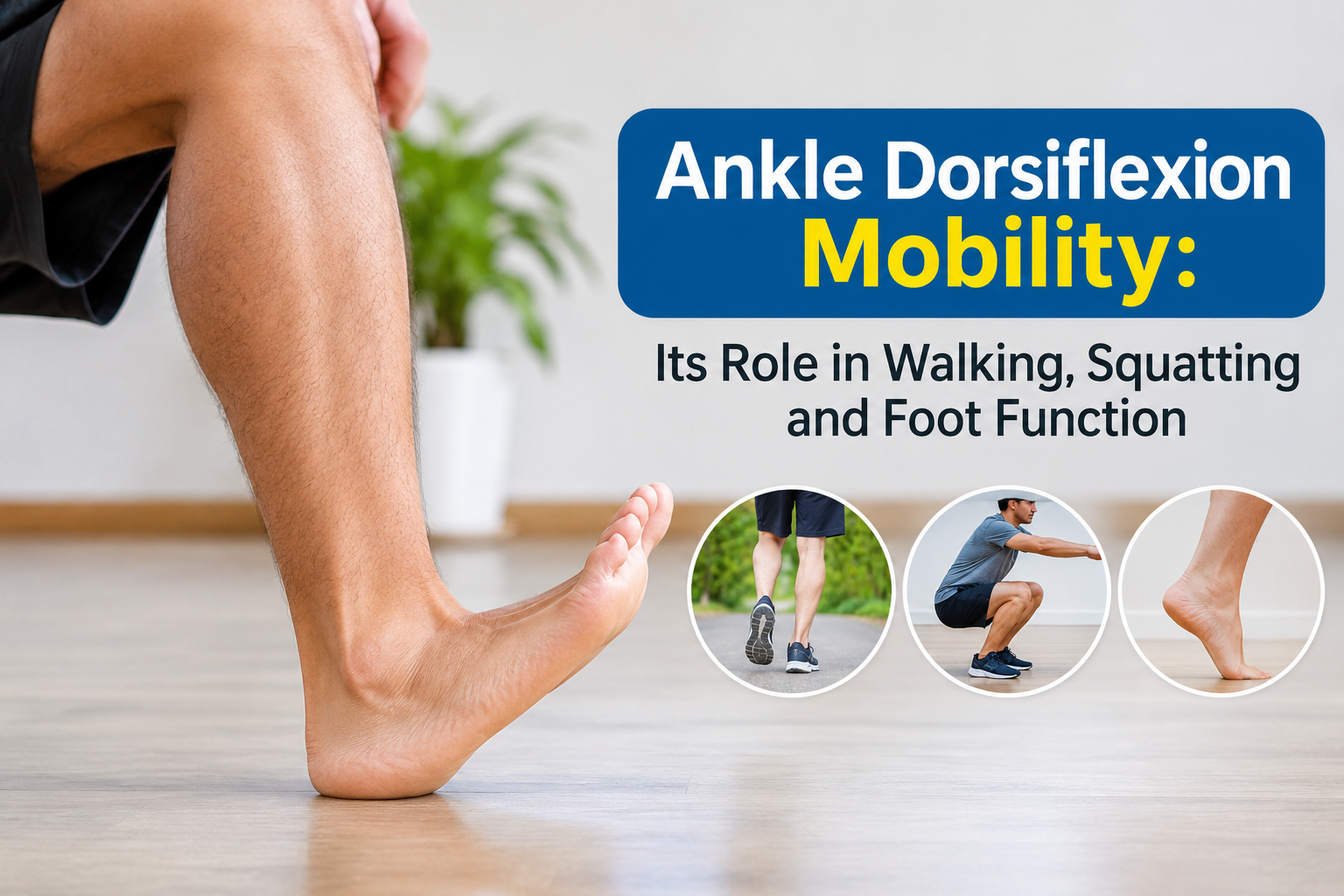
Ankle dorsiflexion is the movement where the top of your foot moves toward your shin, the motion you use when you pull your toes up toward your knee. The opposite movement, pointing the foot down, is called plantarflexion. Dorsiflexion happens mainly at the talocrural joint, where the shin bones (tibia and fibula) meet the talus bone of the foot.
Normal Range of Motion
Most healthy adults have about 15 to 20 degrees of dorsiflexion with the knee straight, and often 20 to 30 degrees with the knee bent. Anything noticeably below this, or a big difference between your left and right ankle, may count as restricted mobility. Athletes who squat, jump, or run often need more range than people with a sedentary routine.
Why Dorsiflexion Mobility Matters
- Squatting and lifting: Limited range makes your heels rise or your torso fold forward.
- Walking and running: The shin must travel over the foot with every step. Restriction can shorten your stride.
- Injury prevention: Poor dorsiflexion is commonly linked with Achilles tendinopathy, plantar fasciitis, shin splints, and patellofemoral (knee) pain.
- Landing mechanics: Stiff ankles push more load to the knees and hips when you jump or land.
- Balance: Good ankle motion supports stability and fall prevention, especially with age.
Common Causes of Limited Dorsiflexion
- Tight calf muscles (gastrocnemius and soleus) and a stiff Achilles tendon
- Joint restriction in the ankle capsule or a talus that glides poorly
- Previous sprains or fractures and scar tissue
- Bony impingement at the front of the ankle
- Footwear habits, such as long periods in high heels or raised-heel shoes
- Prolonged sitting or immobilization in a cast or boot
How to Test Your Ankle Dorsiflexion at Home
The knee-to-wall test is simple and reliable.
- Place a tape measure on the floor, running straight out from a wall.
- Put your big toe on the line, a few centimeters from the wall.
- Keeping your heel flat, bend your knee and try to touch the wall.
- Move your foot back until you reach the furthest distance where you can still touch the wall without the heel lifting.
- Measure toe-to-wall distance and repeat on the other side.
| Distance (toe to wall) | What it usually means |
|---|---|
| Under 8 cm (3 in) | Likely restricted |
| 8 to 10 cm (3 to 4 in) | Borderline |
| 10 cm (4 in) or more | Generally good |
These numbers are general guides, not diagnoses. A large difference between the two sides matters more than the absolute number.
Best Exercises to Improve Ankle Dorsiflexion
1. Standing Gastrocnemius Calf Stretch
Stand facing a wall, one leg back with the knee straight and heel down. Lean forward until you feel a stretch in the upper calf. Hold 30 to 45 seconds, 2 to 3 rounds per side.
2. Soleus Stretch (Bent-Knee Calf Stretch)
From the same position, bend the back knee while keeping the heel on the floor. You should feel the stretch lower in the calf near the Achilles. Hold 30 to 45 seconds, 2 to 3 rounds.
3. Ankle Rocks (Knee-to-Wall Mobilization)
In the test position, glide your knee forward over your toes, pause one second, and return. Do 10 to 15 slow reps per side. Keep the heel down and the knee tracking over the second toe.
4. Banded Ankle Joint Mobilization
Anchor a resistance band low and loop it around the front of your ankle, with the band pulling backward. Step away to create tension and drive the knee forward over the toes. The band helps the talus glide backward. Do 10 to 15 reps per side.
5. Elevated Heel or Slant Board Squat
Placing the heels on a small wedge lets you squat deeper while ankle mobility improves. Use it as a training aid, and keep doing mobility drills so you do not depend on it forever.
6. Tibialis Anterior Raises
Lean your back against a wall, feet slightly forward, and lift your toes toward your shins. Strengthening the muscle at the front of the shin improves active control of dorsiflexion. Do 2 to 3 sets of 15 to 20 reps.
7. Deep Squat Hold
Sink into a comfortable deep squat, holding a support if needed, and gently shift your weight side to side. Spend 1 to 2 minutes daily. This builds mobility in a loaded, functional position.
8. Foam Rolling the Calves
Roll slowly from the Achilles to below the knee for 1 to 2 minutes per leg, pausing on tender spots. It can temporarily reduce stiffness before stretching.
Sample 10-Minute Daily Routine
| Exercise | Dose |
|---|---|
| Foam rolling calves | 1 min per leg |
| Gastrocnemius stretch | 2 x 30 sec per leg |
| Soleus stretch | 2 x 30 sec per leg |
| Banded ankle mobilization | 12 reps per leg |
| Ankle rocks | 12 reps per leg |
| Tibialis anterior raises | 2 x 15 |
| Deep squat hold | 1 to 2 min |
Do this routine 5 to 6 days a week for 4 to 6 weeks, then retest with the knee-to-wall test. Most people see measurable gains in that period.
Useful Equipment for Ankle Mobility
You do not need much, but a few tools make training easier and more consistent:
- Resistance bands for joint mobilization
- Slant board or heel wedge for calf stretching and squats
- Foam roller or massage ball for calf and foot tissue work
- Lifting shoes with a raised heel for squatting while mobility develops
- Tape measure for tracking progress
Choose quality, comfortable gear that fits your budget and training level.
Common Mistakes to Avoid
- Letting the heel lift during stretches, which cancels the benefit
- Collapsing the arch and rolling the foot inward to “cheat” extra range
- Stretching only once in a while instead of regularly
- Pushing into sharp pain instead of a mild, tolerable stretch
- Ignoring strength and only stretching
- Skipping the soleus and working only the straight-knee calf stretch
Frequently Asked Questions
How long does it take to improve ankle dorsiflexion?
Many people notice changes in 2 to 4 weeks, with larger gains after 6 to 12 weeks of regular practice.
Is limited dorsiflexion always a calf problem?
No. It can come from tight calves, a stiff joint capsule, bone impingement, or past injuries, which is why combining stretching with joint mobilization works best.
Can poor ankle mobility cause knee pain?
It can contribute. When the ankle cannot bend, the knee and hip often compensate, which may increase stress on those joints.
Should I stretch before or after workouts?
Short mobility drills such as ankle rocks work well before training. Longer static stretches are usually better after training or on rest days.
Are raised-heel shoes a good long-term fix?
They are helpful for comfort and squat depth, but they do not improve the ankle itself. Combine them with mobility work.
Conclusion
Ankle dorsiflexion mobility is a small movement with a big influence on squatting, running, walking, and joint health. Test your range, work on both the calf muscles and the joint itself, add some strength, and be consistent. Within a few weeks, your movement should feel smoother and more comfortable.
Disclaimer: This article is for educational purposes only and is not a substitute for professional medical advice, diagnosis, or treatment.