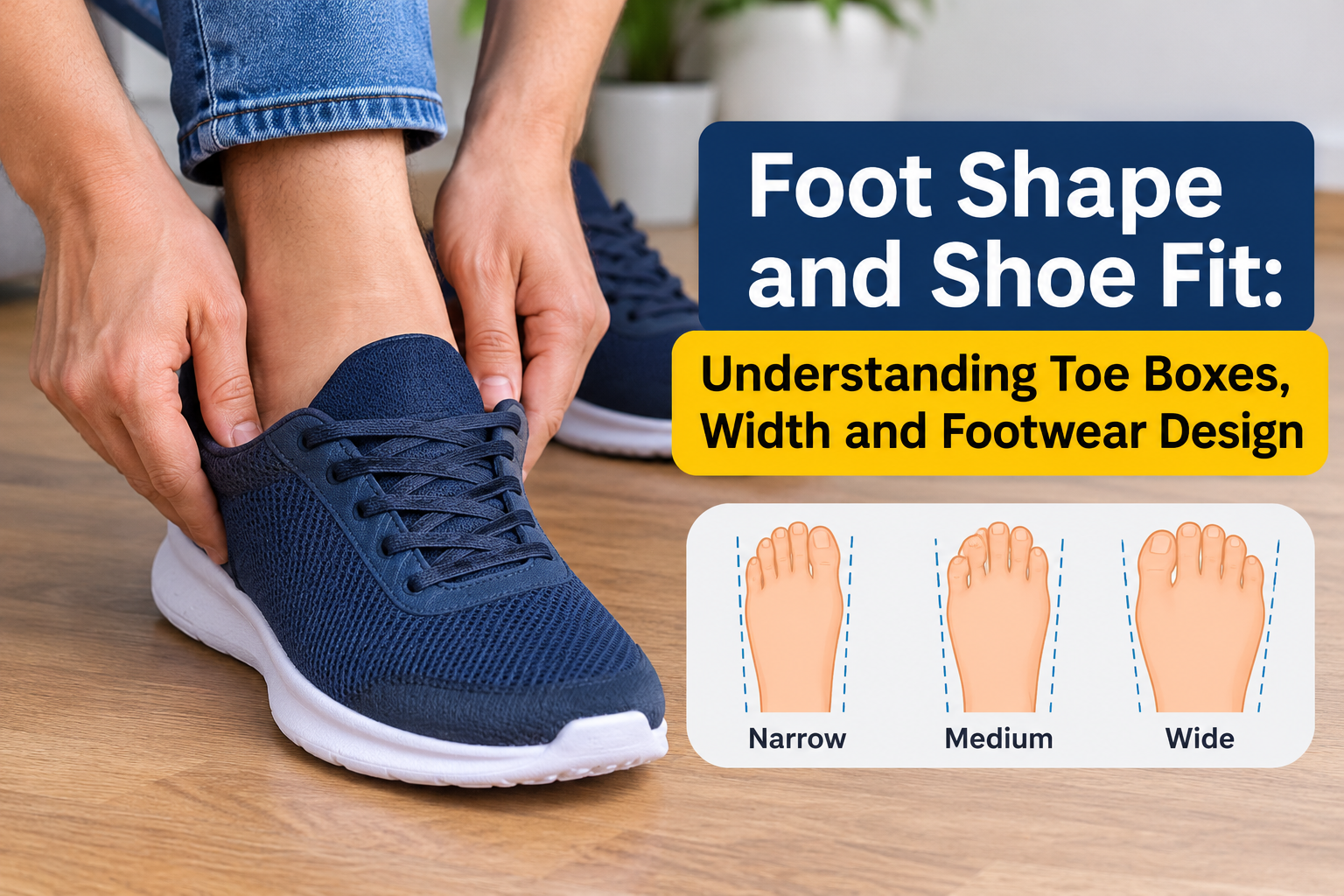
Ever bought a pair of shoes that looked perfect in the box, only to end up with sore toes, blisters, or aching arches after one day? The problem is rarely the shoe alone. It is usually a mismatch between the shoe and the shape of your foot. No two feet are identical, and choosing shoes for different foot shapes is the single best way to improve comfort, reduce pain, and make your footwear last.
This guide explains the main foot shapes, how to find out which one you have, and which shoe features suit each type, so you can shop with confidence.
- Foot shape includes width, arch height, and toe shape, not just length.
- Wide feet need a roomy toe box; narrow feet need a secure heel and midfoot.
- Flat feet need stability; high arches need cushioning.
- Always shop in the afternoon and measure both feet.
Why Foot Shape Matters When Buying Shoes
Shoe size only tells you length. Two people who both wear a size 9 can have very different foot widths, arch heights, and toe lengths. A shoe built for a standard foot can pinch a wide forefoot, gape around a narrow heel, or leave a high arch without enough support.
Wearing poorly fitted shoes is linked with common problems such as blisters, calluses, corns, and general foot fatigue. A well-matched shoe spreads pressure evenly, keeps the foot stable, and helps you stay comfortable during long days on your feet.
The Three Things That Define Your Foot Shape
1. Toe Shape
Your toe shape decides how much room you need in the front of the shoe.
Egyptian
Big toe longest, others slope down
Roman
First three toes nearly even
Greek
Second toe longest
- Egyptian: the big toe is the longest and the remaining toes taper down in a diagonal line. This is the most common type. Shoes with an angled toe box work well.
- Roman: the first three toes are about the same length, giving a square front. A wide, square toe box prevents crowding.
- Greek: the second toe is longer than the big toe. Choose shoes with extra length and depth so the second toe does not press against the front.
2. Arch Type
The arch influences how your weight is distributed with every step.
Flat arch
Sole touches the ground
Neutral arch
Moderate, visible curve
High arch
Pronounced gap under the arch
- Flat arches: the foot may roll inward (overpronation). Stability shoes with firm arch support help control motion.
- Neutral arches: the most flexible group. Most well-made shoes work, as long as the fit is right.
- High arches: the foot tends to roll outward and absorbs shock poorly. Look for soft, cushioned midsoles and flexible uppers.
Quick wet test: wet your foot, step onto a dry paper bag or flat cardboard, and look at the print. A full footprint suggests a flat arch, a very thin band along the outside suggests a high arch, and a print with a moderate curve inward is neutral.
3. Foot Width
Width is the most overlooked measurement and the biggest cause of discomfort.
Narrow
Slim forefoot, heel may slip
Standard
Fits regular-width shoes
Wide
Broad forefoot, needs extra room
- Narrow feet: shoes feel loose and the heel slips. Choose adjustable closures such as laces, straps, or buckles.
- Standard feet: regular-width shoes fit well.
- Wide feet: look for brands that offer wide (D, E, 2E, 4E) sizing and soft, stretchy uppers.
Best Shoes for Each Foot Shape
Shoes for Wide Feet
Wide feet need space across the ball of the foot. Choose shoes with a roomy, rounded or square toe box, flexible knit or soft leather uppers, and removable insoles so you can adjust the volume. Avoid pointed toes and stiff materials that press on the sides of the foot. If a shoe fits your length but feels tight across the widest part, go for a wide version rather than sizing up, because a longer shoe will cause heel slip.
Shoes for Narrow Feet
The goal here is security. Look for shoes with a snug heel cup, lace-up or strap closures, and a lower-volume design. Lace locking (a heel-lock lacing method) helps stop the heel from lifting. Thicker socks or a thin insole can also fill extra space. Avoid loose slip-ons that rely on a standard-width fit.
Shoes for Flat Feet
Flat feet usually benefit from structured arch support, a firm heel counter, and a stable midsole. Motion-control and stability sneakers are designed for this. Supportive sandals with contoured footbeds are better than flat flip-flops. If you feel arch or heel pain, consider talking to a podiatrist about custom orthotics.
Shoes for High Arches
High arches carry more pressure on the heel and ball of the foot, so cushioning matters. Choose shoes with softer midsoles, a flexible forefoot, and a footbed that fills the arch gap. Neutral cushioned running shoes are often a good match. Avoid rigid, flat shoes that give no shock absorption.
Shoes for Bunions and Wide Forefeet
A bunion is a bony bump at the base of the big toe. Shoes that squeeze this area can make it more painful. Pick styles with a deep, wide toe box and stretchy or seamless uppers that move with the joint. Avoid high heels and pointed shoes.
Shoes for Egyptian, Roman, and Greek Toes
- Egyptian toes: angled or rounded toe boxes with space for the big toe.
- Roman toes: square, wide toe boxes that do not squeeze the front of the foot.
- Greek toes: a little extra length and toe-box height so the second toe is not jammed.
Quick Reference Chart
| Foot type | Best shoe features | Features to avoid |
|---|---|---|
| Wide feet | Roomy toe box, foam or knit uppers, multiple width options | Pointed or narrow-toed styles, stiff leather |
| Narrow feet | Adjustable laces or straps, snug heel cup, narrow (B/2A) sizing | Slip-ons and loose, boxy shapes |
| Flat feet | Firm arch support, stable midsole, supportive heel counter | Ultra-flexible, flat minimalist soles |
| High arches | Cushioned midsole, soft insole, flexible shock absorption | Rigid, flat footbeds with no cushioning |
| Egyptian toe shape | Gently angled toe box with space for the big toe | Square, low-ceiling toe boxes |
| Roman toe shape | Wide, square or rounded toe box | Tapered, pointed toes |
| Greek toe shape | Longer toe box with extra length for the second toe | Rounded shoes that are too short |
| Bunions | Wide, soft, stretchy upper; deep toe box | Rigid seams over the bunion joint |
Best Shoe Choices by Activity
| Use case | What to look for |
|---|---|
| Everyday walking | Wide: knit sneakers · Flat: stability trainers · High arch: cushioned trainers |
| Running | Neutral cushioned shoes for high arches; stability shoes for flat feet; wide-toe-box models for wide feet |
| Work / standing all day | Supportive insole, cushioned midsole, slip-resistant outsole |
| Formal / office | Wider lasts, soft leather, low heels with a cushioned footbed |
| Sandals | Contoured footbeds with arch support and adjustable straps |
How to Measure Your Feet at Home
- Place a sheet of paper against a wall and stand on it with your heel touching the wall.
- Mark the tip of your longest toe.
- Measure from the wall to the mark for length, and across the widest part of the foot for width.
- Repeat for the other foot and use the larger measurement.
- Compare your numbers with the size chart of the brand you are buying from, because sizing varies between brands.
Shoe Fitting Tips That Work for Every Foot
- Shop in the afternoon. Feet swell slightly during the day, so this gives a more accurate fit.
- Leave about a thumb’s width of space between the longest toe and the front of the shoe.
- Check the heel. It should stay put with only slight movement when you walk.
- Wear the socks you plan to use with the shoes.
- Walk around. Do not rely on how the shoe feels sitting down.
- Do not count on breaking in. A good shoe should feel comfortable almost immediately.
- Replace worn-out shoes. Running shoes typically lose cushioning after several hundred miles.
Common Mistakes to Avoid
- Buying only by size number and ignoring width.
- Choosing style over comfort for daily wear.
- Sizing up to fix a width problem, which causes heel slip.
- Ignoring differences between your left and right foot.
- Wearing old shoes with a collapsed midsole or worn insole.
Frequently Asked Questions
How do I know my foot shape?
Check three things: toe length pattern, arch height (using the wet test), and width at the ball of the foot. Together these give you your foot profile.
Are wide shoes the same as bigger shoes?
No. Wide shoes are built on a broader last with more room across the forefoot, while the length stays the same.
Do flat feet always need arch support?
Not always. If flat feet are pain-free, support may not be necessary, but many people find stability shoes more comfortable for long walks or standing.
Can insoles fix a poor fit?
Insoles can improve support and cushioning, but they cannot fix a shoe that is too narrow or too short.
Can my foot shape change over time?
Yes. Age, weight changes, pregnancy, and injuries can all change foot width and arch height, so it is worth remeasuring every year or two.
Final Thoughts
The best shoe is the one that matches your foot, not the one that is most popular. Understand your toe shape, arch type, and width, then look for shoes whose features suit them. When you compare options, read size charts carefully, check width availability, and favor comfort and support first. Your feet carry you every day, and the right fit is a small investment that pays off in comfort and long-term foot health.
Note: This article is for general information and is not medical advice. If you have persistent foot pain, swelling, or a deformity, consult a podiatrist or healthcare professional.