If you’ve ever lost your balance on a trail, stumbled while turning quickly, or felt unsteady during a workout, the culprit might not be weak legs or poor coordination—it could be your shoes. More specifically, the shape of the front of your shoe: the toe box. While most people associate a wide toe box with comfort, its real power lies in enhancing stability, balance, and long-term foot health. When your toes can spread naturally upon contact with the ground, they form a broader, more stable base—like fingers gripping a bar—allowing your body to maintain control and move efficiently.
Yet, the majority of conventional footwear narrows dramatically at the front, squeezing toes together and restricting their natural movement. This compression interferes with toe splay, a biomechanical process essential for weight distribution, shock absorption, and propulsion. Over time, this leads to weakened foot muscles, collapsed arches, and reduced stability—increasing injury risk and impairing performance. From elite runners to older adults, the benefits of a wide toe box are clear: improved balance, lower fall risk, and stronger, more resilient feet.
This article explores how a wide toe box enhances stability through anatomical alignment, muscle engagement, and biomechanical efficiency, backed by scientific research and clinical evidence.
How Toe Splay Enhances Balance
Natural Foot Function Requires Toe Spreading
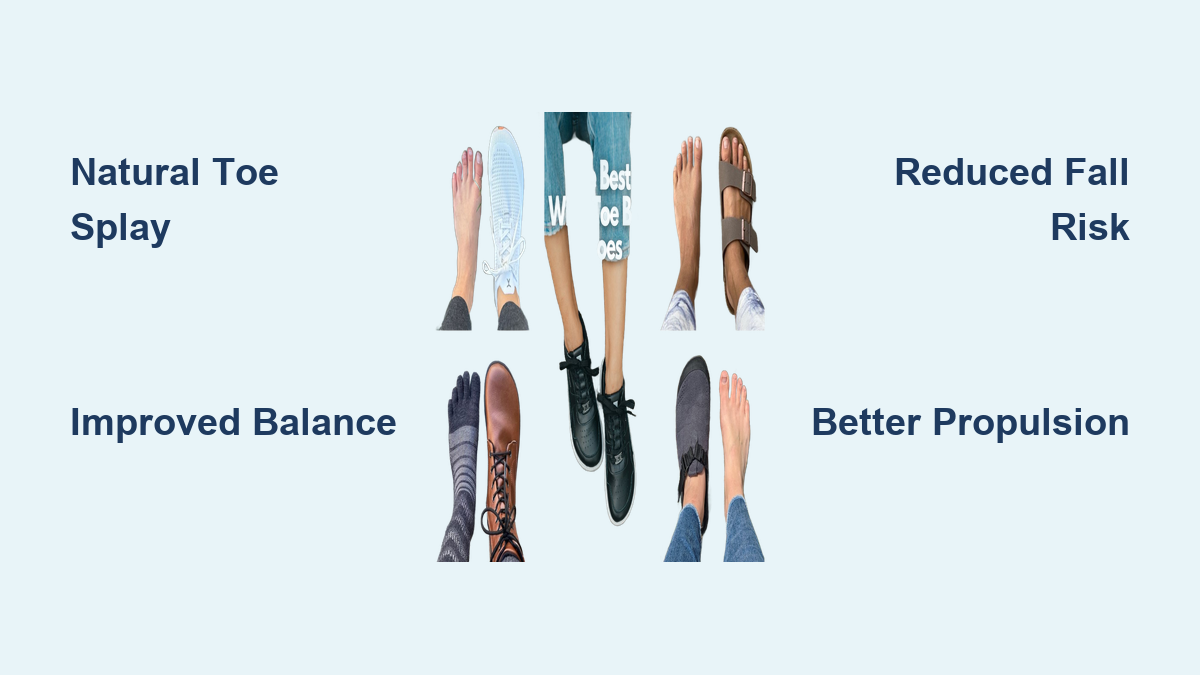
When your foot strikes the ground, your toes should naturally spread apart—a movement known as toe splay. This is not a minor detail; it’s a fundamental aspect of foot biomechanics. Splayed toes increase your base of support, improving balance and grip on the surface. Think of it like spreading your fingers when gripping a barbell—more surface contact means better control and stability.
Shoes with narrow toe boxes prevent this splaying, forcing toes into a compressed, misaligned position. Over time, this leads to poor weight distribution and reduced proprioception—your body’s ability to sense where your foot is in space—making it harder to maintain balance, especially on uneven terrain or during dynamic movements.
Toe Splay and Proprioception
Proprioception relies on sensory feedback from nerves in your skin, joints, and muscles. When your toes are free to move, they send real-time signals to your brain about pressure, position, and alignment. Restricted toes reduce this feedback, dulling your sense of stability. Studies show that people wearing foot-shaped shoes with wide toe boxes exhibit better postural control and faster reaction times to balance disturbances, especially during sudden movements or slips.
The Tie Bar Mechanism: Arch Stability Through Toe Splay

How Foot Arches Stay Intact During Movement
Your foot has three key arches: the medial longitudinal, lateral longitudinal, and transverse arches. These are not rigid structures but dynamic systems supported by ligaments, tendons, and intrinsic muscles. One crucial stabilizing system is the tie bar mechanism, which acts like a tension bridge across the transverse arch.
As your foot pronates (rolls inward) during walking or running, the transverse arch widens, allowing the metatarsal heads to spread apart. This widening enables toe splay, which activates the abductor hallucis (big toe stabilizer) and abductor digiti minimi (little toe stabilizer). These muscles contract to maintain arch integrity and distribute forces evenly across the foot.
What Happens When the Tie Bar Fails
Narrow footwear prevents the transverse arch from widening, disrupting the tie bar mechanism. Without proper splay:
– Intrinsic foot muscles weaken from disuse
– The arches lose dynamic support
– Excessive pronation or flat feet develop
– Stress concentrates on the medial side of the foot
This instability increases the risk of conditions like plantar fasciitis, bunions, and shin splints—all linked to poor foot mechanics.
Forefoot Load Distribution and Stability

Pressure Spreading During Walking and Running
During gait, your forefoot bears 33% to 40% of body weight while walking—and up to 8 times body weight during running. A wide toe box allows this force to be distributed across a larger surface area by enabling full toe splay.
Without adequate space:
– Pressure concentrates on the metatarsal heads
– Risk of Morton’s neuroma and metatarsalgia increases
– Push-off becomes inefficient and painful
Studies using pressure mapping (e.g., Tekscan) confirm that wide toe box shoes reduce peak pressure under the forefoot by up to 20%, enhancing comfort and reducing injury risk.
Enhanced Traction and Propulsion
Splayed toes improve ground contact, creating a “gripping” effect similar to barefoot movement. This increases friction and improves push-off efficiency during the toe-off phase of gait. Runners wearing wide toe box shoes report feeling more “connected” to the ground, with smoother transitions and less fatigue.
One study found that a raised toe box design (extending 8 mm vertically and 3 mm forward) significantly increased vertical ground reaction forces during propulsion (p < 0.001), indicating stronger push-off—key for speed and endurance.
Reduced Fall Risk with Natural Toe Alignment
Wider Base of Support Prevents Trips and Stumbles
Balance deteriorates when your base of support is narrow. By allowing toes to spread, a wide toe box effectively widens the foot’s footprint, improving stability during standing, turning, and walking on unstable surfaces.
Older adults benefit especially. Research shows that individuals over 65 who wear restrictive footwear have a higher incidence of falls due to poor foot control and delayed balance corrections. Toe splay enhances ankle joint stability and improves reaction time to slips or uneven ground.
Improved Agility and Dynamic Stability
Athletes in sports requiring quick cuts, jumps, or directional changes—like basketball, tennis, or hiking—rely heavily on foot stability. A wide toe box supports lateral balance and reduces medial-lateral sway, helping maintain control during explosive movements.
One study measuring in-shoe foot displacement found that a raised toe box reduced forefoot medial shift by 40% (p < 0.001), meaning the foot stayed more centered and stable inside the shoe during activity.
Consequences of Restricted Toe Splay
Muscle Atrophy and Weak Foot Mechanics
“If you don’t use it, you lose it” applies directly to foot muscles. Chronic toe compression leads to atrophy of the abductor hallucis and abductor digiti minimi, muscles critical for toe alignment and arch support.
Weak intrinsic muscles result in:
– Poor toe control
– Over-reliance on external support (orthotics, cushioned shoes)
– Altered gait patterns that strain knees, hips, and lower back
Over time, this creates a cycle of dependency on supportive footwear instead of building natural foot strength.
Development of Foot Deformities
Long-term toe restriction causes structural changes:
– Bunions (hallux valgus): Big toe drifts toward second toe due to lateral pressure
– Hammertoes: Toes become permanently bent from being cramped
– Overlapping toes: Progressive crowding leads to misalignment
– Nerve compression: Leading to neuromas and numbness
These deformities further compromise stability. People with bunions, for example, have been shown to have reduced balance control and higher fall risk.
Wide Toe Box vs. Wide Shoe: Know the Difference
Not All “Wide” Shoes Are Equal
Many shoes labeled “wide” only increase volume in the heel or midfoot but still taper sharply at the toe box. This gives the illusion of width without allowing true toe splay.
A true wide toe box maintains a foot-shaped design, widest at the toes, mimicking the natural anatomy of the bare foot. Look for models where the sole outline matches the spread of your bare foot when standing.
How to Spot a Real Wide Toe Box
Use these checks:
– Visual test: Place the shoe on a flat surface. If the front curves inward, it’s not truly wide.
– Toe wiggle test: After lacing up, ensure all toes can move freely side-to-side.
– Thumb’s width rule: Leave about 1 cm (a thumb’s width) between longest toe and shoe tip.
– Evening fit: Try shoes on later in the day when feet are slightly swollen.
Scientific Proof: Running Biomechanics Study

Effects of a Raised Toe Box on Foot Stability
A 2023 randomized crossover study tested 25 male marathon runners (mean age 22.7) using shoes with a raised toe box (extended 8 mm up and 3 mm forward) versus standard shoes during running at 4.0 m/s.
Key Findings:
- Reduced impact forces:
- Vertical ground reaction force ↓ during loading phase (p = 0.001)
- Antero-posterior shear force ↓ (p = 0.015)
- Improved propulsion:
- Vertical GRF ↑ during toe-off (p < 0.001)
- Less foot movement inside the shoe:
- Forefoot medial displacement ↓ (p < 0.001)
- Rearfoot movement reduced in both directions (p < 0.001)
- Reduced hallux impact:
- Distance change between phalanx and metatarsal head ↓ from 6.2 mm to 3.5 mm (p < 0.001)
What This Means for Stability
The raised toe box minimized internal foot sliding, enhancing in-shoe stability. Lower impact forces mean less stress on joints, while improved push-off suggests better energy return. Reduced hallux compression also lowers the risk of subungual hematoma (bruised toenails), a common runner’s injury.
Who Benefits Most from a Wide Toe Box?
Runners and Athletes
For endurance athletes, stability translates to efficiency. Wide toe box shoes:
– Reduce energy leaks from foot wobble
– Improve stride consistency
– Lower injury rates from overuse
Many elite ultrarunners now wear Altra or Topo shoes specifically for their zero-drop, foot-shaped design.
Older Adults
As balance declines with age, foot strength becomes even more critical. A wide toe box:
– Reduces fall risk
– Supports weaker arches
– Accommodates swelling and deformities
Studies show older adults wearing foot-shaped footwear have faster gait initiation and better obstacle clearance.
People with Foot Conditions
Wide toe boxes help manage:
– Bunions and hammertoes: Relieve pressure and slow progression
– Plantar fasciitis: Promote natural arch function
– Diabetes and neuropathy: Prevent ulcers by reducing friction
– Arthritis: Ease joint stiffness and improve mobility
Top Brands with True Wide Toe Boxes
Altra: FootShape Fit for Natural Splay
Altra pioneered the FootShape toe box, widest at the toes to allow full splay. Popular models:
– Lone Peak: Ideal for trail runners
– Olympus: Maximal cushioning for long distances
– Escalante Racer: Lightweight, breathable road shoe
Other Recommended Brands
- Topo Athletic: Anatomical fit with moderate stack height
- Xero Shoes: Minimalist, zero-drop designs
- Vivobarefoot: Ultra-thin soles for maximum ground feel
- Lems: Stylish, barefoot-inspired options
- Merrell Trail Glove: Lightweight, flexible for gym or trail
- New Balance (select models): Look for 10V or 11V width codes (e.g., Minimus series)
Also consider OS1st wide toe box socks to prevent bunching and enhance breathability.
How to Transition Safely
Avoid Soreness and Build Foot Strength
Switching from narrow to wide toe box shoes can cause temporary discomfort as dormant muscles activate. To avoid strain:
Start Slow
- Wear new shoes for 1–2 hours daily, gradually increasing over 2–4 weeks
- Begin with low-impact activities (walking, standing) before running
Strengthen Your Feet
- Toe spreads: Sit barefoot, spread toes apart, hold 5 seconds, repeat 10x
- Towel scrunches: Use toes to pull a towel toward you
- Marble pickups: Grab marbles with toes and place in a cup
- Single-leg balance: Stand on one foot for 30 seconds, eyes open or closed
Watch for Warning Signs
- Sharp pain, numbness, or blisters mean the fit is wrong
- Mild fatigue is normal; persistent soreness suggests overuse
Final Note
A wide toe box is more than a comfort upgrade—it’s a foundation for stability. By allowing natural toe splay, it strengthens foot muscles, enhances balance, improves gait efficiency, and protects against injuries. Whether you’re an athlete, older adult, or someone dealing with foot pain, choosing footwear that respects your foot’s natural shape can transform how you move.
The evidence is clear: stability starts at the toes. When your feet can function as nature intended, every step becomes stronger, safer, and more efficient.