Many people hear the words “flat feet” and assume it is one single condition. In reality, flat feet (also called pes planus or fallen arches) fall into two very different groups: flexible flat feet and rigid flat feet. They may look similar when you stand, but they behave differently, have different causes, and often need different care.
Understanding which type you or your child has is the first step toward choosing the right footwear, exercises, supports, and, when needed, medical treatment. This complete guide explains the difference between flexible and rigid flat feet, their causes, symptoms, simple home tests, diagnosis, treatment options, and prevention tips.
What Are Flat Feet?
A healthy foot normally has a curved arch on the inner side, between the ball of the foot and the heel. This arch acts like a spring. It absorbs shock, distributes body weight, and helps the foot push off efficiently when you walk or run.
In a flat foot, the arch is lowered or absent, and the inner sole comes close to or touches the ground when standing. Flat feet are very common. All babies are born with flat-looking feet, and the arch develops gradually during early childhood. A large number of people keep low arches for life and never have any problem. Flat feet become a concern when they cause pain, limit movement, or change the way a person walks.
Flexible vs Rigid Flat Feet: The Core Difference
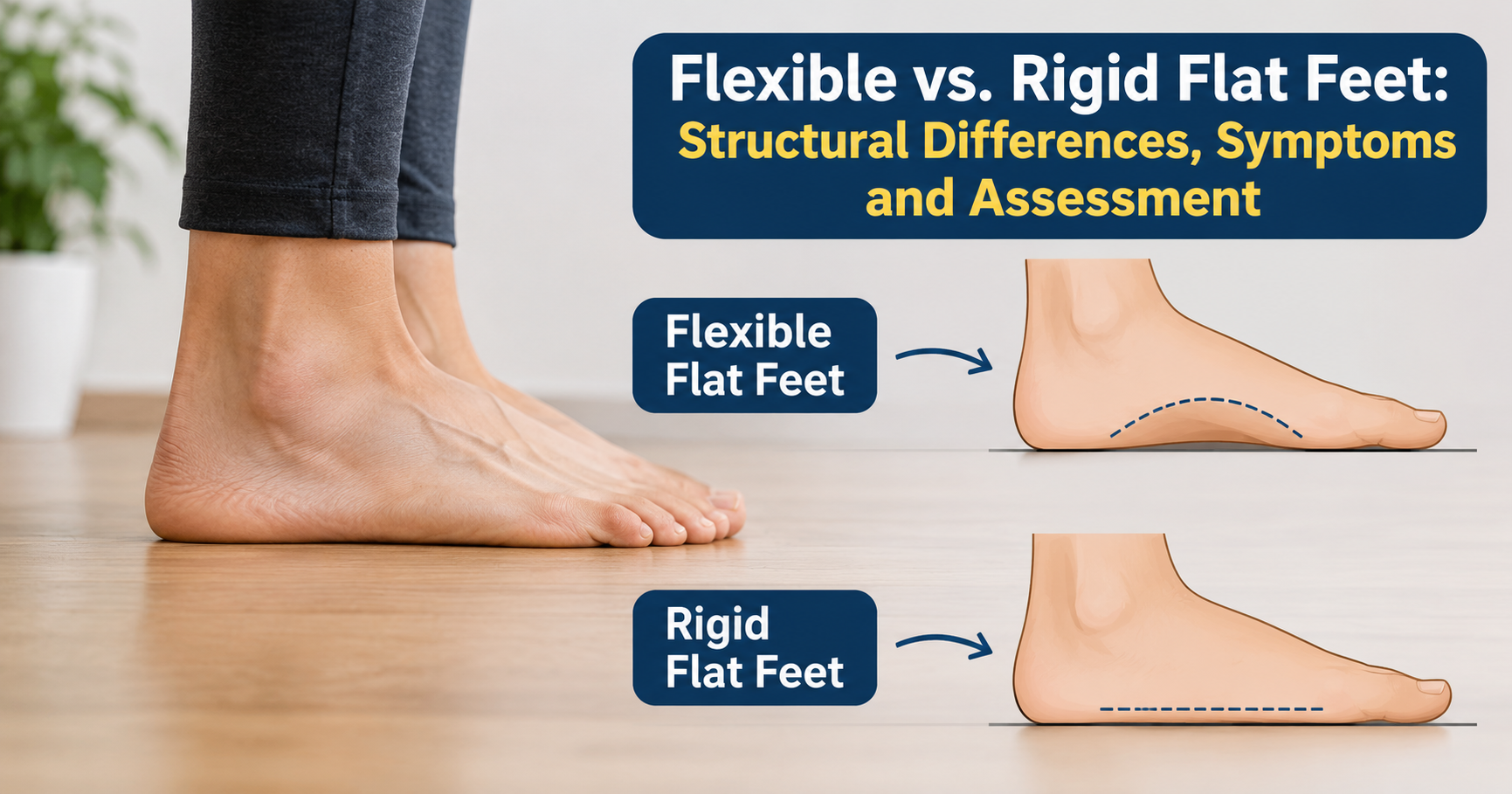
The key question is simple: does the arch come back when the foot is not bearing weight?
- Flexible flat foot: the arch disappears when you stand but appears when you sit, lift your heel, or stand on tiptoe. The joints of the foot still move freely.
- Rigid flat foot: the arch is flat in every position, whether you stand, sit, or rise on your toes. The joints in the back of the foot are stiff and have limited movement.

| Feature | Flexible Flat Foot | Rigid Flat Foot |
|---|---|---|
| Arch when standing | Flat or low | Flat |
| Arch when sitting or on tiptoe | Reappears | Stays flat |
| Foot joint movement | Normal or near normal | Stiff and limited |
| How common | Very common | Uncommon |
| Usual symptoms | Often none; some fatigue or aching | Pain, stiffness, frequent ankle sprains |
| Typical cause | Natural variation, loose ligaments, weak foot muscles | Structural problem, joint fusion, arthritis, injury |
| Need for medical review | Only if painful or worsening | Usually recommended |
| Treatment | Mostly non-surgical | Depends on cause; surgery more likely |
Flexible Flat Feet
What Is a Flexible Flat Foot?
Flexible flat foot is the most common type, especially in children and teenagers. The foot has an arch, but it flattens under body weight. When the weight is removed, the arch returns because the bones and joints can still move normally.
Common Causes
- Natural development: the arch is still maturing in young children.
- Family history: low arches often run in families.
- Ligament laxity: naturally loose or hypermobile joints reduce arch support.
- Weak foot and calf muscles: poor muscle support allows the arch to drop.
- Tight Achilles tendon or calf muscles: this can push the heel outward and flatten the arch.
- Excess body weight: extra load increases stress on the arch.
- Pregnancy: hormonal changes and weight gain can temporarily lower the arch.
- Posterior tibial tendon problems in adults: in early stages the foot is flexible, but the arch gradually collapses if the tendon weakens.
Symptoms
Many people with flexible flat feet have no symptoms at all. When symptoms occur, they usually include:
- Tired or aching feet after long periods of standing or walking
- Pain in the arch or heel
- Ankles that tilt inward (overpronation)
- Uneven wear on shoes, especially the inner edge
- Knee, hip, or lower back discomfort in some people
- Children who tire quickly during play or avoid long walks
Rigid Flat Feet
What Is a Rigid Flat Foot?
In rigid flat foot, the arch is missing whether you stand or sit. The joints beneath the ankle, especially the subtalar joint, have lost normal movement. Because the foot cannot adapt to the ground, rigid flat feet are more likely to cause pain and limit activity.
Common Causes
- Tarsal coalition: two or more bones in the back of the foot are joined abnormally, usually present from birth but often noticed in the pre-teen or teenage years.
- Congenital vertical talus: a rare birth condition in which a bone sits in the wrong position, producing a “rocker-bottom” foot.
- Arthritis: rheumatoid arthritis and osteoarthritis can stiffen and deform foot joints.
- Injury: fractures or severe sprains can damage the joints and change the shape of the foot.
- Advanced posterior tibial tendon dysfunction: a long-standing flexible flat foot in an adult can become stiff over time.
- Nerve or muscle conditions: some neurological disorders can lead to rigid foot deformities.
- Diabetes-related joint changes (Charcot foot): a serious complication that needs urgent medical attention.
Symptoms
- Persistent pain in the foot, ankle, or outer side of the foot
- Stiffness and reduced ability to move the foot side to side
- Difficulty walking on uneven ground
- Frequent ankle sprains
- Muscle spasms in the calf or outer ankle muscles (often seen with tarsal coalition)
- Limping or an unusual walking pattern
- Visible deformity or swelling
Simple Tests You Can Try at Home
These checks can give you a rough idea, but they cannot replace a medical examination.
1. The Wet Footprint Test
Wet your foot, step onto a piece of dark paper or a flat dry surface, and look at the print. If the entire sole is filled in, with little or no curve on the inner side, you likely have a flat foot. This test shows the arch height only. It does not tell you whether the foot is flexible or rigid.

2. The Tiptoe (Heel Rise) Test
Stand on both feet and rise onto your toes. In a flexible flat foot, the arch becomes visible and the heel tilts slightly inward. In a rigid flat foot, the arch stays flat and the heel often does not tilt properly.
3. The Sitting Test
Sit on a chair with your feet hanging freely. If the arch appears when the foot is off the ground, the flat foot is flexible. If the foot looks flat even without weight, it may be rigid.
4. The Big Toe Lift Test (Jack’s Test)
While standing, gently lift the big toe upward. In a flexible foot, the arch rises as the toe lifts. If the arch does not change, the foot may be stiff. This is usually done by a healthcare professional.
How Is It Diagnosed?
A doctor, podiatrist, or orthopedic specialist usually starts with a physical examination. They will look at the foot while you stand, sit, and walk, check joint movement, and examine the pattern of wear on your shoes. Imaging is used when a rigid foot is suspected or when pain is persistent:
- X-rays show the alignment of the bones and any arthritis.
- CT scans are particularly useful for detecting tarsal coalition.
- MRI shows soft tissues such as tendons and ligaments.
Treatment for Flexible Flat Feet
Flexible flat feet without pain generally need no treatment. When symptoms are present, conservative care works well in most cases.
- Supportive footwear: choose shoes with a firm heel counter, good arch support, cushioned midsole, and a stable sole. Avoid worn-out shoes and very flimsy flat sandals for daily use.
- Arch support insoles and orthotics: over-the-counter arch supports can reduce fatigue and improve comfort. Custom orthotics, made from a mold or scan of your feet, are recommended for more severe or persistent symptoms.
- Stretching: regular calf and Achilles tendon stretches reduce strain on the arch.
- Strengthening exercises: towel scrunches, marble pickups, short-foot exercises, heel raises, and resistance band work strengthen the muscles that support the arch.
- Weight management: reducing excess weight lowers the load on the feet.
- Activity changes: low-impact exercise such as swimming or cycling can help when walking or running causes pain.
- Pain relief: rest, ice, and over-the-counter pain relievers can ease temporary discomfort when used as directed.
- Physical therapy: a therapist can design a program to improve foot control and gait.
Surgery is rarely needed. It is considered only when severe pain continues despite months of non-surgical treatment.
Treatment for Rigid Flat Feet
Because rigid flat feet are linked to underlying structural or joint problems, treatment depends on the exact cause and should be guided by a specialist.
- Supportive shoes and custom orthotics help reduce pressure and improve comfort.
- Immobilization: a walking boot or cast for a short period can calm pain, especially with tarsal coalition.
- Anti-inflammatory medication and injections: a doctor may recommend these for arthritis or inflamed joints.
- Physical therapy: gentle movement and strengthening can improve function.
- Surgery: when conservative care fails, options include removing the abnormal bone connection (coalition resection), realigning bones, or fusing painful joints. The right procedure depends on the cause, age, and activity level.
Flat Feet in Children
Most children with flat feet have the flexible type, and the arch often forms by age 6 to 10. Flexible flat feet in kids are usually normal and painless. Parents should avoid expensive treatments that are not needed, but should see a doctor if the child:
- Complains of regular foot or leg pain
- Limps or avoids physical activity
- Has a foot that stays flat when sitting or on tiptoe
- Has one foot that looks different from the other
- Has stiffness or frequent ankle sprains
Encouraging barefoot play on safe surfaces, wearing well-fitting shoes, and doing simple foot exercises are helpful habits.
Flat Feet in Adults
If your arch has dropped later in life, do not ignore it. A new or progressive flat foot in an adult, especially on one side, with pain along the inner ankle, may signal posterior tibial tendon dysfunction. Early treatment with supportive footwear, bracing, and physical therapy can prevent the foot from becoming rigid and painful.
How to Choose Shoes and Insoles for Flat Feet
If you are shopping for footwear or arch supports, these features matter most:
- Firm heel counter: keeps the heel stable and limits inward rolling.
- Medium to firm midsole: gives support without feeling like a hard board.
- Built-in arch support: a contoured footbed that matches your arch shape.
- Wide toe box: allows the toes to spread naturally.
- Flexibility at the ball of the foot: the shoe should bend where the toes bend, not in the middle.
- Removable insole: lets you replace it with a custom or higher-quality insole.
- Proper fit: measure your feet in the evening, when they are slightly swollen, and leave about a thumb’s width at the front.
Remember that insoles are a comfort and support aid. Those with rigid flat feet or significant pain should get professional advice before buying one.
Best Exercises for Flat Feet
- Towel scrunches: place a towel on the floor and pull it toward you using only your toes. Repeat 10 to 15 times per foot.
- Short-foot exercise: while seated, draw the ball of the foot toward the heel without curling the toes, lifting the arch. Hold for 5 seconds and repeat 10 times.
- Calf stretch: stand facing a wall, step one foot back, keep the heel down, and hold for 30 seconds on each side.
- Heel raises: rise up on your toes slowly and lower with control. Do 2 sets of 12.
- Marble pickups: pick up small objects with your toes and place them in a bowl.
- Arch lifts: stand with feet flat and gently raise the arch without moving the toes or heel.
Note: these exercises mainly benefit flexible flat feet. If you have a rigid flat foot or feel pain, check with a healthcare professional before starting.
When to See a Doctor
Book an appointment if you notice any of the following:
- Pain in the foot, ankle, or arch that lasts more than a couple of weeks
- Swelling or redness along the inner ankle
- A foot that is flat both standing and sitting
- Limited movement or stiffness in the foot
- Frequent tripping, sprains, or a changing walking pattern
- One foot that looks noticeably flatter than the other
- Any foot changes if you have diabetes
Can Flat Feet Be Prevented?
Inherited flat feet cannot be prevented, but you can reduce the chance of the arch collapsing or causing pain by:
- Wearing supportive shoes and replacing them regularly
- Keeping a healthy body weight
- Doing foot and calf exercises
- Avoiding long periods barefoot on hard floors if it causes pain
- Treating foot or ankle injuries properly and fully
- Managing conditions such as diabetes and arthritis
Frequently Asked Questions
Are flat feet a serious problem?
Not usually. Most flexible flat feet are harmless and cause no symptoms. Rigid flat feet and painful flat feet should be checked by a professional.
Can flexible flat feet turn into rigid flat feet?
The condition itself usually stays flexible, but in adults with posterior tibial tendon dysfunction or arthritis, a flexible deformity can stiffen over time if untreated.
Can flat feet be corrected without surgery?
The arch usually cannot be permanently rebuilt without surgery, but supportive footwear, orthotics, stretching, and strengthening can control symptoms effectively in most people with flexible flat feet.
Do flat feet cause knee or back pain?
They can in some people. When the foot rolls inward, it can change the alignment of the knee, hip, and lower back. Not everyone with flat feet will have these problems.
Can I play sports with flat feet?
Yes. Many athletes have flat feet. Good shoes, appropriate training, and strengthening exercises are the key.
At what age does the arch develop?
The arch begins forming in early childhood and is usually well developed between the ages of 6 and 10, although this varies from child to child.
Is surgery common for flat feet?
No. Surgery is uncommon and is reserved for severe, persistent pain or structural problems that have not improved with other treatment.
Final Thoughts
Flexible and rigid flat feet may look alike at first glance, but they are very different conditions. Flexible flat feet are common, often painless, and respond well to supportive shoes, orthotics, and exercises. Rigid flat feet are less common, tend to cause pain and stiffness, and often point to an underlying structural or joint problem that needs professional assessment.
The simplest clue is whether the arch returns when your weight is off the foot. If it does, the foot is likely flexible. If it does not, or if you have pain, it is wise to have the foot examined. With the right footwear, exercise, and medical guidance, most people with flat feet can stay active and comfortable.
Disclaimer: This article is for general information only and does not replace professional medical advice, diagnosis, or treatment. Always consult a qualified healthcare provider about your or your child’s foot health.