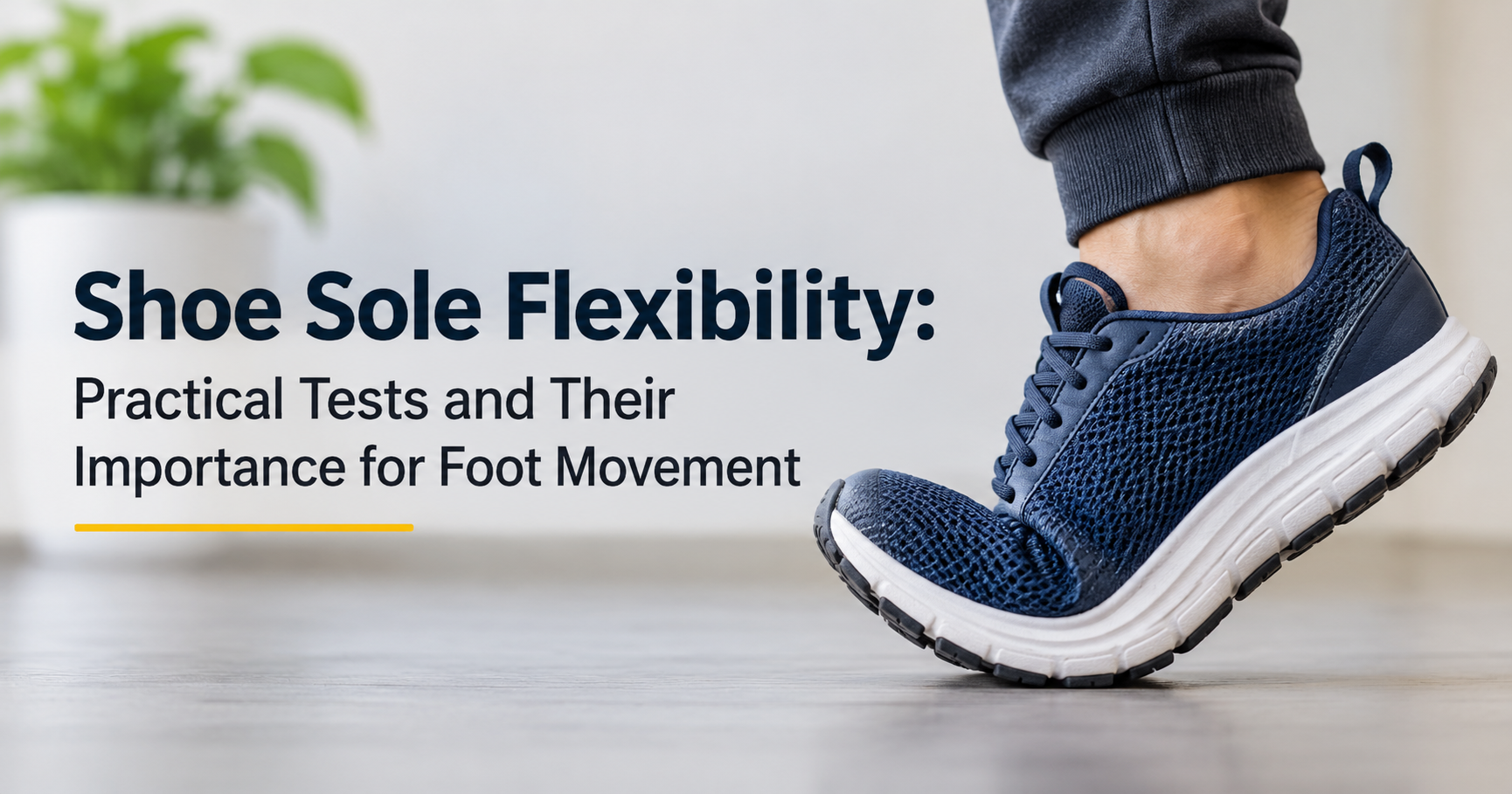
A shoe can look perfect on the shelf and still feel awful after an hour of walking. The hidden reason is often the sole. If the sole is too stiff, your foot fights it with every step. If it is too floppy, your arch gets no support. A shoe sole flexibility test takes under a minute, needs no tools, and tells you more about comfort and durability than most product descriptions do.
This guide explains what sole flexibility is, how to test it at home or in a store, how to read the result for different activities, and the mistakes to avoid when buying.
What Is Shoe Sole Flexibility?
Sole flexibility describes how easily the midsole and outsole bend when your foot moves through a step. Your foot naturally bends at the ball (where your toes meet the foot) as you push off. A good shoe lets that happen while still supporting the heel and arch.
Flexibility is not simply “softer is better”. The right amount depends on your foot, your activity and the surface you walk on.
Why Sole Flexibility Matters
- Comfort: A sole that bends where your foot bends reduces fatigue and pressure on the forefoot.
- Natural gait: Proper flex helps the foot roll from heel strike to toe-off smoothly.
- Foot health: Too much stiffness can strain the toes and plantar fascia, while too little support can aggravate flat feet or arch pain.
- Durability: Soles that bend in the wrong place tend to crack, separate or wear unevenly.
- Safety and grip: A sole that conforms to the ground keeps more rubber in contact with the surface.
The Three Simple Flexibility Tests
1. The Bend Test
Hold the shoe with one hand at the heel and the other at the toe. Press the toe upward toward the shin. Watch where the shoe bends.
- Bends at the ball of the foot: This is the ideal result for most shoes.
- Bends in the middle or arch: The shoe offers weak support and may cause arch fatigue.
- Barely bends at all: It may suit heavy-duty work boots, but is uncomfortable for daily walking.
2. The Twist Test
Hold the heel in one hand and the toe in the other, then twist gently in opposite directions like wringing a towel. A shoe with moderate twist resists collapsing yet lets your foot adapt to uneven ground. A shoe that twists like a rag lacks stability. A shoe that will not twist at all is likely too rigid for natural movement.
3. The Fold Test
Try folding the toe section back toward the heel. Minimalist and barefoot-style shoes fold easily. Running shoes bend part of the way. Hiking and work boots should resist a full fold. If a shoe that is supposed to be supportive folds in half, treat that as a warning sign.
Bonus: The Press and Flex-Grooves Check
- Press your thumb into the midsole. Quality foam compresses and rebounds quickly.
- Look at the outsole. Flex grooves (cut lines across the forefoot) show where the designer wants the shoe to bend.
- Check the shank, a stiffener under the arch. A firm shank is useful in boots but unnecessary in casual sneakers.
Ideal Flexibility by Shoe Type
The chart shows typical ranges, not strict rules. Individual models vary widely.
| Shoe type | Ideal flexibility | What to look for |
|---|---|---|
| Running shoes | Moderate to high | Forefoot flex, supportive heel |
| Walking shoes | Moderate | Smooth roll-through, firm arch |
| Hiking boots | Low to moderate | Stable midsole, protective shank |
| Work boots | Low | Rigid protection, slip-resistant outsole |
| Minimalist shoes | Very high | Thin sole, ground feel |
| Kids’ shoes | High | Easy forefoot bend for growing feet |
What Affects Sole Flexibility?
- Material: EVA foam is light and flexible, polyurethane is firmer and longer lasting, and rubber varies by compound.
- Thickness: Thicker soles generally bend less.
- Construction: Cemented soles are usually more flexible than stitched or welted ones.
- Plates and shanks: Carbon, nylon or steel inserts add stiffness on purpose.
- Temperature: Soles stiffen in the cold, so test shoes at room temperature.
How to Choose Based on Your Foot
- Flat feet or low arches: Pick moderate flexibility with a firm midfoot so the arch does not collapse.
- High arches: Look for cushioning and a sole that flexes freely at the forefoot.
- Plantar fasciitis or heel pain: A slightly stiffer sole with cushioning often feels better than a very flexible one.
- Wide or sensitive forefoot: Choose shoes that bend easily at the ball to reduce pressure.
If you have ongoing foot pain, a podiatrist can recommend the best sole type for your condition.
Common Mistakes to Avoid
- Assuming a stiff sole means better support. Support comes from structure, not only stiffness.
- Choosing the most flexible shoe for long standing hours or heavy loads.
- Skipping the test because the shoe feels soft inside. Cushioned insoles can hide a rigid sole.
- Ignoring wear. An old shoe that bends in the wrong place has lost its support, even if it looks fine.
When to Replace Shoes with Failing Soles
Check your shoes every few months. Replace them if the sole folds in the middle, shows deep cracks, wears unevenly, separates from the upper, or if you feel new aches in your feet, knees or back after wearing them. Most running and walking shoes last roughly 500 to 800 km, though this depends on body weight and surface.
Quick Buying Checklist
- Do the bend test and confirm the flex point is at the ball of the foot.
- Do the twist test to check stability.
- Match overall stiffness to your activity.
- Walk around the store or your home for several minutes.
- Check the outsole for flex grooves and a quality grip pattern.
- Test later in the day, when feet are slightly swollen, for a true fit.
Frequently Asked Questions
Should a shoe sole be flexible or stiff?
It should be flexible at the ball of the foot and supportive through the heel and arch. Fully stiff or fully floppy soles are rarely ideal for daily use.
Where should a shoe bend?
Right where your toes meet the foot. Bending in the middle of the shoe usually signals poor arch support.
Are flexible soles good for flat feet?
Only if the midfoot stays supportive. Choose moderate flexibility rather than a very soft, twisty sole.
Do shoe soles get more flexible over time?
Yes. Break-in softens the sole slightly, but a sole that becomes too floppy has lost its structure and should be replaced.
Can I test flexibility while buying online?
Look for product descriptions mentioning flex grooves, shank or midsole material, and repeat the bend and twist tests the day the shoes arrive. Return them if the flex point feels wrong.
Final Thoughts
The shoe sole flexibility test is quick, free and surprisingly revealing. Bend, twist and fold a shoe before you commit, match its flexibility to your activity and foot type, and you will avoid most comfort problems before they start. A sole that bends in the right place is one of the clearest signs of a well-made shoe.