If you’ve recently ramped up your running routine, started a new fitness regimen, or spent more time on your feet—only to develop a persistent ache in the front of your foot—you may be experiencing a metatarsal stress fracture. These tiny, hairline cracks in the long bones of the forefoot don’t result from a fall or sudden injury but instead develop silently over time due to repetitive strain. Often mistaken for tendonitis, sprains, or general foot fatigue, metatarsal stress fractures are common among runners, dancers, military personnel, and anyone who increases physical activity too quickly.
Left undiagnosed, a stress fracture can progress into a complete break, leading to prolonged recovery, chronic pain, or even surgical intervention. The key to avoiding long-term issues lies in recognizing the early signs of a metatarsal stress fracture: activity-related forefoot pain, pinpoint tenderness, localized swelling, and sometimes unexplained bruising. In this guide, you’ll learn how to identify these warning signals, understand who’s most at risk, when to seek medical help, and what steps to take for proper healing and prevention.
Forefoot Pain That Worsens with Activity
One of the earliest and most consistent signs of a metatarsal stress fracture is pain in the ball of the foot that starts or intensifies during weight-bearing activities. This isn’t the kind of soreness that fades after warming up—it typically begins during or after exercise and gradually becomes more pronounced.
You might notice:
– A dull ache in the midfoot or forefoot after running, jumping, or walking long distances
– Pain that starts earlier in your workout and lingers longer afterward
– Discomfort that eventually persists even at rest, especially at night
The second and third metatarsals—the longest bones in the forefoot—are most vulnerable because they absorb the greatest impact during push-off. As microdamage accumulates, the pain shifts from diffuse to sharp and localized. If you continue training, the discomfort may become severe enough to alter your gait or force you to stop mid-activity.
Pro Tip: If the pain disappears when you rest but reliably returns when you resume activity, it’s a classic sign of a stress reaction or early fracture.
Localized Swelling on the Top of the Foot

Unlike ankle sprains or soft tissue injuries that cause widespread puffiness, a metatarsal stress fracture leads to focal swelling on the dorsal (top) surface of the forefoot. This swelling doesn’t spread—it stays directly over the injured bone and may be subtle at first, appearing only after prolonged standing or exercise.
Over time, the area may feel warm to the touch, and in some cases, slight redness develops. Because the inflammation is bone-based rather than muscular or ligamentous, it tends to be stubborn and doesn’t improve significantly with basic rest or elevation alone.
This targeted puffiness, especially when paired with activity-related pain, strongly suggests a bony issue rather than a soft tissue strain.
Sharp Point Tenderness Over the Metatarsal

Point tenderness is one of the most reliable indicators of a stress fracture. If pressing along the top of your foot—particularly over the shaft of one of the long metatarsal bones—causes a sharp, localized pain, it’s a red flag.
To test at home:
1. Remove your shoe and sit comfortably.
2. Use your thumb to press firmly along the length of each metatarsal, from the base of the toes toward the arch.
3. Compare both feet. A spot that’s significantly more tender on the affected side likely indicates a fracture.
Doctors use this same method during physical exams. The consistency and location of the tenderness help differentiate a stress fracture from conditions like plantar fasciitis, Morton’s neuroma, or tendonitis, which tend to cause broader discomfort.
Unexplained Bruising on the Foot
While not always present, mild bruising (ecchymosis) on the top or sole of the foot—without a known injury—is a concerning sign. This discoloration results from tiny blood vessels breaking around the fracture site due to bone microdamage.
If you notice bluish, purple, or yellowish spots appearing days after the onset of pain, especially without trauma, it’s likely more than just muscle soreness. Bruising in the forefoot is uncommon in soft tissue injuries, making it a strong clue of an underlying bone issue.
Warning: Any bruising in the foot without a clear cause warrants medical evaluation.
Pain During Functional Movement Tests
Simple at-home tests can help confirm whether your symptoms align with a stress fracture. While these aren’t diagnostic on their own, they can guide you toward seeking professional care.
Hop Test
Try gently hopping on the affected foot. If this causes sharp, localized pain in the forefoot, it’s a strong indicator of a bone injury. Avoid repeating the test, as it can worsen the fracture.
Squeeze Test
Have someone gently compress your midfoot from both sides, as if closing a book. Pain radiating to the forefoot may suggest a fracture, especially if it’s reproducible.
Other signs include difficulty standing barefoot on hard floors, limping during daily activities, or needing to lean on furniture for support while walking.
Who’s Most at Risk? Key Causes and Triggers
Metatarsal stress fractures don’t happen in isolation. They occur when the rate of bone stress exceeds the body’s ability to repair itself. Certain factors significantly increase your risk.
Rapid Increase in Activity
Going from low to high impact too quickly—like starting a new running program or adding hill sprints—is the most common trigger. Bones need time to adapt through remodeling. When overload happens too fast, microdamage accumulates.
Poor or Worn-Out Footwear
Shoes that lack cushioning or arch support transfer more shock to the metatarsals. Switching from grass to pavement, or wearing minimalist shoes before your body adapts, can increase forefoot loading.
Biomechanical Imbalances
- High arches (cavus foot): Reduce shock absorption
- Overpronation: Alters force distribution, overloading certain metatarsals
- Tight calf muscles: Increase forefoot pressure during walking and running
These imbalances often cause the second or third metatarsal to bear disproportionate stress.
Low Bone Density and Nutritional Deficiencies
Inadequate calcium, vitamin D, or protein weakens bones and slows healing. This is especially critical for:
– Postmenopausal women
– Athletes with low energy availability (e.g., female athlete triad)
– Individuals with eating disorders or restrictive diets
Even elite athletes can develop stress fractures if nutrition doesn’t match training demands.
High-Risk Groups
- Runners and dancers: Repetitive impact on hard surfaces
- Military recruits: Long marches with heavy loads
- Overweight individuals: Greater mechanical stress on feet
- Anyone with a prior stress fracture: Recurrence risk is significantly higher
How It’s Diagnosed: From Physical Exam to Imaging
While symptoms can point to a stress fracture, only a healthcare provider—such as a podiatrist, orthopedic specialist, or sports medicine doctor—can confirm it.
During the evaluation, your provider will:
– Ask about your activity level, training changes, and footwear
– Palpate your foot to locate point tenderness
– Perform the hop and squeeze tests
– Observe your gait and weight-bearing ability
Even if initial X-rays are normal, a stress fracture may still be present. Standard X-rays often miss early fractures because bone changes (like callus formation) take 2–3 weeks to appear.
That’s why more sensitive imaging is often needed:
– MRI: The gold standard. Detects bone edema and microcracks within days.
– Bone scan: Shows increased metabolic activity at the injury site; useful when MRI isn’t available.
– Diagnostic ultrasound: Emerging as a fast, radiation-free option in clinical settings.
Repeat X-rays after 2–3 weeks may reveal healing signs, confirming the diagnosis.
Treatment: Healing the Fracture the Right Way

Most metatarsal stress fractures heal without surgery, but only with proper care.
Immediate Self-Care: R.I.C.E. Protocol
While waiting for medical evaluation:
– Rest: Stop all painful activities.
– Ice: Apply for 15–20 minutes, 3–4 times daily.
– Compression: Use a light elastic bandage to reduce swelling.
– Elevation: Keep your foot above heart level to minimize inflammation.
Immobilization and Protection
To allow healing:
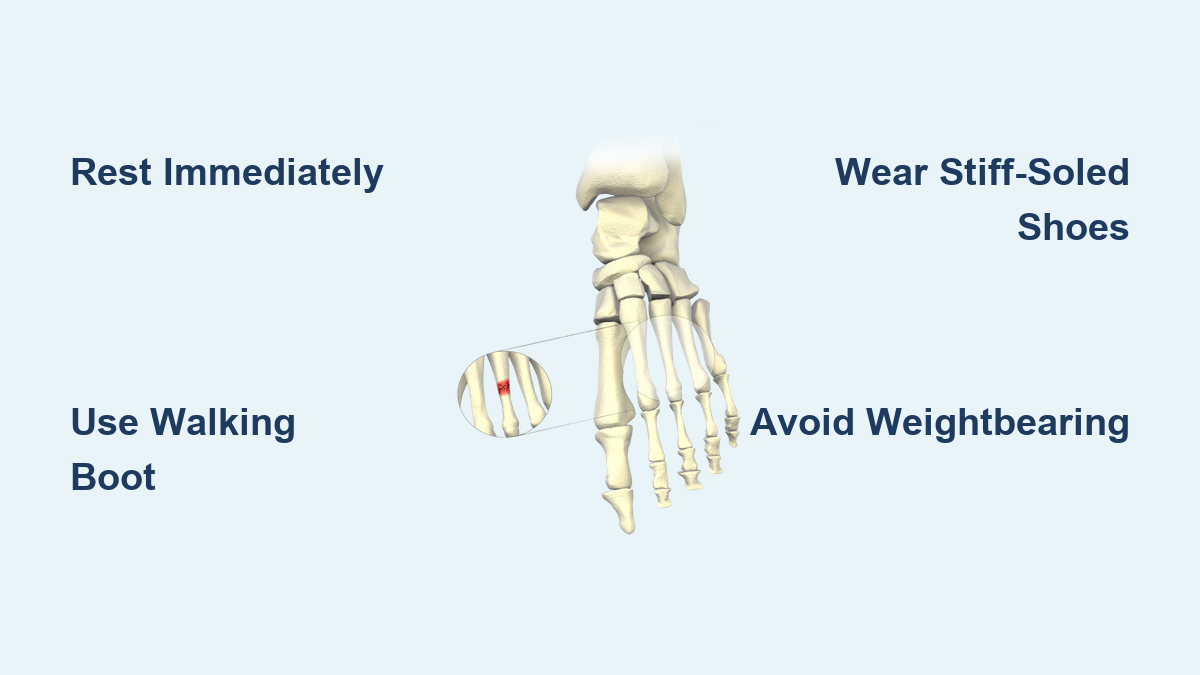
– Wear stiff-soled shoes or a post-op shoe
– Use a walking boot (CAM walker) for moderate cases
– Avoid barefoot walking—even socks offer no protection
Healing typically takes 4–8 weeks, depending on severity and compliance.
Pain Management and Support
- Use acetaminophen (Tylenol) for pain relief
- Limit NSAIDs (e.g., ibuprofen)—long-term use may delay bone healing
- Consider custom orthotics to correct biomechanical issues
- Wear supportive, cushioned shoes with wide toe boxes
Nutrition and Bone Health
Support healing with:
– Calcium: 1,000–1,200 mg/day
– Vitamin D: 600–800 IU/day
– Protein: Essential for tissue repair
If you’ve had multiple fractures, ask about a DEXA scan to check bone density.
Healing Timeline and Return to Activity
- Weeks 1–2: Rest, immobilization, pain control
- Weeks 3–6: Gradual weight-bearing in a boot
- Weeks 6–8: Begin low-impact cross-training (swimming, cycling)
- Week 8+: Slow return to walking, then running—only if pain-free
Follow a graded return plan:
1. Walk 5 minutes
2. Increase to 10, then 15 minutes
3. Introduce walk-run intervals
4. Gradually increase running volume by no more than 10% per week
Imaging may be used to confirm healing before full activity resumes.
When to See a Doctor
Seek medical attention if:
– Pain lasts more than 3–5 days
– Swelling or tenderness doesn’t improve with rest
– You can’t hop or walk without pain
– Bruising appears without injury
– You have risk factors like osteoporosis or prior fractures
Bottom Line: Early diagnosis means faster healing. Ignoring symptoms can turn a 6-week recovery into a 3-month setback.
Final Note: A metatarsal stress fracture may start as a small ache, but it’s your body’s way of saying, “Slow down.” Recognizing the signs—activity-related pain, point tenderness, swelling, and bruising—lets you act fast. With proper rest, protection, and prevention, most people return to full activity within 6–8 weeks. But ignoring it? That’s a recipe for long-term problems. Listen to your feet—they’re carrying you through life.