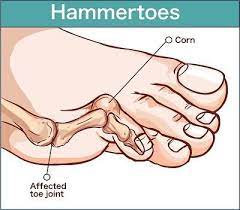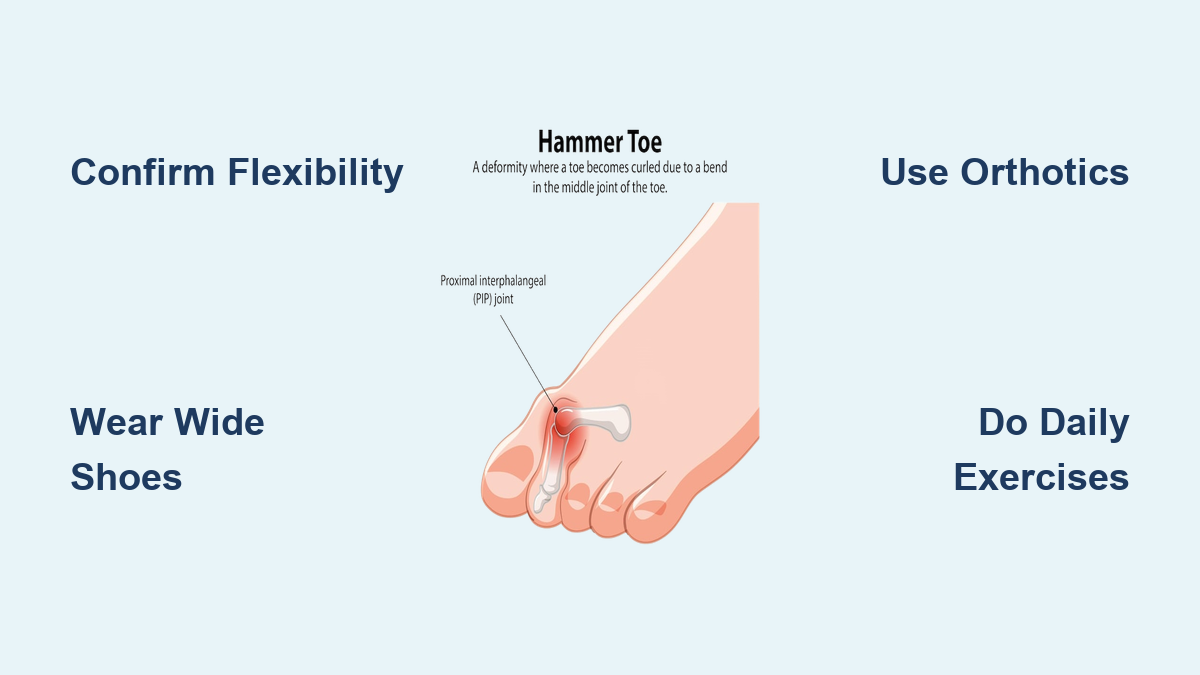
If your toes are curling downward at the middle joint, causing pain, pressure, or difficulty slipping into shoes, you may be dealing with hammertoe—a progressive foot deformity that affects millions of people worldwide. The good news? You don’t have to go under the knife to correct it—especially if you catch it early. Many individuals can straighten hammer toes without surgery using proven, non-invasive methods like targeted exercises, proper footwear, orthotics, and mechanical support devices.
The key is early intervention. In the flexible stage—when the bent toe can still be manually straightened—conservative treatments are most effective. These approaches do more than just relieve pain; they can actually restore alignment, improve function, and halt progression. While rigid hammertoes often require surgical correction, flexible and semi-rigid cases respond remarkably well to consistent at-home care combined with professional guidance.
This guide breaks down the most effective, science-backed strategies to straighten hammer toes without surgery, based on clinical evidence and podiatric best practices. You’ll learn how to assess your condition, choose the right shoes, strengthen weakened muscles, use supportive devices, and know when to seek expert help—so you can avoid surgery and return to pain-free walking.
Confirm It’s a Flexible Hammertoe
Before starting any treatment, it’s essential to determine the stage of your hammertoe. Only flexible cases respond well to non-surgical correction.
Test for Flexibility
- Sit barefoot and gently try to straighten the bent toe with your fingers.
- If it moves freely and stays straight when released (or mostly straight), it’s flexible—ideal for conservative treatment.
- If it resists movement or snaps back into a bent position, it’s semi-rigid—still treatable but may require combination therapy.
- If the toe is completely stiff and immovable, it’s rigid—likely requiring surgical evaluation.
✅ Good sign: You can manually straighten the toe.
❌ Red flag: No movement, persistent pain, or skin changes like corns or ulcers.
When to See a Podiatrist
Even if you suspect a flexible hammertoe, get a professional diagnosis. A podiatrist can:
– Rule out mallet toe or claw toe (similar but distinct conditions)
– Check for arthritis, nerve damage, or circulatory issues
– Assess your gait and foot structure
– Order X-rays to evaluate joint alignment and degeneration
Never self-treat if you have diabetes or poor circulation—even minor pressure or irritation can lead to serious complications like ulcers or infections.
Wear Toe-Friendly Shoes Immediately
Improper footwear is the #1 preventable cause of hammertoes. High heels and narrow toe boxes force toes into a bent position, tightening tendons over time and accelerating deformity.
Choose Shoes That Prevent Worsening
Look for:
– Wide, deep toe box (your toes should lie flat without crowding)
– Low heel (under 1 inch / 2.5 cm)
– Adjustable fit (laces, straps, or buckles)
– Cushioned, flexible sole
– Proper arch support
📏 Fit tip: There should be ½ inch (1.27 cm) between your longest toe and the shoe tip.
Do This Shoe Check at Home
- Trace your foot on paper while standing.
- Place the insole of your shoe over the tracing.
- If your toes hang over the edge, the shoe is too narrow.
Shoes to Avoid
- High heels
- Pointed-toe pumps
- Ballet flats (often too shallow)
- Slip-on loafers without support
- Worn-out sneakers with collapsed arches
💡 Pro tip: Shop for shoes in the evening—feet swell throughout the day, so this ensures a proper fit when your feet are largest.
Use Custom Orthotics for Long-Term Correction

Orthotics don’t just cushion—they correct the root cause: muscle imbalance and poor foot mechanics.
Custom vs. Over-the-Counter Insoles
| Feature | Custom Orthotics | OTC Insoles |
|---|---|---|
| Fit | Molded to your foot | One-size-fits-most |
| Support | Addresses gait issues | Mild cushioning |
| Cost | Higher upfront | Affordable |
| Effectiveness | High (slows/halts progression) | Moderate (symptom relief) |
Custom orthotics can prevent surgery by redistributing pressure and supporting proper alignment.
How They Help Hammer Toes
- Reduce strain on flexor tendons
- Support arch collapse (common in flat feet)
- Prevent forefoot overload that worsens bending
🩺 Prescription-grade orthotics are often covered by insurance—ask your podiatrist.
Do Daily Toe Exercises for 6–8 Weeks
Muscle imbalance causes hammertoes—so rebuilding strength and flexibility is essential.
5 Key Exercises to Straighten Toes
1. Toe Stretching
- Sit barefoot, gently pull the bent toe upward.
- Hold 30 seconds, repeat 3 times.
- Best after a warm shower—tendons are more pliable.
2. Towel Scrunches
- Place a towel on the floor.
- Use toes to scrunch it toward you.
- 10–15 reps, 2–3 sets daily.
🔁 Builds intrinsic foot muscle strength.
3. Marble Pickups
- Place 10 marbles on the floor.
- Pick them up one by one with your toes, drop into a cup.
- Start with 5, work up to 10.
🎯 Improves dexterity and joint control.
4. Toe Lifts (Yoga Toes)
- Press all toes down, then lift one at a time.
- Alternate between big toe and smaller toes.
- 10 reps per toe.
🧠 Enhances neuromuscular coordination.
5. Calf Stretches
- Tight calves shift weight forward, increasing toe pressure.
- Do wall calf stretches 2x daily for 30 seconds.
🦵 Stretching the Achilles tendon reduces forefoot load.
Exercise Schedule
| Week | Frequency | Progress |
|---|---|---|
| 1–2 | 1 set, 2x/day | Focus on form |
| 3–4 | 2 sets, 2x/day | Add resistance band |
| 5–8 | 3 sets, 2x/day | Measure improvement |
📈 6–8 weeks of consistency leads to measurable change in toe position.
Stop If You Feel:
- Sharp or shooting pain
- Numbness or tingling
- Swelling or redness
Apply Taping or Splinting for Realignment

Mechanical support helps retrain the toe into a straighter position.
How to Tape a Hammertoe
- Clean and dry the foot.
- Use non-latex athletic tape (e.g., paper tape).
- Gently straighten the toe.
- Wrap tape around the bent toe and anchor to the adjacent toe.
- Ensure it’s snug but not tight—no discoloration or numbness.
🚫 Never tape if you have diabetes or poor circulation.
Use These Splinting Devices
Gel Toe Spacers
- Fit between toes to prevent overlapping.
- Wear at home or in wide shoes.
- Start with 15–20 minutes, increase gradually.
Padded Sleeves
- Protect corns from friction.
- Don’t correct alignment—use with other methods.
Night Splints
- Hold the toe straight while sleeping.
- Best for flexible hammertoes.
- Remove if painful or causing skin irritation.
⚠️ Use only one device per toe—don’t stack splints.
Try Custom Pedy Plast (MPC) Pads

Pedy Plast (Mulle Podiatry Compound) is a custom-molded offloading pad used by podiatrists to relieve pressure and prevent corns.
Why It’s Better Than Silicone Pads
- Custom-fitted to your foot
- Durable and washable
- Redistributes pressure more effectively
- Elongates the toe structure, reducing tip pressure
How It’s Made
- Podiatrist mixes Pedy Plast to a putty-like consistency.
- Shapes it around the base of the toe, extending the support.
- Lets it harden into a flexible, stable pad.
- Trims and fits for daily wear.
✅ Clinically proven to reduce pain and delay or avoid surgery.
Combine Treatments for Best Results
No single method works alone. Success comes from layering strategies.
Sample Daily Routine
| Time | Action |
|---|---|
| Morning | Wear orthotics + proper shoes |
| Midday | Remove shoes, do 1 set of exercises |
| Evening | Warm soak + massage + marble pickups |
| Bedtime | Apply splint or tape (if flexible) |
🔄 Consistency is key—6–8 weeks of daily effort yields results.
What Works Together?
- Orthotics + exercises = correct mechanics + build strength
- Wide shoes + spacers = reduce pressure + prevent rubbing
- Stretching + splinting = improve flexibility + maintain alignment
Recognize When Surgery Is Needed
Non-surgical methods won’t fix rigid hammertoes. Know when to consider surgery.
Surgery May Be Necessary If:
- Toe is completely stiff and can’t be moved
- Constant pain interferes with walking
- Corns or ulcers won’t heal
- No improvement after 8 weeks of consistent care
- Deformity is worsening
🏥 Modern hammertoe surgery is minimally invasive, with short recovery (4–6 weeks).
Prevent Future Deformities
Even after improvement, maintenance is crucial.
Daily Prevention Habits
- Wear wide-toe-box shoes every day
- Do 5 minutes of toe exercises daily
- Use orthotics if you have flat feet or bunions
- Inspect feet weekly for corns or redness
🧼 Diabetics: Check feet daily for sores or pressure spots.
Long-Term Outlook
| Stage | Can It Be Reversed? | Surgery Likely? |
|---|---|---|
| Flexible | ✅ Yes, with consistent care | ❌ Rarely |
| Semi-Rigid | ⚠️ May stabilize, partial correction | Maybe |
| Rigid | ❌ No | ✅ Usually |
📢 “The earlier you treat it, the more you can avoid surgery.”
Final Checklist: Avoid Surgery with These Steps
- ✔️ Confirm flexibility—can you straighten the toe?
- ✔️ See a podiatrist—get a proper diagnosis.
- ✔️ Switch shoes—wide toe box, low heel.
- ✔️ Use orthotics—custom or OTC with arch support.
- ✔️ Do exercises daily—towel scrunches, stretches, marble pickups.
- ✔️ Try taping or splinting—only if no diabetes or poor circulation.
- ✔️ Add Pedy Plast or spacers—for pressure relief.
- ✔️ Re-evaluate in 6–8 weeks—if no improvement, consult a specialist.
Non-surgical treatment works—but only if you act early and stay consistent. With the right approach, you can straighten hammer toes, reduce pain, and keep walking comfortably—without surgery.