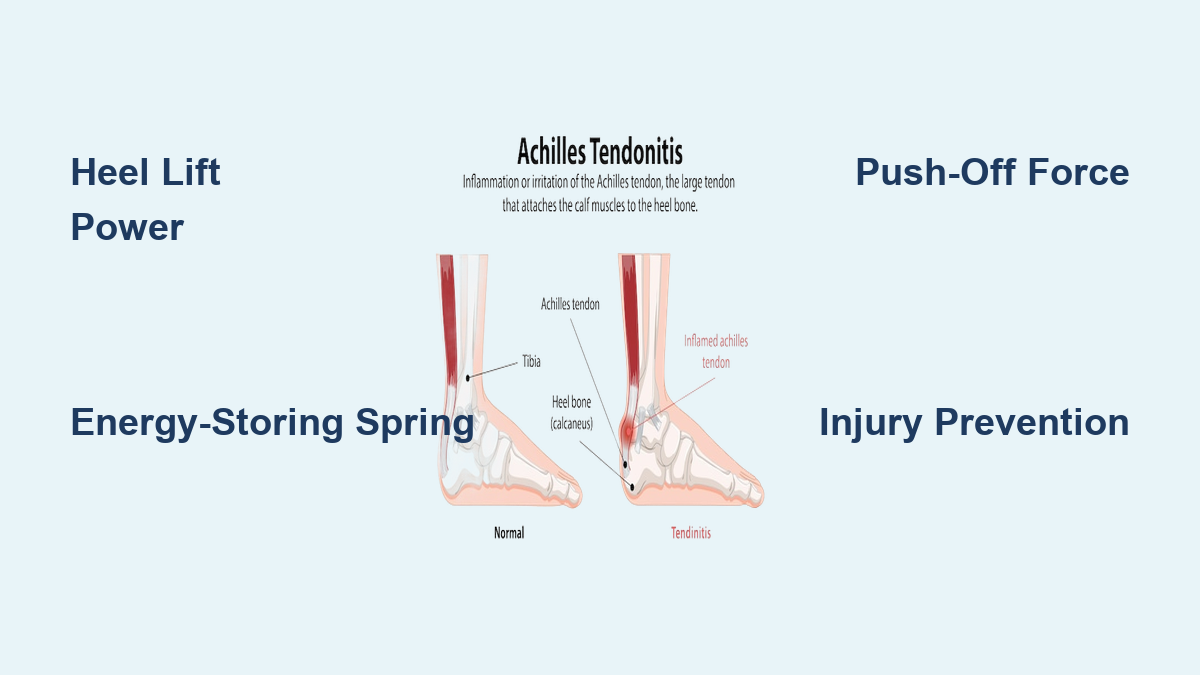
Every step you take—from a morning stroll to climbing stairs—is powered by one of the most critical yet underappreciated structures in your body: the Achilles tendon. This robust band of connective tissue is the powerhouse behind heel lift, forward propulsion, and energy-efficient movement. As the largest and strongest tendon in the human body, it connects your calf muscles to your heel bone and plays a central role in translating muscular effort into motion. Without a functioning Achilles tendon, walking would be slow, unstable, and exhausting. Its unique ability to store and release elastic energy makes it more than just a cable—it acts like a biological spring, reducing fatigue and enhancing gait efficiency. Understanding how this tendon operates during walking reveals why injuries can so drastically impair mobility and why protecting its health is essential for lifelong ambulation.
How the Achilles Tendon Powers Heel Lift and Forward Motion

Generating Push-Off Force During Gait
The Achilles tendon’s primary mechanical function in walking is to drive ankle plantar flexion—the downward pointing of the foot that lifts the heel off the ground. This action occurs during the late stance phase of gait, just before the leg swings forward. As your body weight rolls over the ball of your foot, the gastrocnemius and soleus muscles contract, pulling on the Achilles tendon to push the toes down and propel you forward.
Research shows that the tendon delivers approximately 93% of the total plantar flexion force during normal walking, making it the dominant engine of propulsion. Without effective push-off, strides become shorter, walking speed decreases, and balance suffers—leading to a shuffling or flat-footed gait pattern commonly seen after injury.
Acting as an Energy-Storing Spring
Beyond transmitting force, the Achilles tendon functions as a high-efficiency spring. During mid-stance, when your body is directly over the foot, the ankle dorsiflexes (foot bends upward), stretching the tendon while supporting up to four times body weight. This stretch stores elastic strain energy, which is then released during push-off, much like a coiled spring snapping back.
Studies estimate that over 50% of the mechanical work performed by the calf muscle-tendon unit comes from this passive recoil—not active muscle contraction. This energy-saving mechanism significantly reduces metabolic demand, allowing you to walk longer distances with less fatigue. The tendon’s collagen-rich structure enables it to withstand repeated loading, making it perfectly adapted for thousands of steps per day.
Anatomy Behind the Power: Structure and Function

Muscle-Tendon Connection and Force Transmission
The Achilles tendon forms from the fusion of two major calf muscles: the gastrocnemius, responsible for explosive movements, and the soleus, which sustains posture and endurance. Together, they make up the triceps surae and insert onto the posterior calcaneus (heel bone). The tendon twists about 90 degrees as it descends, positioning the gastrocnemius fibers laterally and the soleus medially—optimizing leverage and force alignment during push-off.
This anatomical arrangement ensures that muscle contractions are efficiently translated into movement, allowing for smooth and powerful propulsion with each step.
Collagen Strength and Elastic Properties
Composed primarily of type I collagen, the Achilles tendon resists tensile forces up to ten times body weight during dynamic activities. Interwoven elastin fibers allow controlled elongation—typically 4–6% under load—enabling the stretch-and-recoil cycle essential for energy conservation. The highly organized fibril structure provides durability, but also makes the tendon vulnerable to overuse damage when subjected to repetitive stress without adequate recovery.
Limited Blood Supply and Injury-Prone Zones
Despite its strength, the Achilles tendon has a hypovascular zone located 2–6 cm above its heel insertion, where blood flow is minimal. This region relies on diffusion from surrounding tissues and is particularly prone to degeneration and rupture. Blood supply naturally declines with age, increasing injury risk in adults over 30—especially those engaging in sudden, intense activity (“weekend warriors”).
Why Walking Speed Changes Achilles Tendon Efficiency

The 7.5 km/h Threshold and Gait Transition
The Achilles tendon operates most efficiently during walking at speeds below 7.5 km/h. Beyond this point, its mechanical contribution drops sharply:
– Tendon force decreases
– Elastic energy return diminishes
– The ankle shifts from a spring-like to a motor-like function, requiring more active muscle work
This inefficiency explains why people naturally transition to running around 7.2–7.5 km/h—not out of preference, but biomechanical necessity. Running restores the tendon’s spring behavior, improving energy economy.
Running vs. Fast Walking: A Mechanical Advantage
At speeds of 8–9 km/h, running increases:
– Achilles tendon force production
– Stretch magnitude
– Elastic energy return (up to 64% of muscle-tendon unit power)
The ankle compresses at foot strike and recoils at push-off, functioning like a pogo stick. In contrast, fast walking forces the ankle into damper or motor roles, increasing fatigue. Thus, the walk-to-run transition isn’t arbitrary—it’s a smart evolutionary adaptation to preserve tendon efficiency.
Daily Mobility: More Than Just Walking
Essential for Common Weight-Bearing Tasks
The Achilles tendon is indispensable for everyday activities:
– Climbing stairs
– Rising from a chair
– Stepping onto curbs
– Standing on tiptoes
Even minor tasks like reaching overhead engage the tendon. Its integrity directly affects balance, coordination, and fall risk—especially in older adults.
Role in Postural Stability and Balance
During quiet standing, the Achilles tendon fine-tunes ankle stiffness to correct body sway. Sensory receptors within the tendon—Golgi tendon organs, Ruffini, and Vater-Pacini corpuscles—detect tension and movement, sending feedback to the brain. This proprioceptive input allows real-time gait adjustments, crucial for walking on uneven or slippery surfaces.
Consequences of Injury on Walking Ability
Tendinopathy: Painful, Inefficient Gait
Achilles tendinopathy, a degenerative condition involving microtears and collagen breakdown, causes:
– Morning stiffness
– Tendon thickening
– Pain during push-off
Patients often walk with a reduced stride length and avoid heel lift, leading to compensatory strain on knees, hips, and lower back.
Rupture: Loss of Propulsion
A complete rupture results in:
– Sudden “pop” or snap
– Inability to stand on tiptoes
– Absent or weak push-off
– Flat-footed gait
While other muscles (e.g., flexor hallucis longus) provide limited function, walking remains slow, unstable, and tiring without treatment.
Diagnosis and Recovery: Restoring Normal Gait
Key Diagnostic Tools
- Thompson test: Calf squeeze should cause foot plantar flexion; absence indicates rupture.
- Ultrasound/MRI: Visualize tendon thickness, tears, and degeneration.
- VISA-A questionnaire: Assess pain and function in chronic cases.
Rehabilitation Pathways
- Conservative care: RICE protocol, heel lifts, orthotics, and eccentric strengthening.
- Physical therapy: Stretching, gait retraining, and progressive loading.
- Surgery: For complete ruptures, followed by 3–6 months of structured rehab.
Return to full walking typically takes 8–12 weeks conservatively and 3–6 months post-surgery.
Prevention: Protecting Your Walking Engine
Strengthening and Stretching
- Calf raises (bilateral and single-leg)
- Eccentric heel drops
- Daily stretches (gastrocnemius and soleus)
Perform 3–4 times weekly to build tendon resilience.
Smart Footwear and Training
- Wear shoes with moderate heel drop (10–15 mm) and firm heel counters.
- Avoid sudden increases in activity (≤10% weekly).
- Cross-train to reduce repetitive strain.
Final Thoughts
The Achilles tendon is the hidden engine of walking, enabling efficient heel lift, powerful propulsion, and energy-saving spring mechanics. Its performance declines at high walking speeds, prompting the natural shift to running. Injuries severely disrupt gait, causing pain, weakness, and compensatory movement patterns. Early diagnosis, targeted rehab, and consistent prevention strategies—stretching, strengthening, and proper footwear—are vital for maintaining mobility. Protect your Achilles tendon—it’s the unsung hero behind every step you take.