If your feet sweat during workouts, long shifts, or even on a warm day, you’ve likely experienced the discomfort of damp socks—itching, slipping, blisters, and persistent odor that no amount of deodorant can fix. The solution? Moisture-wicking materials. These advanced textiles are engineered to pull sweat away from your skin and move it to the outer layer of your sock, where it evaporates quickly—keeping your feet dry, healthy, and comfortable all day.
Moisture-wicking fabrics go beyond comfort—they’re essential for foot health. By reducing moisture buildup, they help prevent blisters, fungal infections like athlete’s foot, and chronic foot odor. Whether you’re a runner, nurse, hiker, or someone who just wants to avoid soggy socks, understanding what these materials are—and which ones actually work—can transform how your feet feel.
This guide breaks down the top moisture-wicking materials, how they function, and which ones you should choose based on your activity level, climate, and skin sensitivity—all backed by science and real-world performance.
How Moisture Wicking Works: The Science Behind Dry Feet

Moisture wicking isn’t about absorbing sweat—it’s about moving it. Unlike cotton, which soaks up moisture and holds it against your skin, wicking fabrics actively transport sweat away through microscopic channels in the fiber structure.
Capillary Action: The Engine of Wicking
The core mechanism is capillary action, where tiny spaces between fibers act like straws, drawing moisture outward due to molecular forces. This process works continuously as long as there’s a difference in moisture concentration between your skin and the fabric surface.
“Moisture wicking relies on ‘capillary action,’ which is the movement of a liquid (sweat) through tiny spaces within a fabric due to the interaction between the liquid and the fabric’s internal surfaces.” – REI Editor Emeritus Ken Knapp
Dual-Layer Transport System
Most high-performance socks use a two-layer design:
– Inner layer (skin side): hydrophobic – repels moisture, pushing it outward.
– Outer layer: hydrophilic – absorbs and spreads moisture for faster evaporation.
This creates a continuous pumping effect, maintaining a dry microclimate next to your skin—just like a towel pulls water from your body, but in reverse.
Why Dry Feet Are Essential for Health and Performance
Keeping feet dry isn’t just about comfort—it’s critical for performance, hygiene, and long-term foot wellness.
Prevent Blisters and Skin Breakdown
Wet skin is weaker and more prone to friction. Studies show that moisture increases skin slip, significantly raising blister risk—especially during long runs or hikes. Dry feet stay protected.
Stop Odor at the Source
Foot odor (bromhidrosis) comes from bacteria feeding on sweat. A damp sock becomes a bacterial breeding ground. Wicking materials reduce moisture—and with it, odor.
Avoid Fungal Infections
Fungi like Tinea pedis (athlete’s foot) thrive in warm, moist environments. By keeping feet dry, moisture-wicking socks disrupt this ecosystem.
Regulate Temperature Efficiently
- In heat: Evaporation cools the skin.
- In cold: Wet socks lose insulation and accelerate heat loss—dry socks keep you warmer.
“As moisture evaporates, it strips away body heat—leading to the ‘cold and clammy’ feeling common in people with hyperhidrosis.”
Best Moisture-Wicking Materials for Socks

Not all fabrics wick equally. Here’s a breakdown of top performers—and one to avoid at all costs.
Merino Wool: The Natural Performance Leader
Why It Works
– Absorbs up to 30% of its weight in moisture before feeling wet.
– Wicks sweat while retaining warmth, even when damp.
– Contains lanolin, a natural wax with antimicrobial properties.
Key Benefits
– Stays odor-free for days—perfect for hiking or travel.
– Soft, non-itchy, and hypoallergenic.
– Excellent temperature regulation in all seasons.
Best For: All-day wear, hiking, cold weather, sensitive skin.
“Merino wool is the ultimate fabric for high-performance socks—it doesn’t absorb odor, it’s warm without overheating, and it doesn’t leave you cold when wet.”
Top Blend: 72% Merino, 27% Nylon, 1% Elastane (e.g., SmartWool Hiking Light Crew)
Alpaca Fiber: The Hidden Superstar
Why It Works
– Fibers have a semi-hollow core, creating natural air channels for breathability.
– Wicks moisture twice as fast as merino wool.
– Absorbs only ~8% of its weight in moisture—dries quickly.
Key Benefits
– 30% warmer than wool in cold conditions.
– Naturally hypoallergenic (no lanolin).
– Antimicrobial and odor-resistant—stays fresh over extended use.
– Tensile strength of 50 N/ktex—more durable than merino.
Best For: Winter sports, all-day wear, eco-conscious users, sensitive skin.
“Alpaca fibers are hollow, which traps heat in winter and draws sweat away in summer.”
Polyester (CoolMax®): Fast-Drying Synthetic Power
Why It Works
– Four-channel fiber design acts like moisture superhighways.
– Hydrophobic—doesn’t absorb water, just moves it.
– Dries 15% faster than acrylic.
Key Benefits
– Ideal for high-intensity workouts.
– Highly durable and abrasion-resistant.
– Often blended with elastane for stretch and fit.
Limitations
– Can trap odors over time—bacteria bind to synthetic fibers.
– May feel plastic-like (“plastic bag effect”).
– Contributes to microplastic pollution.
Best For: Running, gym, cycling.
Look For: CoolMax®, DryMax®, or REPREVE® (recycled version).
Nylon: Durability Meets Moisture Management
Why It Works
– High abrasion resistance—ideal for heels and toes.
– Absorbs six times more moisture than polyester, helping in blended fabrics.
– Thermal conductivity: 0.25 W/mK (vs. polyester: 0.14) —transfers heat efficiently.
Key Benefits
– Adds durability and structure to performance socks.
– Works well in blends with wool or polyester.
Best For: High-wear zones, athletic socks, compression gear.
Polypropylene (Olefin): Ultra-Dry Base Layer
Why It Works
– 100% hydrophobic—never absorbs moisture.
– Sweat passes through, not into, the fiber.
Key Benefits
– Keeps skin consistently dry.
– Lightweight and stain-resistant.
Best For: Cold-weather base layers, high-sweat conditions.
Bamboo Fiber: Soft and Sustainable
Why It Works
– Naturally porous structure absorbs and releases moisture.
– Contains “bamboo kun”, a natural antimicrobial agent.
Key Benefits
– Silky soft—great for sensitive skin.
– Biodegradable and eco-friendly.
– Naturally breathable.
Limitations
– Antimicrobial properties may not survive industrial processing.
– Slower drying than synthetics.
– Less durable over time.
Best For: Daily wear, light activity, eco-conscious buyers.
Cotton: The One to Avoid
Why It Fails
– Hydrophilic—absorbs up to 60% of its weight in water.
– Doesn’t release moisture—stays wet and heavy.
– Takes 10x longer to dry than synthetics.
Risks
– Increases blister risk.
– Promotes bacterial and fungal growth.
– Loses insulation when wet—dangerous in cold weather.
“Cotton is the worst possible choice for moisture management. It takes your foot moisture and holds onto it for dear life.”
Verdict: Avoid 100% cotton socks—even 78% cotton blends perform poorly under sweat.
Advanced Technologies and Blends That Boost Performance
High-performance socks combine materials to maximize benefits.
Dual-Layer Wicking Systems
- DryMax®: Inner layer repels moisture; outer layer absorbs it.
- Creates rapid transport from foot to sock surface.
Antimicrobial Infusions
- Silver or copper fibers woven into fabric disrupt bacterial growth.
- Proven to reduce odor in bromhidrosis sufferers.
- Examples: YingDi Copper Socks, Kodal Copper Infused Socks.
Eco-Friendly Innovations
- REPREVE®: Recycled polyester from plastic bottles.
- Biodegradable wools: Merino and alpaca break down naturally.
- Alpaca farming: Low environmental impact, no microplastics.
Material Comparison at a Glance

| Feature | Merino Wool | Alpaca | CoolMax | Nylon | Bamboo | Cotton |
|---|---|---|---|---|---|---|
| Drying Speed | Moderate | Fast | Very Fast | Fast | Moderate | Very Slow |
| Odor Resistance | Excellent | Excellent | Poor | Poor | Good | Poor |
| Temperature Control | Excellent | Excellent | Good | Moderate | Good | Poor |
| Durability | Good | Excellent | Excellent | Excellent | Fair | Poor |
| Comfort | Soft | Very Soft | Can be scratchy | Smooth | Very Soft | Soft (when dry) |
| Eco Impact | Sustainable | Eco-friendly | Microplastics | Microplastics | Sustainable | Sustainable |
| Best Use | All-day, outdoor | All conditions | High-intensity | Durability | Daily wear | ❌ Avoid |
Best Material by Activity
Running, Gym, Cycling
- Best: CoolMax or DryMax polyester blends.
- Why: Fast wicking, quick drying, durable.
- Design Tips: Mesh ventilation, seamless toes, compression fit.
All-Day Wear (Nurses, Teachers)
- Best: Merino wool or alpaca.
- Why: Odor-resistant, comfortable, regulates temperature.
- Design Tips: Moderate cushioning, breathable arch zones.
Hiking and Travel
- Best: Merino or alpaca blends.
- Why: Works in all temps, stays fresh for days.
- Design Tips: Reinforced heels, cushioned soles, crew length.
Hot Weather
- Best: Lightweight synthetics or ultra-fine merino.
- Why: Max breathability and evaporation.
- Design Tips: No-show style, mesh panels.
Cold Weather
- Best: Alpaca or merino wool.
- Why: Insulates when damp, prevents chilling.
- Design Tips: Knee-high, thermal cushioning.
Real-World Testing Results
Top Performers for Sweaty Feet
- SmartWool Hiking Light Crew: Scored 9/10 for dryness in hyperhidrosis testing.
- Saucony Performance Socks (95% polyester): 8/10—fast wicking, good for gym use.
- Cotton Socks: 4/10—traps sweat, increases skin breakdown.
“High-density merino blends offer the best ‘dry-feel’ index for plantar hyperhidrosis.”
User Feedback
- Copper-infused socks: Reduce odor significantly.
- Alpaca socks: Stay fresh after 12+ hours.
- Synthetics: Dry fast but develop smells over time.
Care Tips to Preserve Wicking
Even the best materials fail if not cared for properly.
Washing Do’s and Don’ts
- ✅ Wash in cold water with mild detergent.
- ✅ Turn socks inside out—removes trapped sweat and bacteria.
- ❌ Avoid fabric softeners—they coat fibers and block wicking channels.
- ❌ No bleach—damages fiber structure.
Drying Tips
- ✅ Air dry or tumble dry low.
- ❌ No high heat—melts synthetic fibers and ruins wicking.
Features That Boost Performance
Seamless Toes
- Eliminate friction points.
- Prevent blisters in high-moisture zones.
Mesh Ventilation Zones
- Increase airflow on top and sides.
- Critical for runners and hikers.
Cushioning and Arch Support
- High-density padding absorbs more moisture.
- Reduces foot movement and friction.
Graduated Compression
- Improves circulation, reduces swelling.
- Ideal for nurses, travelers, and long flights.
Common Myths Debunked
❌ “All synthetics are the same.”
- False. Basic polyester doesn’t wick. Look for CoolMax, DryMax, or REPREVE®.
❌ “Cotton is comfortable, so it’s fine.”
- False. It traps moisture. Avoid for active use.
❌ “Wicking socks stop sweating.”
- False. They manage sweat—but don’t reduce production. For excessive sweating, consider iontophoresis.
Final Recommendations
✅ Top 3 Materials
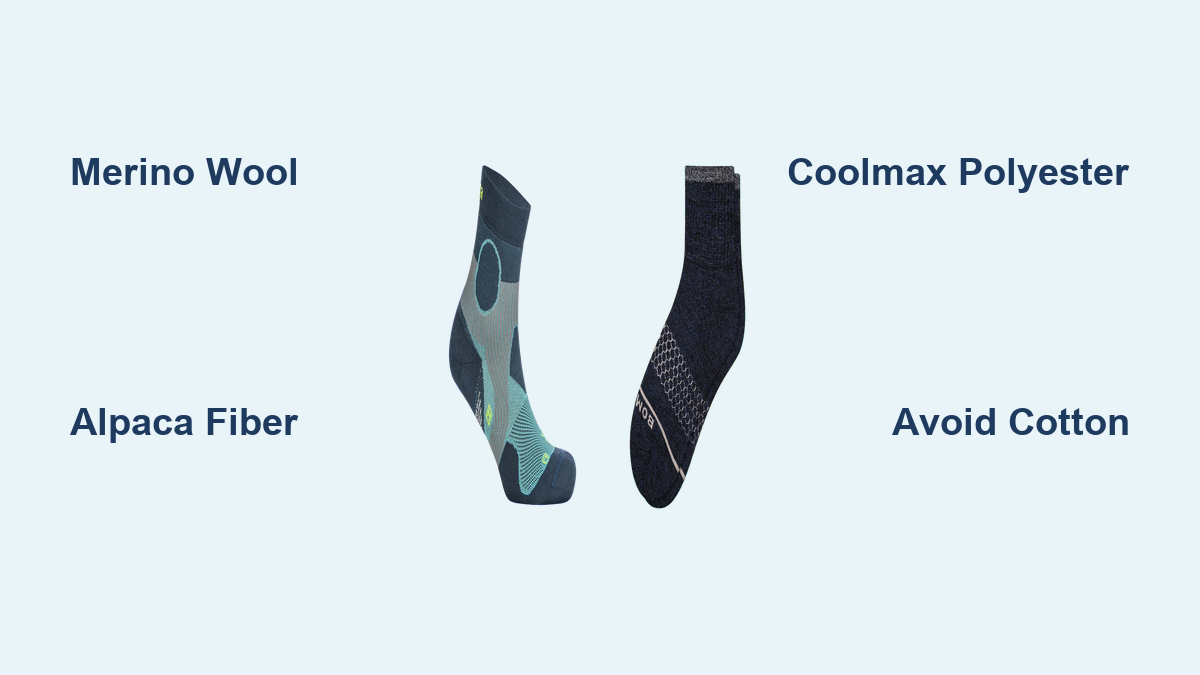
- Alpaca Fiber – Best overall: fast wicking, warm, durable, eco-friendly.
- Merino Wool – Gold standard for comfort and odor control.
- CoolMax Polyester – Best for high-intensity, fast-drying needs.
🚫 Avoid
- 100% cotton or high-cotton blends.
- Basic synthetics without wicking tech.
🔍 Buying Tips
- Check fiber content—prioritize merino, alpaca, CoolMax, DryMax.
- Choose seamless, cushioned, breathable designs.
- For odor: try copper or silver-infused socks.
- Replace socks every 6–12 months—wicking degrades over time.
Moisture-wicking materials are a non-negotiable for foot health and comfort. The best options—alpaca, merino wool, and advanced synthetics—use smart fiber engineering to keep your feet dry, blister-free, and odorless. Cotton may feel soft, but it traps sweat and causes more harm than good.
Choose based on your activity, climate, and skin needs. Pair the right sock with proper care, and you’ll never go back to soggy feet again. Your feet don’t just want to be dry—they need to be.